Aselsan’s TUFAN USV and KILIC UUV
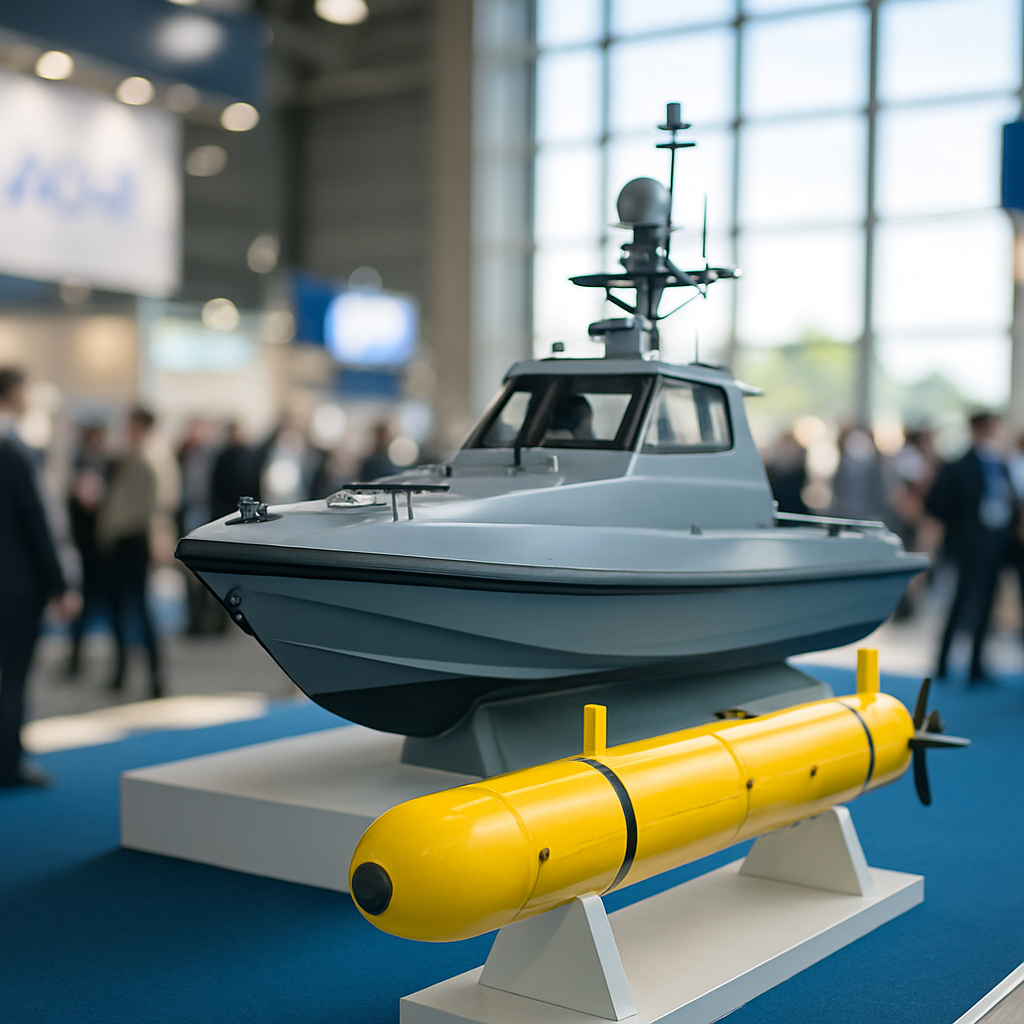
At a crowded ceremony on its stand, Turkish electronics giant Aselsan unveiled two naval systems: the TUFAN unmanned surface vessel (USV) and the KILIC autonomous underwater strike system. As described by the company, the TUFAN is mounted with an antenna and an electro-optics pod and is mainly a one-way attack vessel that can also perform intelligence, surveillance and reconnaissance (ISR) missions.
The KILIC is an unmanned underwater vessel (UUV) equipped with communication and navigation systems that Aselsan says allow it to operate alone or as part of a swarm of UUVs. Akyol framed both platforms as part of a new generation of unmanned naval systems designed “to address the evolving requirements of modern maritime operations” and to leverage Turkey’s geographical advantages as maritime security becomes increasingly important, according to his statement at the show.
Baykar’s Sivirsnek, Mizrak, and K2 Kamikaze
On the aerial side, Turkey’s UAV giant Baykar presented three one-way attack platforms. The smallest, the Sivirsnek (Mosquito), carries a 3.2 meter (10-foot) wingspan and is tube-launched; the company says it can perform reconnaissance and strike missions simultaneously.
The Mizrak (Spear) was presented with a stated range “beyond line of sight for more than 1,000 km (620 miles)” and a payload capacity of 40 kg (approximately 90 pounds). Both the Sivirsnek and the Mizrak can be equipped with AI-assisted autonomy, Baykar said.
The largest platform shown was the K2 Kamikaze, displayed as a full-sized model in gleaming gray. Baykar states the K2 has a payload capacity up to 200 kg; the company had previously revealed trials with the system in March.

Audit-ready is a season. It shouldn't be.
Evidence in spreadsheets, controls drifting between audits, frameworks multiplying on flat headcount. Nubivance runs continuous compliance on Rapid7 Cyber GRC - SOC 2, HIPAA, ISO 27001, PCI, CMMC.
End the scrambleTRENDS analysis: cost-effectiveness, suppression, and saturation
Serhat Süha Çubukçuoğlu, an expert at TRENDS Research & Advisory in Abu Dhabi, told Breaking Defense that Turkey’s emphasis on one-way attack UAVs and unmanned naval platforms reflects their cost-effective nature. “It provides Turkey with the ability to suppress or destroy enemy air defenses or surface naval units at a much cheaper cost,” he said, adding that another reason is their flexibility and ease of deployment.
Çubukçuoğlu also characterised kamikaze drones as a means to overwhelm and saturate defenses, writing that such saturation is “an ideal way to open up the way for more strategic, heavier, more capable and longer range manned units to enter and establish air superiority in the area.” Those specific tactical benefits were presented as the rationale behind the systems shown at SAHA 2026.
What this means for naval forces, procurement leaders, and regional militaries
- Naval forces and military planners: The TUFAN’s dual ISR and strike description and the KILIC’s ability to operate in swarm configurations underline an operational emphasis on layered unmanned maritime effects that can be integrated into broader naval operations, according to the vendors’ descriptions.
- Procurement leaders: Aselsan’s framing of maritime security needs and Baykar’s range and payload figures for aerial systems provide concrete performance claims — from AI-assisted autonomy to specified payload capacities — that procurement officials will use to compare systems, the companies suggested at SAHA.
- Regional militaries and defensive planners: TRENDS’ analysis highlighted the appeal of lower-cost one-way systems to suppress or destroy air defenses or surface units and to saturate defensive systems, a tactical capability that regional actors will note given the performance attributes Baykar and Aselsan put forward.
Public unveiling and the immediate follow-up
SAHA 2026 in Istanbul served as the public venue for at least five new homegrown systems to make their exhibition debuts — two naval platforms from Aselsan and three aerial systems from Baykar. The appearance of the K2 Kamikaze as a full-sized model follows Baykar’s revelation that trials had taken place in March, a factual thread the companies have made public at consecutive moments.
Together, the statements and displays at SAHA 2026 stressed autonomy, integration, and cost-efficiency as central selling points. Aselsan and Baykar presented distinct form factors and capability claims — from tube-launched, 3.2-meter wingspan strike/reconnaissance UAVs to multi-hundred-kilogram payload kamikaze platforms and swarming underwater vehicles — leaving observers with precise performance figures and a declared operational rationale to evaluate.
Original story: One-way attack drones under the spotlight at SAHA 2026 — Breaking Defense