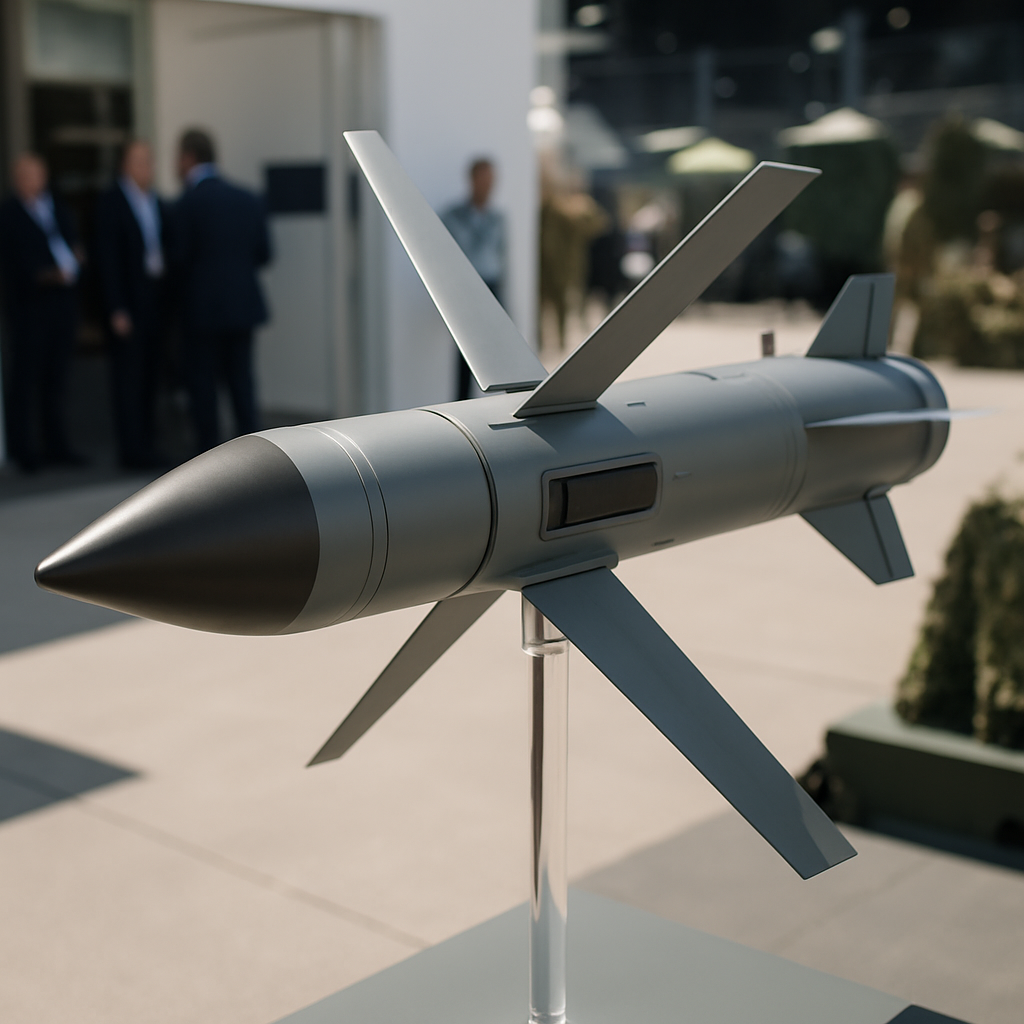
"NEŞTER, patlayıcı içermeyen harp başlığı ve kesici yapısıyla hedefi noktasal ve kontrollü şekilde etkisiz hale getirebiliyor," tweeted TRT HABER on May 5, 2026, as Roketsan unveiled a scaled-down, blade-equipped munition intended to strike with surgical effect.
What Roketsan showed at SAHA 2026
Roketsan unveiled Neşter — Turkish for "scalpel" — at the SAHA 2026 International Defense and Aerospace Exhibition in Istanbul on May 5, 2026. The company presented the weapon as a variant of its MAM-L lightweight smart micro-munition, explicitly described in coverage as lacking a conventional explosive warhead and instead using an array of pop-out, sword-like blades to neutralize targets while minimizing collateral damage.
Design, size and mechanical effect
The Neşter mirrors a distinctive configuration first identified in the secretive AGM-114R9X: six blades stowed along the missile body that deploy just prior to impact. The new Turkish munition is presented as a MAM-L derivative; the manufacturer lists the MAM-L as roughly 3.3 feet long, 6.3 inches in diameter, weighing about 48 pounds, and having a range of about 9.3 miles. By contrast, the AGM-114 Hellfire family is larger — the source material cites roughly 5.2 feet in length and close to 100 pounds — indicating the Neşter will be physically smaller than the U.S. weapon it emulates. Images shown at the exhibition displayed the Neşter with blades extended and a proximity or approach sensor that, according to Roketsan materials, activates the cutting mechanism just before contact with the target.

Audit-ready is a season. It shouldn't be.
Evidence in spreadsheets, controls drifting between audits, frameworks multiplying on flat headcount. Nubivance runs continuous compliance on Rapid7 Cyber GRC - SOC 2, HIPAA, ISO 27001, PCI, CMMC.
End the scrambleGuidance, terminal options and engineering questions
Both the MAM-L and the basic AGM-114R series use laser guidance, and the Neşter is discussed in the source as likely to use some form of precision cueing. The article outlines several possible terminal guidance approaches without asserting which Roketsan has chosen: a fine-tuned imaging infrared (IIR) seeker paired with automation to zero in on a narrow section of a vehicle; laser-guidance cueing combined with an IIR package; or a human-in-the-loop terminal control system that would require compatible datalinks and ground terminals. The Neşter is reported to include an approach/proximity sensor that triggers blade deployment; whether it is powered or unpowered was not confirmed, and the source notes the munition's kinetic effect would differ markedly depending on whether it has a motor.
Operational context inside Turkey and export posture
The Neşter was framed by Roketsan and Turkish reporting as a tool for "minimum secondary damage" precision strikes and as responsive to a requirement to reduce civilian harm while targeting high-value individuals. The source connects the MAM-L lineage to common Turkish platforms — notably uncrewed aerial vehicles — and observes that the MAM-L has become closely associated with the Bayraktar TB2 drone. The article notes Turkish security forces and police regularly conduct offensive operations on Turkish territory, often combined, and that such operations have included proactive engagement of actors labeled as terrorists, like the Kurdistan Workers' Party (PKK), whose insurgency and cross-border activity are described in the source as longstanding. For export customers, the piece highlights that Turkish munitions like the Neşter would not be subject to U.S. International Traffic in Arms Regulations (ITAR) restrictions that apply to some U.S.-origin systems.
What this means for Turkish forces, export customers, and militant adversaries
- Turkish Armed Forces and police: The Neşter, designed for extreme precision and low collateral effects, would be usable from light attack aircraft, helicopters and a country-wide fleet of drones derived from the MAM-L form factor; forces will monitor development completion, integration, and whether the weapon is powered or unpowered, which affects terminal lethality.
- Export customers and procurement officials: Buyers not subject to U.S. ITAR restrictions could view the Neşter as an option for missions demanding narrow collateral footprints; procurement teams will need to evaluate guidance packages, datalink compatibility for any human-in-the-loop modes, and export controls that apply outside U.S. law.
- Militant groups and other targeted actors: The article draws an explicit parallel to the AGM-114R9X's role in pinpoint strikes, illustrating that a blade-equipped munition can be used to “target not just a vehicle, but a specific occupant inside it,” a capability that alters risk calculations for those operating in contested areas.
The Neşter’s public unveiling closes one chapter and opens several technical and ethical questions. Roketsan has put a bluntly stated capability on display — a small, blade-equipped precision munition intended to reduce blast damage — but the source material is clear that key details remain: whether the missile is powered, what exact guidance and target-discrimination systems it will use, and how integration across Turkey’s rotorcraft and drone fleet will be certified. Those answers will determine whether Neşter is a narrow niche tool, an export commodity, or a new standard for low-collateral targeted strikes.
Original reporting: https://www.twz.com/air/turkey-developing-its-own-bladed-ginsu-precision-guided-munition