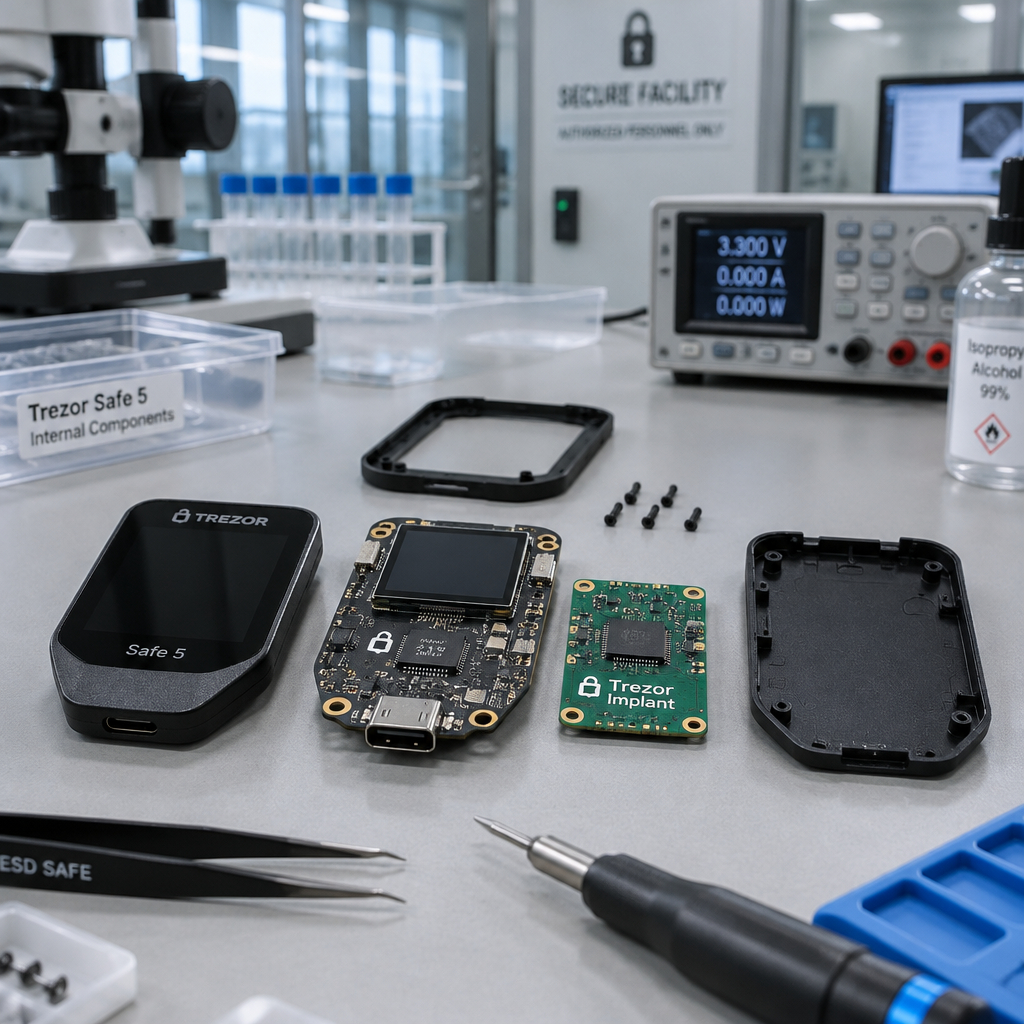
Three Trezor Safe 5 wallets bought from the reseller CryptoBilis contain an implant — an extra circuit board that can copy recovery phrases and exfiltrate them to an attacker-controlled server, the company said yesterday.
Three Safe 5 devices and the CryptoBilis connection
Trezor examined one of the affected wallets in its lab and identified two more from photos supplied by their owners. The three wallets were purchased between August 20 and September 23 from CryptoBilis, which had been an official reseller for the company in Southeast Asia until October 9, when Trezor removed the partner from its authorized network. The company says it has found implants only in Safe 5 units sold by that reseller and none in wallets from its other resellers or in its other models.
Trezor has received contact from 48 people who bought a wallet from CryptoBilis since the company asked buyers to get in touch after the October reports; it is checking their devices in its lab or from photos. The company says none of the three owners whose wallets were confirmed to contain implants has reported lost funds. Trezor wallets are self-custodial, so the company cannot see customers' balances.
How the implant reads and exfiltrates recovery phrases
According to the company's analysis, the implant sits between the Safe 5's main board and its screen and does not change the wallet's own firmware or its Secure Element. The extra circuit board reads the recovery phrase when the wallet displays it during backup creation and when a user types a phrase to restore a wallet; it also copies any passphrase that appears on the screen.
The implant encrypts the captured data and attempts to send it over the mobile network to a server controlled by the attackers; if it cannot connect, it stores the data and retries until transmission succeeds. Trezor engineers extracted and analyzed the implant's firmware from the first wallet they reported and described the behavior in an investigation update.

This site is the portfolio.
OSINTSights runs on Cloudflare Workers, D1, R2, and Vectorize, with an AI pipeline on Hetzner ARM. Nubivance designed, built, and operates it. We do the same for clients.
See what we buildFirmware update 2.13.1 and its limits
Trezor released firmware version 2.13.1 earlier this week for the Safe 7, Safe 5, Safe 3 and Model T. The company says the update stops the implants found so far from capturing anything on wallets that run it, but “the update can’t protect a wallet backup that was captured before it.”
Trezor has not published technical details about the implant that might help attackers or put customers at risk, the company said. Its public guidance for anyone who bought a Trezor from CryptoBilis remains unchanged since March and includes these steps:
- Move your funds to a new wallet with a new recovery phrase. Restoring the old phrase on another wallet does not solve the problem.
- Do not set up an unused wallet from the reseller, and never type an existing recovery phrase into one.
- Keep the wallet and contact Trezor Support, which offers a new Trezor wallet to anyone who bought from the reseller since March. Contact Support too if you are not sure where your wallet came from.
- Do not weigh or open the wallet to check it. Neither is a reliable test.
- Never share your recovery phrase, as the company will never ask for it. Scammers may pose as the company to offer replacements or refunds.
Connection to Ledger's findings and supply-chain questions
Trezor said the implants in its Safe 5 devices “work the same way as those found in Ledger devices, adapted to the Safe 5's display.” Ledger had earlier confirmed an unauthorized implant in a wallet the reseller sold and said attackers fitted genuine Ledger devices with hidden components designed to capture recovery phrases during setup, then drained wallets in a single coordinated operation, according to Ledger's incident statement. Trezor has not said who fitted the implants or where in the supply chain that modification occurred.
Separately, Trezor told partners on October 13 that it would reduce its reseller network by about 80%, cutting out partners that it judged did not fit stricter new rules. In the partner letter it said dropped resellers would receive no new stock, could sell existing inventory until January 1, 2027, and would then be removed from the list of authorized sellers. The company first announced the reduction on X on October 13, more than two weeks before the first report of an implant in one of its own wallets.
What this means for end users, security teams, and resellers
- End users and customers: Follow Trezor's guidance — move funds to a new wallet with a new recovery phrase, do not set up or type an existing phrase into a potentially compromised device, and contact Trezor Support for replacement offers if you bought from CryptoBilis since March.
- Technologists and security teams: Confirm devices are running firmware 2.13.1 where applicable and treat any device purchased from the reseller with caution; Trezor is continuing laboratory checks and image analysis of reported units.
- Resellers and procurement leaders: Expect tighter authorization rules from Trezor and limited supply relationships — the company has cut roughly 80% of its reseller network and set an explicit January 1, 2027 deadline for remaining inventory sales for dropped partners.
Trezor said it is still investigating and “will post an update if it confirms an implant outside the reseller's wallets or the Safe 5, receives a report of lost funds linked to the implants, or releases new protections.” The company's analysis so far ties the risk to a specific reseller and to Safe 5 units; whether the campaign extends beyond those boundaries remains the central question the company says it will answer as the investigation continues.