Tag: phishing
756 articles

Aussie Telco Limited Stunning Data Leak: Risky Fallout
A stolen login at iiNet has put roughly 280,000 customers’ names, emails, phone numbers and addresses in the hands of attackers — the exact kind of info scammers use to launch convincing phishing and account-fraud attempts. If you’re affected, enable MFA, stay alert for suspicious messages, and follow any guidance from your provider.

QR codes Risky: Must-Have Defenses Against Quishing
Think twice before you scan — attackers are now weaponizing QR codes with split and hidden payloads that can reassemble on your device or piggyback on legitimate codes, making phishing harder to spot. As QR use spreads to payments and workplace authentication, simple scan previews, better detection, and a healthy dose of skepticism are your best defenses.

North Korean cyber-espionage: Exclusive Dangerous Campaign
Imagine getting a flawless meeting invite from a trusted colleague that’s actually a spy—researchers found a North Korean campaign using believable calendar invites and GitHub-hosted malware to target diplomats and foreign ministry staff. The attack’s clever blend of social engineering and mainstream developer tools shows how easily trust can be weaponized, risking sensitive negotiations and long-term access to government networks.

Allianz Life data breach: Stunning Risky Fallout
About 1.1 million Allianz Life customers may have had personal data exposed in a breach tied to the ShinyHunters group — here’s what to watch for and the quick steps you can take now to protect your identity and finances.

reducing cyber risk: Must-Have Culture for Best Defense
Technology can only take you so far—attackers now target people and culture, not just systems. Building a stronger security culture with clear policies, consistent training, and aligned incentives is the simplest, most effective way to cut cyber risk.

zero-day vulnerability in WinRAR: Stunning Risk Exposed
A newly discovered WinRAR zero-day lets attackers sneak executables into Windows locations that are normally off-limits, turning an innocent archive into a potential backdoor. Update WinRAR and avoid opening unsolicited RARs until patches are applied.

iiNet data breach: Risky Stunning 280k Exposed
Worried about the data you hand to your ISP? A recent iiNet incident exposed over 280,000 customer records—here’s what happened, who’s at risk, and simple steps you can take to protect yourself.

CRM platform Risky Breach: Stunning Contact Exposure
Workday says its core systems were untouched, but a third-party CRM was breached — exposing business contacts that could fuel phishing, BEC and credential-stuffing attacks. Treat contact data as compromised: tighten MFA, audit integrations, and warn teams to watch for targeted social engineering.

government email credentials: Exclusive Risky Threat
Imagine someone buying access to a government inbox for less than the price of dinner — and using it to intercept investigations, impersonate officials, or fuel disinformation. With law-enforcement emails reportedly selling for about $40 on underground markets, stronger credential hygiene, MFA, and coordinated policy action aren’t optional — they’re urgent.

fake-lawyer schemes: Risky Scam Alert, Must-Have Tips
Think twice before paying a stranger promising to recover your crypto—scammers are posing as lawyers with fake credentials and forged documents to squeeze victims a second time. Verify any attorney independently, avoid crypto or untraceable payments, and report suspicious offers to the FBI’s IC3.

law enforcement email accounts: Shocking Risk Exposed
For as little as $40, criminals can buy real law-enforcement and government email accounts on the dark web — and that cheap access lets them impersonate officials, steal data, and trick people into payments. Strengthening authentication, email protections, and simple verification habits is essential to protect trust and public safety.

hotel booking system Risky Breach: Stunning 100k Leak
Imagine strangers knowing where you slept last summer — and maybe even what you paid — because Italy’s digital agency confirmed a massive breach of hotel bookings affecting nearly 100,000 records since June. If you stayed in Italy recently, check your accounts, beware phishing, and know hotels are scrambling to secure systems and notify guests.

Artificial intelligence: Stunning Defense, Risky Threat
AI is turning cybersecurity into a high-speed arms race—defenders use machine learning to triage alerts and automate responses while attackers leverage generative models to scale convincing attacks. Check out Prompt||GTFO’s demos to see how practitioners are testing AI’s promise and peril in real-world defenses and offensives.

Equation Editor: Must-Have Fix for Risky Exploit
Eight years after Microsoft patched the Equation Editor, attackers are still exploiting CVE-2017-11882 to drop keyloggers and steal credentials from unpatched Office installs. If you haven’t audited Office versions or enforced updates and controls like EDR and MFA, now’s the time—old vulnerabilities keep paying off for attackers.

Interlock ransomware Exclusive: Risky St. Paul Data Leak
Mayor Melvin Carter confirmed that employee data was posted online by the Interlock ransomware gang, putting city workers at risk and exposing St. Paul’s cybersecurity gaps. Now officials must act quickly to support those affected, investigate the breach, and shore up defenses before the next attack.
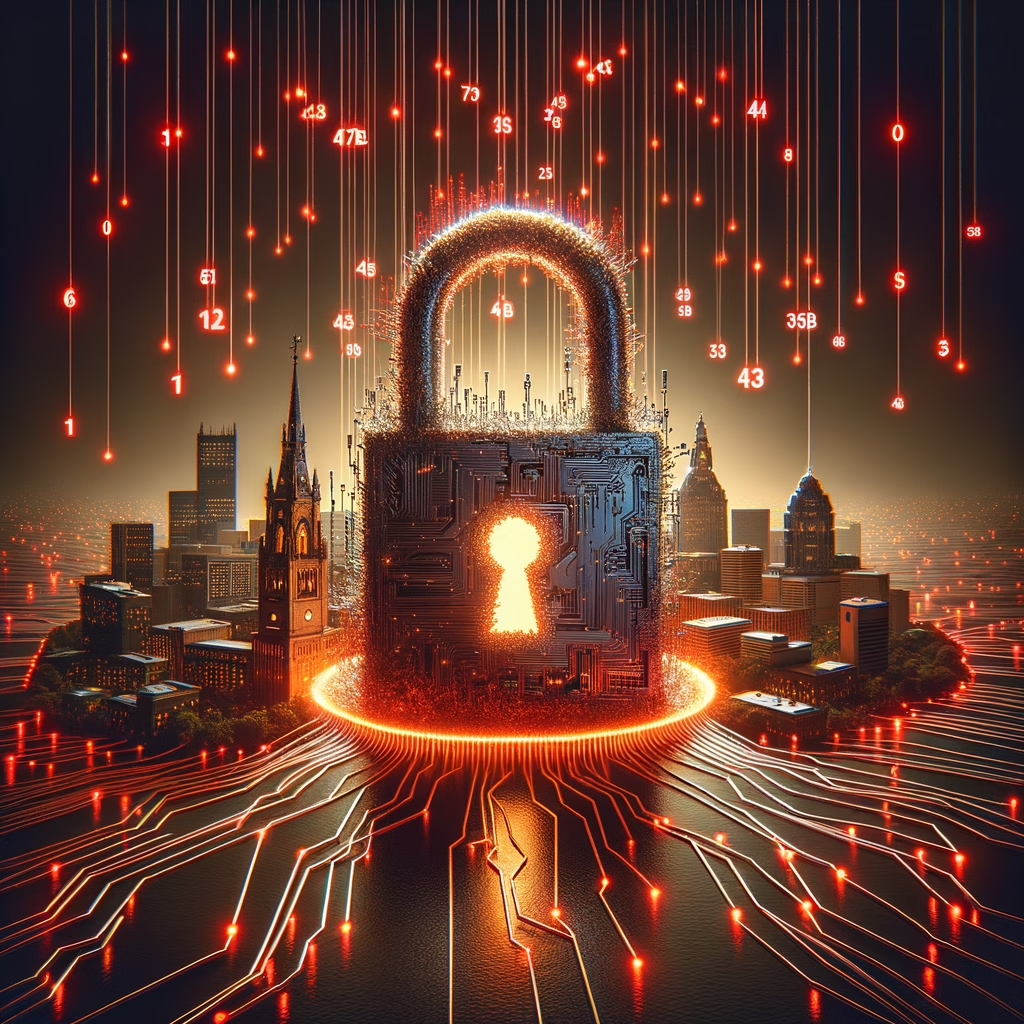
Saint Paul data Stunning Massive Leak Risky Fallout
Imagine the city you trust to protect your records suddenly airing them online — that’s what happened when the Interlock ransomware gang published an alleged 43GB cache from Saint Paul, triggering a state of emergency. Residents now deserve clear answers about what was exposed, how they’ll be protected, and what steps will stop this from happening again.

Microsoft Exchange servers: Must-Have Patch for Risky Flaws
Over 29,000 Microsoft Exchange servers are still unpatched, leaving hybrid Active Directory–Azure environments vulnerable to attackers who could seize domain control. If you manage Exchange, now’s the time to inventory, patch, and tighten configurations before adversaries walk through this wide-open door.

phishing campaign: Stunning Risk to UK Sponsors
A slick phishing campaign is targeting Home Office sponsor licence holders, risking fraud, extortion and even licence revocation by stealing the credentials used to manage migrant sponsorships. If you manage a sponsor account, verify any Home Office contact, enable MFA, and treat unexpected emails with extreme caution to protect your organisation and the people you sponsor.

APT28 LameHug: Exclusive Risky AI Threat Warning
MITRE’s take on APT28’s LameHug at Black Hat is a wake-up call: while crude now, this testbed shows how AI and automation could quickly turn basic tools into powerful cyber weapons. Defenders, policymakers, and everyday users should sharpen defenses and share intel now—before experiments like this graduate into routine attacks.
ShinyHunters cybercrime group: Critical Exclusive Threat
When your bank calls about a transaction you didn’t make, it’s a stark reminder that the ShinyHunters cybercrime group is now homing in on banks, fintechs and their vendors to harvest credentials and personal data for large-scale fraud. Institutions must act fast—tightening credential defenses, shoring up vendor security, and boosting detection—to protect customers, reputation and regulatory standing.

sextortion scams: Must-Have Best Survival Guide
Most sextortion emails are bluffs—ask where’s the tape? and demand verifiable proof instead of paying. Secure your accounts with unique passwords and 2FA, scan devices, preserve evidence, and report the scam.

NIST Cyber AI Profile: Must-Have Guide to Best Defenses
NIST’s Cyber AI Profile brings technologists, policymakers, and everyday users together to build practical defenses against AI-enabled attacks—balancing strong security with the innovation that powers our digital lives.

AI in Cybersecurity: Stunning Must-Have Defense
In a rapidly evolving digital landscape, the battle between AI-driven attacks and defenses is more intense than ever. Join us as we unpack the insights from the recent Black Hat conference, where experts discussed how AI can transform from a weapon for cybercriminals to a vital shield for defenders—reminding us that in cybersecurity, staying one step ahead is crucial!

Romance fraud scheme: Stunning $100M Risky Scam
When online romance turns into a $100 million criminal scheme, four Ghana-based suspects have been extradited to the U.S., spotlighting how emotional manipulation fuels sprawling scams and why stronger international cooperation is urgently needed.