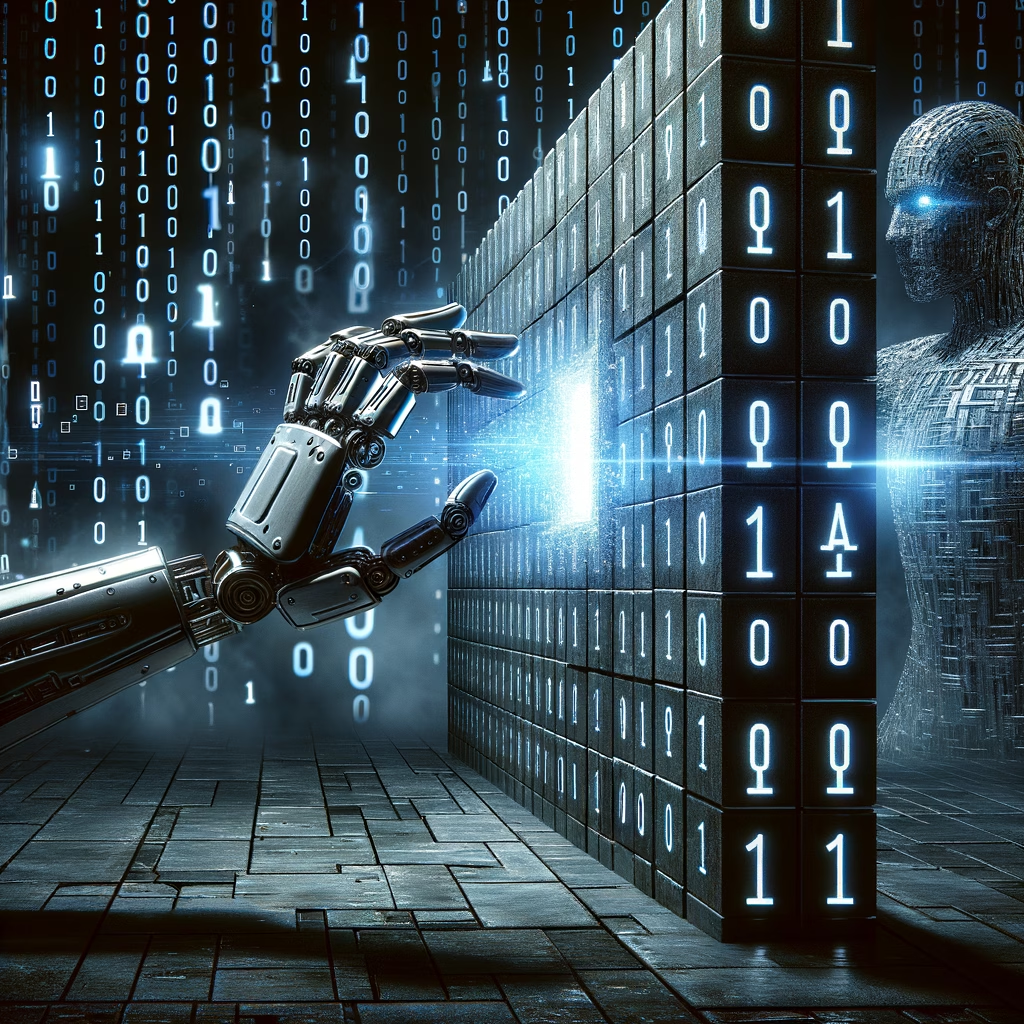
Artificial intelligence in cybersecurity
What happens when the scalpel learns to think like the surgeon and the thief starts to think like the locksmith? Artificial intelligence is rewriting the rules of cyber defense and offense alike, creating an arms race where speed, scale, and subtlety are the new battlegrounds. On one side, defenders deploy machine learning to triage alerts, automate containment, and hunt threats across sprawling cloud estates. On the other, attackers harness generative models and cheap compute to scale reconnaissance, craft convincing social-engineering campaigns, and evade traditional detection. The net effect is neither purely beneficial nor entirely catastrophic — it depends on engineering choices, governance, and operational discipline.
Why AI matters now
For two decades security has shifted from signature-driven control to behavior-driven detection. Modern sensors generate far more telemetry than any human team can parse: logs, network flows, endpoint signals, and cloud audit trails accumulate in volumes that overwhelm manual analysis. That overload made machine learning attractive: algorithms reveal patterns in noisy data, surface anomalies, and prioritize the signals analysts actually need to see. Generative AI then added conversational interfaces for querying systems, automated playbook synthesis for Security Orchestration, Automation and Response (SOAR), and even synthesized threat intelligence that accelerates both investigation and response.
But adoption carries costs and trade-offs. Models trained on historical incidents can inherit bias, miss novel tactics, or overfit to specific environments. Automated containment actions that trigger on false positives can disrupt business-critical operations. And the same models that help analysts craft incident reports can be repurposed by attackers to write persuasive phishing lures, produce polymorphic malware, or automate exploit discovery at scales previously impossible for small criminal teams.
Real-world trends reshaping risk
– Automation of routine tasks. AI-driven SOAR playbooks dramatically reduce mean time to containment, yet they also create single points of failure when rules or models are flawed. Automated responses without human oversight can magnify mistakes.
– Offensive automation. Both researchers and threat actors use models to generate tailored phishing campaigns, exploit chains, and adaptive payloads that evade signature-based defenses.
– Adversarial machine learning and model abuse. Attackers probe models to find blind spots, craft inputs that induce misclassification, or exfiltrate model weights and training data for later misuse.
Operational lessons and mitigations
The technology debate centers on necessity versus risk. You cannot hire your way out of a tsunami of alerts: automation is essential. But automation must be engineered with safeguards.
– Defense-in-depth remains essential. Layered controls, network segmentation, microsegmentation, and least-privilege architectures limit blast radius when automation fails.
– Human-in-the-loop controls. Automated playbooks should require human confirmation for high-impact actions. Role-based approvals, escalation protocols, and canary environments reduce the chance of runaway containment.
– Continuous adversarial testing. Red teams should emulate AI-enabled attacker automation and probe defensive models to surface brittle assumptions before real adversaries do.
– Model provenance and logging. Tracking training data sources, update cadence, and decision traces supports incident reconstruction and remediation of biased outcomes.
Governance, policy, and economics
The stakes extend beyond data theft and downtime. Critical infrastructure, supply chains, and democratic processes all hinge on secure information systems. When defensive tools that accelerate analysis also empower attackers, the net security outcome becomes a function of governance and transparency as much as algorithmic capability.
Policymakers face hard choices: require disclosure of adversarial robustness testing and provenance metadata? Certify AI systems used in critical cyber roles? Standards and testing regimes can improve accountability, but overprescription risks stifling innovation while under-regulation leaves systemic weaknesses unaddressed.
Economics shape behavior. Vendors trumpet AI features promising lower mean time to detection and response. Buyers must balance vendor claims with independent evaluation and the operational cost of false positives. Models need retraining; data pipelines require curation; and new attack surfaces arise as model architectures evolve. For many organizations the long-term maintenance burden tempers the short-term allure of automation.
Human factors and ethics
End users are the unwitting battleground. Better AI defenses can reduce successful phishing and accelerate recovery. Conversely, increasingly convincing machine-crafted social engineering raises the bar for nontechnical users. Security education must evolve: teach people to verify context (origin, purpose, and unusual request patterns), not just content, and to assume persuasive-looking messages may be machine-generated.
Bias and privacy also matter. Detection models can disproportionately flag certain populations or geographies, causing unequal operational impacts. Training on sensitive telemetry raises privacy concerns. Addressing these issues requires inclusive testing, clear policy, and technical protections such as differential privacy where appropriate.
Paths forward
Constructive measures already exist. Collaborative exercises, public events that demonstrate attack and defense techniques, and shared red-team repositories accelerate collective learning. Public–private partnerships can fund adversarial datasets, responsible disclosure programs, and tooling for robust testing. Standards bodies can define minimum robustness and interoperability criteria for AI in security contexts — not to prohibit technology but to ensure baseline reliability.
Engineers and security leaders must choose whether AI amplifies human judgment or replaces it. Operational best practices tilt toward amplification: use AI to surface hypotheses, speed low-risk actions, and free humans to focus on complex decisions. Continuous validation, adversarial testing, and carefully designed human oversight reduce catastrophic failure modes.
Conclusion: directing Artificial intelligence toward resilience
The paradox is clear: the same Artificial intelligence that predicts and prevents attacks can invent them. The question is not whether AI will change cybersecurity — it already has — but whether organizations and societies will guide that change toward resilience rather than runaway vulnerability. With deliberate engineering, transparent governance, and ongoing testing, AI can become a force multiplier for defenders. Without those disciplines, it will simply level the playing field for increasingly sophisticated attackers.



