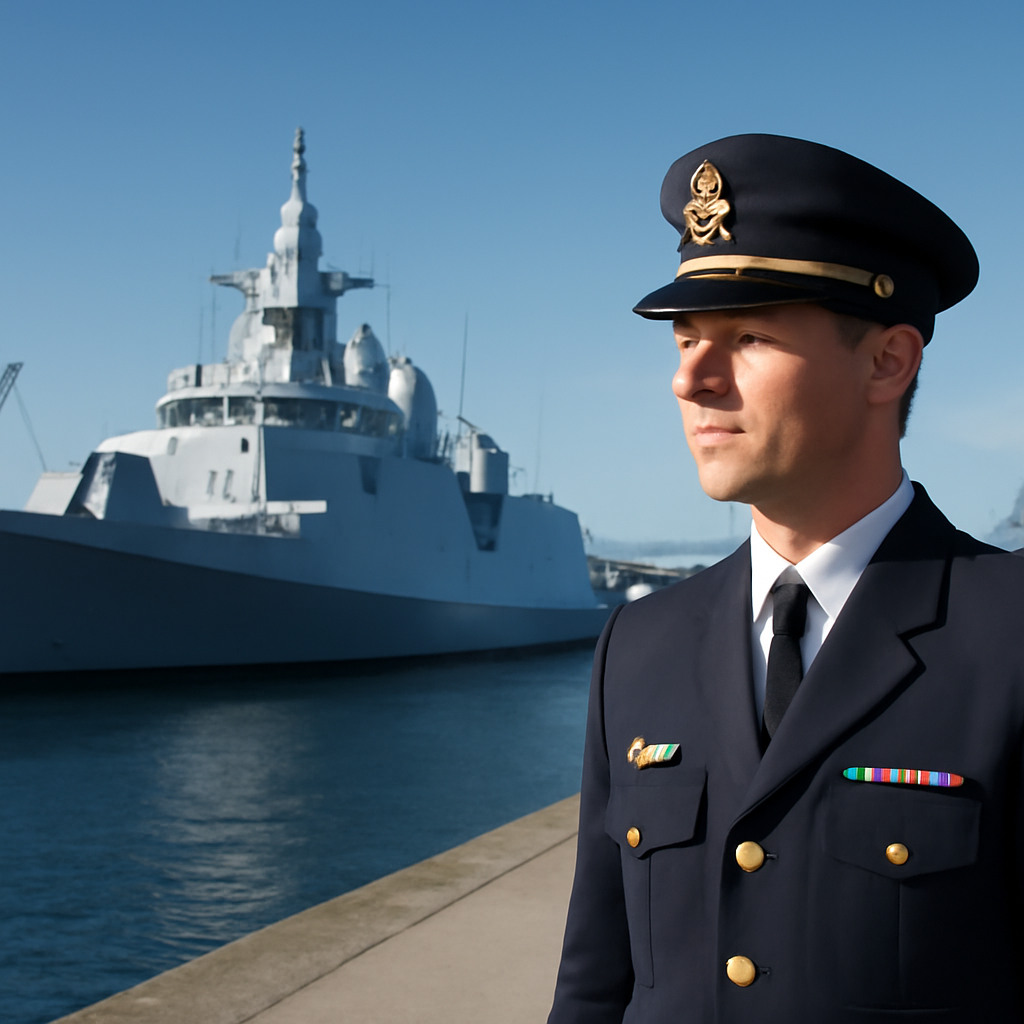
"The most important thing for me right now is that we move forward in integrating the Swedish weapon systems and sensor systems that we have included in the contract," said Swedish Commander-in-Chief Gen. Michael Claesson on Sept. 1, 2026, underscoring Stockholm’s immediate priorities even as it opens the door to farther-reaching options.
The contract: four FDI frigates, €4.3 billion
Sweden and France signed a contract for four FDI (Frégate de Défense et d’Intervention) frigates worth some €4.3 billion. The signing was marked by speeches from Swedish Prime Minister Ulf Kristersson and French President Emmanuel Macron aboard the French flagship Amiral Ronarc’h. French Minister of Armed Forces Catherine Vautrin and Swedish Defense Minister Pål Jonson also signed a framework agreement intended to strengthen Swedish–French cooperation on operational matters, defense capabilities and industrial development.
The first of the four frigates is due for delivery in 2030. According to the Swedish government, the ships will carry a set of national systems: Saab’s RBS 15 anti-ship missiles, 47 lightweight torpedoes, Giraffe 1X radars, Trackfire weapon stations, and BAE Systems Bofors 57 mm and 40 mm naval guns. The frigates will also include Aster air-defense missiles, supplied by MBDA.
MdCN and the question of naval long‑range strike
President Macron suggested at the signing that France could offer an offensive naval cruise missile in the future, saying, “And by equipping the Swedish frigates with the Aster missile and possibly with a naval cruise missile, France is not only delivering ships; it is also providing a capability to protect the territories of our allies.” Macron did not name a specific missile, but French media reported that Paris was positioning to offer MBDA’s MdCN (Missile de Croisière Naval).
Gen. Claesson told Breaking Defense that Sweden will “evaluate and discuss the French [long‑range naval cruise missile] offer as well,” calling the MdCN “an interesting capability.” Swedish Defense Minister Pål Jonson said a naval long‑range strike capability could be an important next step, adding that lessons from the war in Ukraine demonstrate the importance of long‑range precision‑strike capability and that Sweden has “an open mind” about developing such a capability on the FDI platform.
Officials emphasized that no decision has been made to buy a French naval strike missile or to add one to the frigates. Sweden is also a participant in the European Long‑Range Strike Approach (ELSA), an initiative launched in 2024 by France, Germany, Italy and Poland and later expanded to include Sweden and the United Kingdom.

This site is the portfolio.
OSINTSights runs on Cloudflare Workers, D1, R2, and Vectorize, with an AI pipeline on Hetzner ARM. Nubivance designed, built, and operates it. We do the same for clients.
See what we buildTechnical integration and the launcher constraint
Integration of Swedish national systems into the FDI design is the stated immediate priority. The contract includes Sylver A50 vertical launch systems, compatible with the Aster family of missiles. The Swedish Ministry of Defence told Breaking Defense that firing MdCN would require replacing those A50 launchers with A70 launchers — a specific hardware change with implications for ship design, logistics and integration schedules.
Claesson reiterated the sequencing: first integrate the declared Swedish weapon and sensor package, then examine the option of adding a naval cruise missile. That packaging includes both anti‑air and anti‑submarine warfare capabilities, reflecting how Stockholm intends to use the FDI class predominantly as an air‑defense and ASW platform while remaining receptive to longer‑range strike options.
What this means for the Swedish military, MBDA, and ELSA
- Swedish military leadership: Gen. Claesson’s emphasis on integrating national systems signals an operational posture focused on capability coherence; the frigates will first deliver national anti‑ship, ASW and air‑defense capacities before any offensive naval strike capability is added.
- MBDA and the French defense sector: Macron’s remarks and French media reporting put MBDA’s MdCN into negotiations as a potential follow‑on sale, but delivery would require technical changes — notably the A50→A70 launcher swap — and a formal Swedish decision.
- European long‑range strike planners (ELSA participants): Sweden’s declared interest in improving long‑range strike beyond its recent Taurus KEPD 350 air‑launched cruise‑missile test, and its stated membership in ELSA, position Stockholm as a potential contributor to European long‑range strike discussions while it evaluates national options.
Timeline, near‑term steps and the question left open
The immediate timeline is concrete: the first FDI frigate delivery is scheduled for 2030 and integration of Swedish systems is the current priority. Sweden has recently expanded its deep‑strike baseline by test‑firing a Taurus KEPD 350 from a JAS 39 Gripen at the Vidsel Test Range; Defense Minister Jonson has said Stockholm is “looking into” improving long‑range strike capabilities beyond Taurus.
What remains open — and is now framed as a formal evaluation item — is whether Sweden will decide to replace Sylver A50 launchers with A70s and fit a naval cruise missile such as the MdCN to the FDI class. The Ministry of Defence’s technical note on launcher compatibility makes that decision a tangible engineering and procurement choice, not only a strategic one. Sweden’s stated sequence — integrate national systems, then evaluate the French offer — sets the path. The next concrete markers will be Swedish internal evaluation outcomes and any formal request or agreement to modify the ships’ launcher fit.