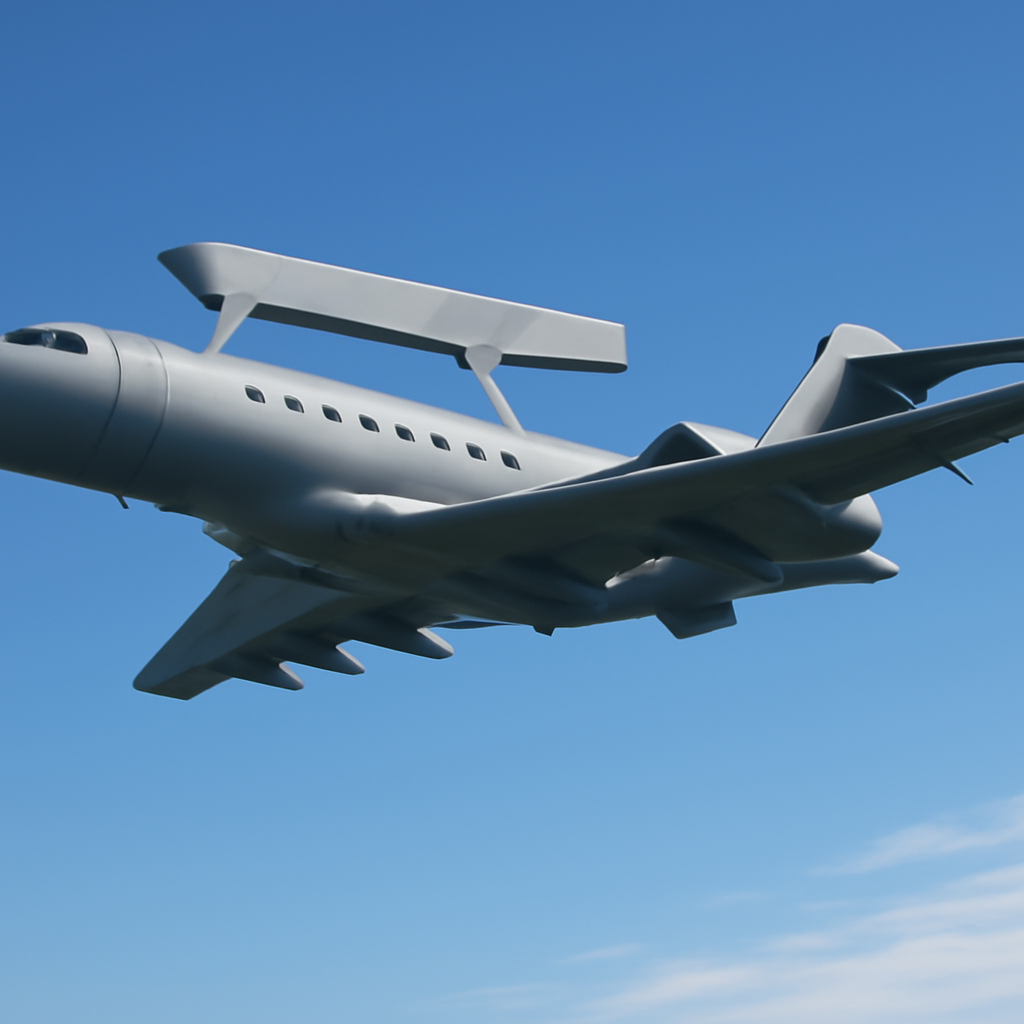
What Maj. Gen. Jonas Wikman said about Sweden’s GlobalEyes
Wikman, head of the Swedish Air Force, described Sweden’s order of three Saab GlobalEye aircraft as “on top” of the alliance deal announced earlier this month at the NATO summit in Turkey. He said Sweden intends to operate a national fleet that will cooperate with other nations and that he has already opened a “dialogue” with NATO to develop operational concepts for the aircraft.
Wikman framed the GlobalEye—also referred to in the Swedish program as the S106—not simply as an airborne early warning asset for control of the air but as a sensor suite for “all domains.” He told Saab that the company needs to be able to “import the space data” Sweden is now producing and described the ambition for the GlobalEye fleet to be integrated with other sources of intelligence.
NATO’s decision to buy 10 GlobalEyes, and Boeing’s reaction
NATO announced plans this month to buy 10 GlobalEyes to replace its Boeing E-3 AWACS, a decision that left Boeing’s competing E-7 Wedgetail pitch on the losing side. Boeing executives responded publicly in London. Steve Parker, president and CEO of Boeing Defense, Space and Security, defended the E-7, saying it is “unmatched” and pointing to a technology roadmap that he said would keep it relevant “30, 40 years.” Parker also said Boeing was “super proud” to support the NATO mission with the E-3.

Audit-ready is a season. It shouldn't be.
Evidence in spreadsheets, controls drifting between audits, frameworks multiplying on flat headcount. Nubivance runs continuous compliance on Rapid7 Cyber GRC - SOC 2, HIPAA, ISO 27001, PCI, CMMC.
End the scrambleSweden’s current contributions to Ukraine and delivery timeline
Sweden has already provided AEW capability to Ukraine by donating two of its older Saab 340 radar planes. The country ordered its third GlobalEye in 2024 and is awaiting delivery of the new aircraft in 2027 or sooner. Wikman explicitly tied the donation of the Saab 340s to Sweden’s transition to the next-generation GlobalEye fleet: “We are supporting Ukraine with our previous fleet of airborne early warning and control aircraft, and we are now waiting to introduce our next generation of aircraft,” he said.
U.S. funding debate around the E-7 Wedgetail and related programs
The announcement and subsequent debate have unfolded alongside a U.S. procurement contest over the E-7. In May, Defense Secretary Pete Hegseth reversed an earlier position and decided to support funding for the E-7 after the aircraft had been zeroed out in the initial budget request. Last month, House appropriators mostly backed the White House’s $1.5-billion budget amendment to fund Wedgetail development.
Those domestic debates intensified after a U.S. Air Force E-3 Sentry was heavily damaged “during the war in Iran,” a development the source links to renewed urgency about replacement and complementary systems. Hegseth has publicly defended the Wedgetail and emphasized space-based capabilities for the mission; Air Force officials, the coverage says, are also backing space programs such as the Airborne Moving-Target Indicator alongside development of next‑generation radar aircraft.
How NATO planners, Boeing, and Ukraine are affected
- NATO planners: The alliance’s decision to procure 10 GlobalEyes establishes a common platform for airborne early warning moving forward; Wikman’s stated intention to pursue operational concepts with NATO suggests planning will need to align national Swedish employment with NATO fleet operations.
- Boeing and U.S. defense procurement: Boeing publicly defended the E-7 Wedgetail and the company’s ongoing role supporting the E-3, even as U.S. funding politics shifted—Defense Secretary Hegseth’s May reversal and the House’s $1.5-billion amendment are concrete milestones that will influence how Boeing’s proposals proceed in the U.S. market.
- Ukraine and Swedish defense aid: Sweden has already contributed two Saab 340 AEW&C planes to Ukraine and is phasing those out as it awaits delivery of GlobalEyes in 2027 or sooner, creating a near-term capability transfer and a medium-term modernization timeline for Sweden’s own forces.
Sweden’s purchase of three GlobalEyes is positioned by its air force chief as both national capability and a cooperative complement to NATO’s larger buy. Key next steps are already spelled out in the facts: Sweden will pursue operational concepts with NATO, Saab must accommodate Swedish space-data inputs, and the new GlobalEyes are expected to arrive in 2027 or sooner. How those national and alliance concepts mesh in practice—especially against ongoing procurement choices in the United States and Boeing’s sustained advocacy for the E-7—remains the practical question left to be resolved in coming months.