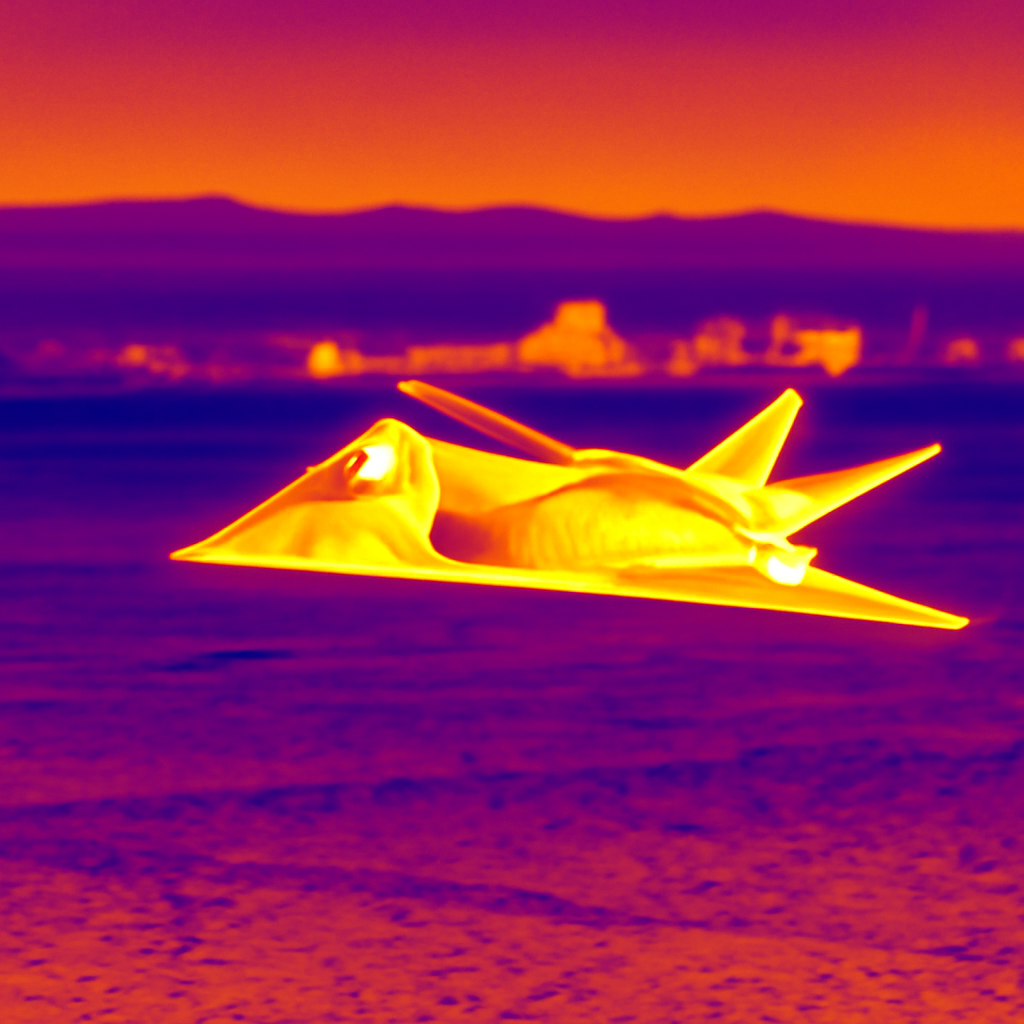
"I never considered this to be a serious contender for the ATF program, as the aircraft was unstable beyond 10 degrees angle of attack!" said Darold Cummings, reflecting on a decades‑old fighter concept that has reappeared in discussions after a viral sighting near Groom Lake.
Viral thermal footage from Groom Lake shows an unusual forward profile
Project Fear, a YouTube channel, released a full video that TWZ says was captured near the U.S. military’s Groom Lake test base, better known as Area 51. The clip includes a thermal-frame view that went viral after TWZ published an initial analysis. TWZ described the image as showing an "exotic design" with a distinctive "double arrowhead" forward fuselage in the thermal frame, though the outlet also cautioned the shape could be an artifact of consumer‑grade thermal imaging.
Observers noted a bright light on the aircraft as it passed; Aviation writer Tyler Rogoway suggested that bright lighting could be used "to keep its silhouette from being seen from certain aspects from the ground," while conceding other possibilities like an emergency. TWZ pointed readers to the exact moment in the released footage — around 49:34 in the video runtime — for close inspection.
Darold Cummings’ DP‑21 "Christmas tree" concept resurfaced on LinkedIn
Darold Cummings, founder and president of ForzAero and a longtime designer credited in the source with work on the YF‑23 and other projects, posted a blueprint and explanation of a DP‑21 "Christmas tree" fighter concept on LinkedIn late last year. Cummings said the DP‑21 was created in June 1983 as a way to produce a "4‑spike" low‑observable tactical fighter.
Cummings explained the "4‑spike" idea as minimizing radar cross‑section hot spots in azimuth and argued such a layout yields survivability "especially the front as the aircraft is heading into hostile territory." He also acknowledged flight control limits in 1983 — the design, he wrote, "would have been difficult to fly" then — but told TWZ that "with modern flight control systems, this design could be controlled, even at high angle of attack."

The cyber insurance questionnaire just landed. Now what?
SOC 2, HIPAA, insurance renewals - someone has to own security strategy. Nubivance provides fractional CISO leadership without the full-time salary.
Get a security leadDesign parallels: canards, shovel noses, X‑36 and Bird of Prey echoes
TWZ compared the mysterious thermal image to Cummings’ DP‑21 and to demonstrators such as Boeing’s X‑36 and Bird of Prey. TWZ’s analysis reads that the thermal frame shows "aft‑set lambda‑type wings" with camber and wingtip droop "as on the Boeing Bird of Prey demonstrator," very large canard foreplanes, and a broad nose that could alternatively be a shovel nose — a feature TWZ links to Northrop’s Tacit Blue and the YF‑23.
TWZ also noted features consistent with a twin‑engine layout — the outlet described a "sawtooth‑type trailing edge" and no obvious exhaust plumes in the thermal view, and interpreted those absences as possibly related to the recording sensor, power setting, or signature‑reduction measures built into the aircraft. Cummings separately suggested canards can be kept "ported" — aligned with the wing during cruise — to reduce signature, a technique he said was used on the YF‑23's V‑tail.
Where this sits in program context: F‑47, NGAD, F/A‑XX and Northrop
TWZ placed the sighting against the backdrop of the United States’ sixth‑generation efforts. The outlet noted Boeing won the Air Force contract for the F‑47 and that Air Force officials have said they expect first flight of the service’s new sixth‑generation fighter in 2028. TWZ added there are no indications an F‑47 EMD prototype has flown to date.
The report recalled that Boeing and Lockheed built flying demonstrators under the Next Generation Air Dominance (NGAD) initiative, and mentioned past reports of a possible third NGAD demonstrator that may have been built by Northrop Grumman. TWZ said Northrop voluntarily dropped out of the NGAD combat jet competition around 2023 and "is said to have been on the verge of being cut at the time." TWZ also pointed out crossover with the Navy’s F/A‑XX effort and noted Boeing and Northrop have both released renderings of prospective carrier‑based sixth‑generation designs.
What this means for Boeing, the U.S. Air Force, and public observers
- Boeing and design engineers: TWZ and Cummings both identify influences from the X‑36 and Bird of Prey; engineers will be watching how canard layout, long leading‑edge shaping, and "ported" control surfaces are reconciled with low observability and handling.
- The U.S. Air Force and program managers: the Air Force's scheduled first flight in 2028 for the F‑47 remains the firm program milestone noted by TWZ; the report also underscores that official renders are managed to protect classified programs.
- Public observers and spotters: the Project Fear release and TWZ’s analysis demonstrate how limited, consumer‑grade thermal footage can spark renewed attention to legacy concepts such as Cummings’ DP‑21 and to classified demonstrators at Groom Lake.
TWZ concluded that the thermal footage and Cummings’ publicly available designs make for an intriguing comparison, and wrote that "it seems very likely this is the Boeing NGAD demonstrator, if the video is indeed authentic, which it appears to be." Whether the aircraft in the footage is a technology demonstrator, a naval variant, an uncrewed vehicle, or something else, the sighting has reopened a narrow but vivid line of inquiry into how past experimental ideas may inform next‑generation combat aircraft.