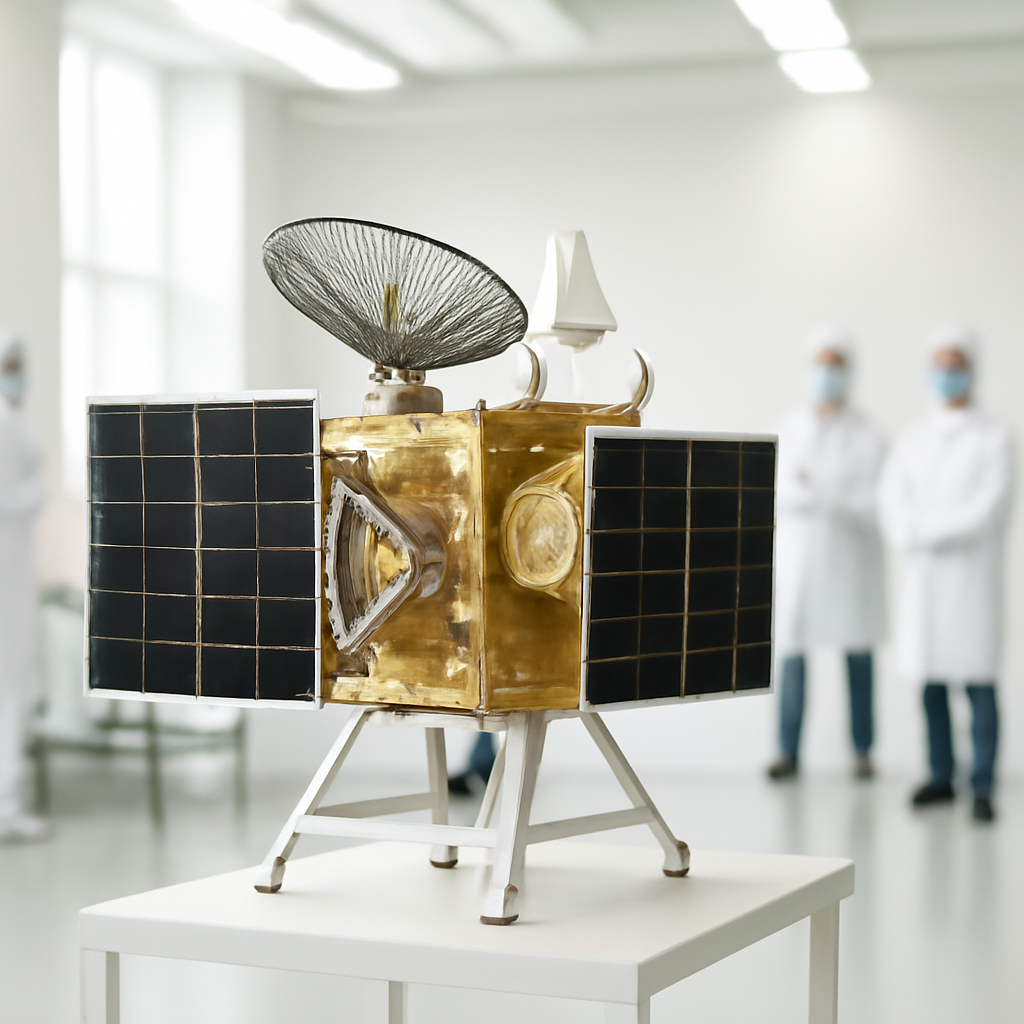
“The core focus of this second task order is diversifying our capabilities and ensuring we don’t rely on a single technical solution,” Col. Ryan Frazier, acting Space Based Sensing and Targeting portfolio acquisition executive, said in the Space Systems Command release.
Who received the second-round SB‑AMTI task orders
Space Systems Command (SSC) awarded task orders totaling $615 million to three firms to develop satellites that can detect fast-moving airborne targets, SSC said in a press release. The recipients named were Rocket Lab, STR and a third company whose identity was withheld for “operational security.” SSC did not break out the individual awards; Rocket Lab later disclosed its portion was $397 million.
How this fits into the SB‑AMTI program and prior awards
The new task orders are the second round under the April-issued indefinite delivery/indefinite quantity (ID/IQ) Space‑Based Airborne Moving Target Indicator (SB‑AMTI) contract vehicle, which is managed by SSC’s Space‑Based Sensing and Targeting portfolio office. The program previously yielded a much larger first task order: SpaceX received a $4.6 billion award in May, and last week SpaceX also won a separate $1.6 billion contract to launch the future AMTI satellites, according to SSC.

This site is the portfolio.
OSINTSights runs on Cloudflare Workers, D1, R2, and Vectorize, with an AI pipeline on Hetzner ARM. Nubivance designed, built, and operates it. We do the same for clients.
See what we buildRocket Lab’s approach: Flatellites and Neutron launches
Rocket Lab’s press release said the company will “develop, launch, and operate multiple advanced Flatellites — a next‑generation flat satellite design optimized for large constellations — with space‑based sensors and low latency, high bandwidth communication links.” The release added that the satellites will be launched on the company’s new Neutron heavy‑lift rocket, with a planned liftoff window between October and December from Rocket Lab’s launch complex on Wallops Island, Va.
STR, the undisclosed third vendor, and SSC’s OPSEC rationale
STR, based in Woburn, Mass., could not be reached for comment about its award, SSC said. When asked by Breaking Defense why the third vendor’s identity was being withheld, an SCC spokesperson responded by email: “To help clarify, the decision to not disclose the identity of the third vendor is based strictly on operational security (OPSEC) protocols designed to protect sensitive mission profiles and capabilities. We carefully evaluate each award on a case‑by‑case basis to determine what information can be safely released publicly without compromising our operational advantages.
“All partners selected for these awards have met our rigorous security, technical, and operational requirements to support Space Force missions.”
Operational security, contracting practice, and what that means for procurement transparency
The Pentagon has increasingly cited the need for “operational security” to protect developing capabilities from falling into the hands of China and other adversaries as a rationale for declining to detail contract specifics, SSC said. That practice is enabled in part by the use of non‑traditional contract vehicles such as ID/IQs and Other Transaction Authorities (OTAs), which do not carry the same public reporting requirements found in the Federal Acquisition Regulations (FAR). An analysis by Federal News Network noted that the 2025 National Defense Authorization Act included an exemption for “non‑traditional defense contractors” waiving certain FAR‑required cost and pricing requirements, including some types of reporting.
How SSC, launch providers, and adversaries are positioned
- Space Systems Command: SSC has stated its intent to diversify technical approaches and “explore unique innovations and technologies,” arguing that maturing varied solutions will yield “distinct performance advantages” and ensure the best technology is fielded, in Col. Frazier’s words.
- Launch providers and vendors: Rocket Lab has publicly committed to producing and orbiting Flatellites and to flying them on Neutron in the October–December window; SpaceX already holds the principal first task order for SB‑AMTI hardware development and a separate $1.6 billion launch contract for future AMTI satellites.
- Adversaries named by SSC and the Pentagon: the stated operational security rationale explicitly cites the risk of capabilities being exposed to China and other adversaries, and that concern is being used to limit disclosure about participating companies and contract details.
SSC’s second‑round task orders underscore a dual approach: concentrate major investment in one large award while simultaneously hedging by funding alternate technical paths. The public milestones to watch in the near term are Rocket Lab’s Neutron launch window of October–December from Wallops Island and any further public disclosures about the undisclosed awardee and STR’s role — both details SSC has withheld in the name of OPSEC. The agency’s decision to couple large, visible awards with less‑transparent task orders highlights how acquisition law, contracting vehicles and security concerns are reshaping how and how much the government discloses about emerging space capabilities.
https://breakingdefense.com/2026/08/space-force-awards-3-firms-615m-to-track-airborne-targets/