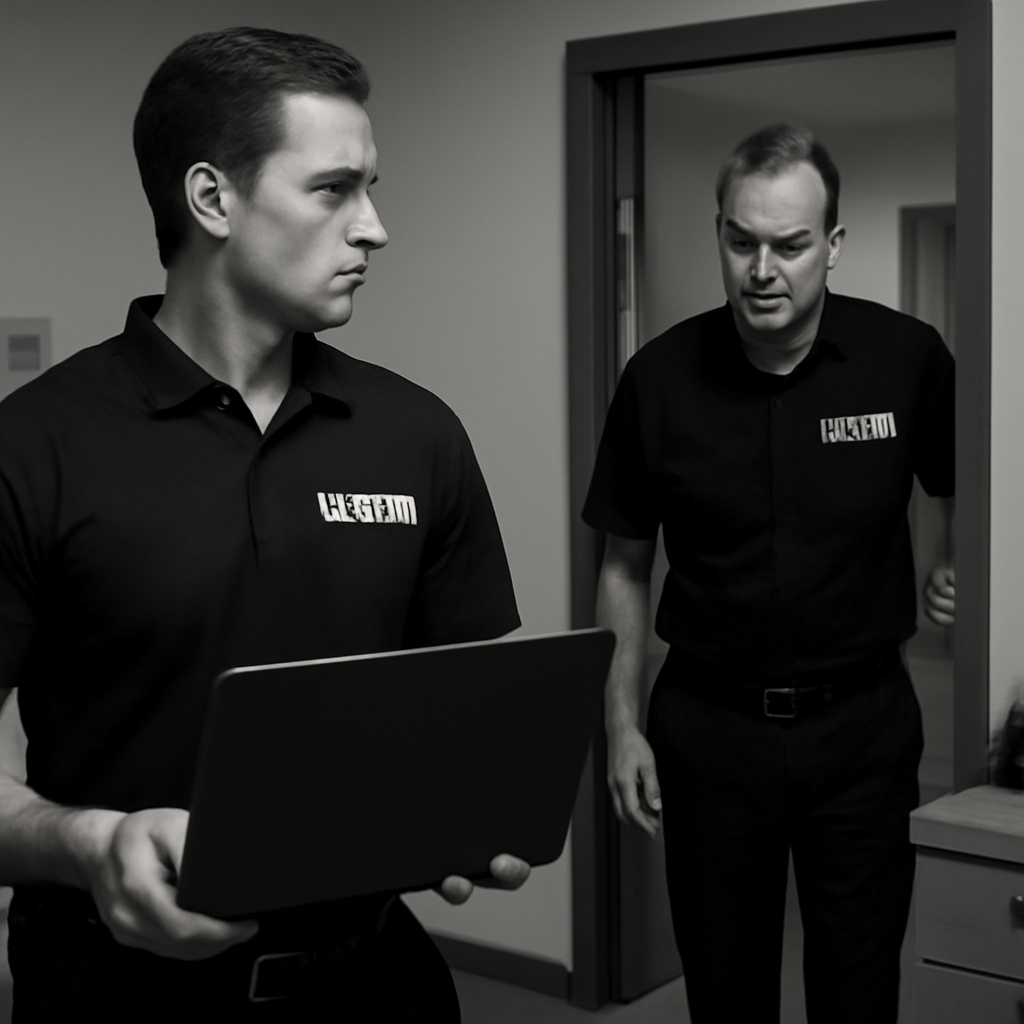
Confrontation over a departing workstation
The scene opens with a simple, practical gesture: a staffer carrying a PC out of the office to "archive the contents and then reset it to factory defaults." That action triggers a direct intervention from the Head of Security. What follows is a terse exchange about who should control the machine's fate. The staffer argues for an offsite reinstall on the DMZ segment to avoid reinfection, while the Head of Security insists the laptop looks "almost brand new" and volunteers to take responsibility for it. He wrests the machine from the staffer and steps out of the doorway.
Why the new Security team is on edge
The backdrop to the confrontation is a recent wholesale change in Security personnel. HR discovered "several empty bottles in Security's overflowing recycling bin," apparently ending a run of alcohol thefts from the boardroom liquor cabinet. HR replaced the prior staff with a "whole new security team" led by "a keen new broom," who immediately implemented strict measures: isolating Security onto a separate internet feed, firewalled off from the rest of the Company, and recording equipment people leave the building with — an unpopular step among laptop users.

This site is the portfolio.
OSINTSights runs on Cloudflare Workers, D1, R2, and Vectorize, with an AI pipeline on Hetzner ARM. Nubivance designed, built, and operates it. We do the same for clients.
See what we buildThe technical disagreement: factory reset versus reinstall
The reporting centers on a single technical risk: that a restored factory image might contain malware embedded in the recovery partition. The staffer makes the specific claim that "if there's malware installed on the recovery partition, you'll reinfect the machine when you restore it to factory defaults." That is why the staffer prefers a reinstall performed from a clean image on a DMZ segment rather than an in-place factory restore on the floor. This technical objection is the proximate cause of the argument which escalates to Security asserting control and the Boss being notified.
Mission Control, the Boss, and an apparent dismissal of caution
The Boss receives a two-minute phone call from Security, accepts the Head of Security's competence based on that short exchange, and tells Mission Control "it certainly sounded like he had everything under control." The narrator offers a sardonic aside about the Boss's "superpowers," but the practical consequence is clear: the Boss's call ends the dispute in favor of Security, despite the staffer's technical concerns.
Back in Mission Control the staffer and colleagues discuss contingency options. The PFY observes a ping on a machine and suggests a rapid sequence of actions: wait "maybe half an hour – to really trash your network – before I head downstairs," then investigate why all the machines in the Security office "appear to be going crazy." The conversation moves to a plan to discover a potential stash: "It will be when you discover the stash of Company laptops in the boot of his car as he leaves the parking basement," the PFY says, and recommends bringing the Head of HR along because "one of the laptops is his..."
How HR, Security, and Mission Control are responding
- HR: Having discovered alcohol-related misconduct in the prior Security team's recycling bin, HR replaced that team and is already positioned to intervene in disputes over company property — the narrator explicitly suggests involving the Head of HR in a planned interception.
- Security (new team and Head of Security): The new leadership has tightened control: isolating the Security office on its own internet feed and instituting recorded checks of departing equipment. That enforcement posture led the Head of Security to seize the departing PC rather than permit the staffer to perform an external reinstall.
- Mission Control (the staffer, PFY, and the Boss): Mission Control prefers rigorous techn ical precautions (reinstall from a clean image on a DMZ segment) and contemplates active countermeasures to expose policy violations — including timing a network disruption and physically searching for company laptops allegedly being removed from the building.
The episode closes as it began: with organizational change colliding with operational judgment. A new, zealous security team has imposed procedures (network isolation and exit recording) intended to tighten control; Mission Control's technical team insists on more cautious removal and rebuilding procedures; HR is already in the loop because past misconduct prompted the personnel change. The immediate next steps, as laid out by the participants, are a confrontation downstairs — involving Mission Control, Security, and HR — and the potential discovery of company machines in the boot of a car.
That is where the story leaves us: a procedural dispute rooted in a specific technical risk (the recovery partition) and amplified by personnel turnover, differing operational cultures, and a plan to test whether the new security arrangements are enforcing policy or masking impropriety.