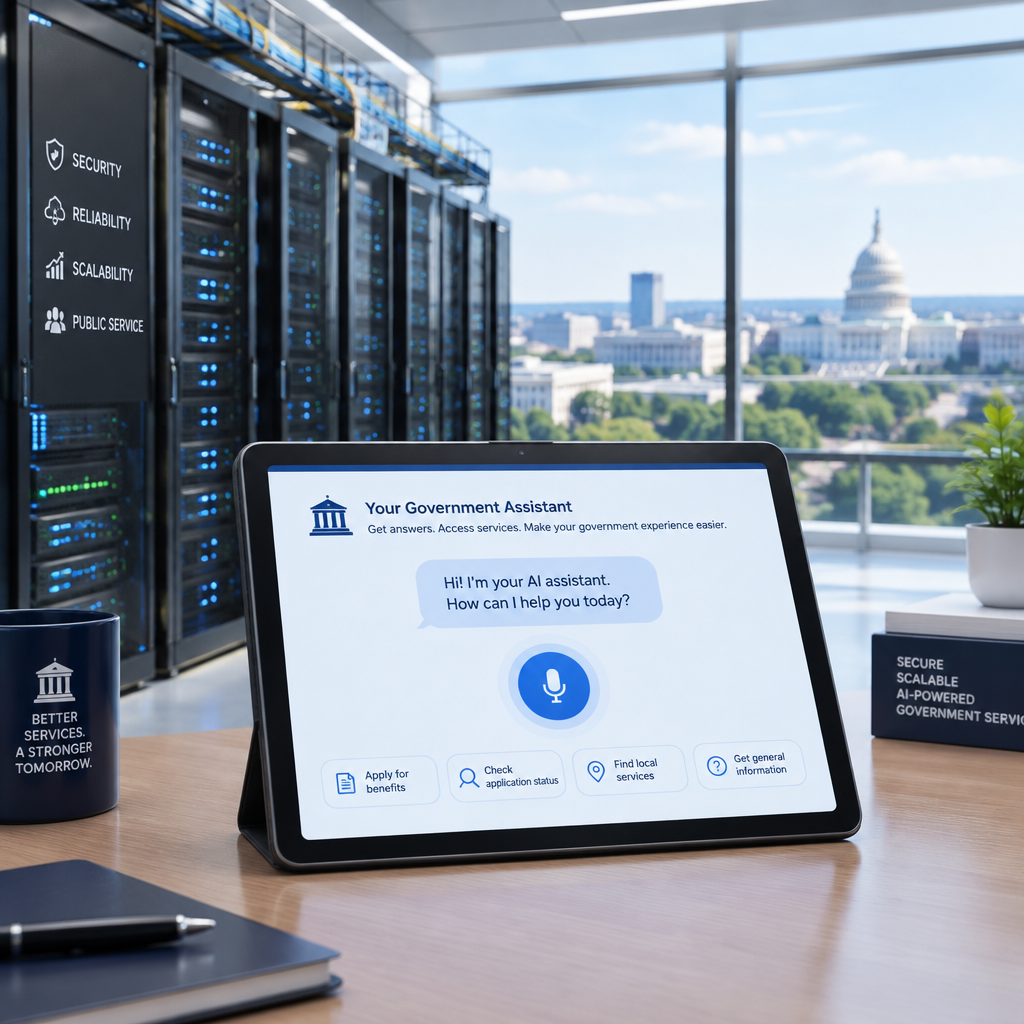
Executive Order (September 29, 2026) and the America.gov mandate
An Executive Order signed September 29, 2026 directs America.gov to become a unified digital front door to the federal government: a single, conversational way for Americans to discover, access, and eventually complete government services online. The order requires agencies to integrate qualifying services with America.gov, making existing APIs, dashboards, and digital forms accessible through the platform while establishing common expectations for privacy, security, reliability, interoperability, and accessibility. Login.gov is identified in the source as the platform’s authentication service.
AI changes the infrastructure equation
Conversational, AI-driven interactions alter the demands placed on government digital services. The source explains that AI-powered applications can generate highly variable traffic patterns, require computationally intensive processing, and depend on multiple large language models (LLMs) and AI services. Users, meanwhile, expect fast, reliable responses and near-constant availability. Meeting those expectations means building infrastructure that scales with the application, not merely accommodates a fixed traffic profile.
The article maps out a layered set of capabilities needed for national-scale AI services: content delivery, AI and LLM integration, application development platforms, and security. On the AI side, an infrastructure layer may need to connect applications with multiple LLMs and providers while offering analytics, caching, rate limiting, request retries, and model fallback. A modern developer platform can add flexibility by enabling applications to be built and deployed across a distributed network rather than relying on a single, static environment—an advantage as agencies experiment and integrate new AI capabilities.

Audit-ready is a season. It shouldn't be.
Evidence in spreadsheets, controls drifting between audits, frameworks multiplying on flat headcount. Nubivance runs continuous compliance on Rapid7 Cyber GRC - SOC 2, HIPAA, ISO 27001, PCI, CMMC.
End the scrambleSecurity and Zero Trust: lessons from VFS Global
Security must move closer to the application as America.gov evolves from an informational portal into a gateway for transactional services. The source draws a concrete comparison to VFS Global, which consolidated security and performance infrastructure with Cloudflare when international travel resumed and traffic surged following the pandemic shutdowns. VFS reported traffic spikes exceeding five times its 2019 peak and faced threats aimed at disrupting appointments or exposing applicant data—precisely the kinds of risks agencies must reckon with as services centralize.
The administration’s plans emphasize integrating services through a secure, privacy-preserving approach. The source advocates a Zero Trust model in which access is continuously verified and security controls apply across users, applications, and APIs. That posture also needs to manage automated traffic and maintain availability during attacks or unexpected surges, and to govern how models are accessed, how requests are managed and monitored, and how applications can remain flexible as AI providers and models change.
From WhiteHouse.gov to a government-wide infrastructure
The piece places America.gov in a historical arc: WhiteHouse.gov launched in October 1994, and almost thirty-two years later the nature of digital government has shifted from static repositories of information and forms to conversational, personalized, and transactional services. America.gov is designed to centralize access to services that historically lived across many agency websites, and that change alters the underlying infrastructure requirements: speed, resilience, secure connectivity to other systems, and the ability to incorporate changing AI capabilities.
In short, the visible conversational interface will be only part of the story; the network, application platform, and AI connectivity underneath will determine whether the experience is dependable at national scale.
What this means for agencies, technologists, and end users
- Agencies: must make qualifying APIs, dashboards, and digital forms accessible through America.gov and meet the Executive Order’s expectations for privacy, security, reliability, interoperability, and accessibility while relying on Login.gov for authentication.
- Technologists and security teams: will need to design layered infrastructure that supports multiple LLMs and providers, built-in analytics, caching, rate limiting, retries, and model fallback, and to adopt Zero Trust practices that verify access continuously across users, applications, and APIs.
- End users: can expect a more conversational, centralized way to find and use government services—but that experience depends on behind-the-scenes investments in scalable, secure AI and platform infrastructure.
The America.gov vision moves government from scattered websites toward a cohesive digital front door. The Executive Order sets the goal; the technical and security work—connecting agency systems, enforcing privacy and reliability expectations, and building an AI-ready infrastructure that can scale and adapt—will determine whether that front door opens smoothly for the public. The agencies and their industry partners must now translate policy direction into engineering and operational reality so that the conversation citizens have with government is also a secure, resilient one.