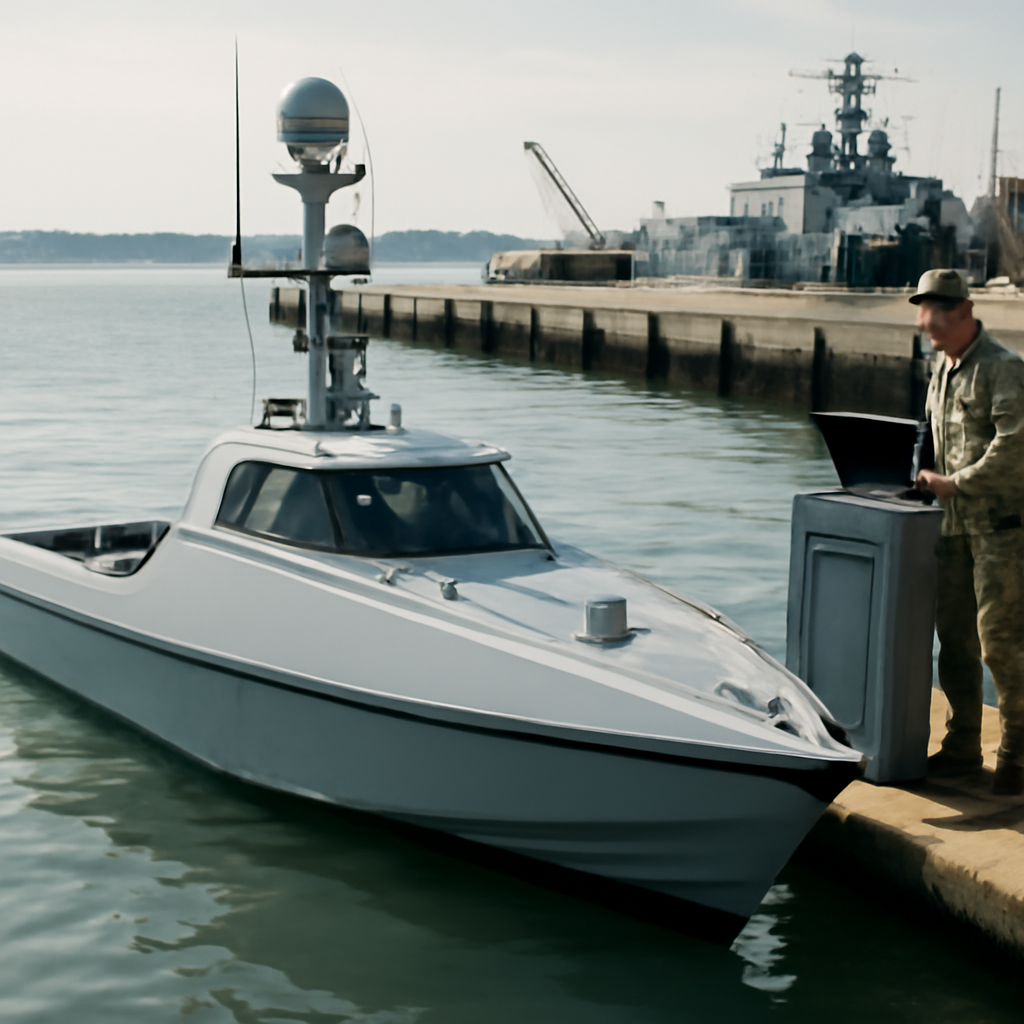
“We didn’t fit to that. We didn’t change our course,” Saildrone founder and CEO Richard Jenkins said, describing why the company now plans to enter the Navy’s new medium unmanned surface vessel effort with a much larger design than its previous boats.
Saildrone, Lockheed Martin, and Fincantieri introduce Spectre
A collaboration between Saildrone and defense contractors Lockheed Martin and Fincantieri produced Spectre, a 170-foot unmanned surface vessel unveiled at the Sea‑Air‑Space Exposition. The design is the result of two years of work and, company executives said, aligns with the Navy’s recently launched competition for a family of Medium Unmanned Surface Vessels (MUSV). Saildrone said construction of Spectre is about to begin and sea trials for the first vessel are set for early next year.
Two variants, multiple mission sets, and containerized payloads
Spectre comes in two variants. The Silent Endurance model uses Saildrone’s trademark sail, a 43‑meter composite “wing” made by American Magic Services, and an electric engine optimized for sustained operations at about 12 knots. The Stealth Strike variant relies solely on internal propulsion, powered by a 5,000‑horsepower Caterpillar diesel intended to cruise around 25 knots and capable of brief sprints toward the company’s cited maximum of 30 knots.
The vessel is designed to carry modular, containerized payloads: space for either two 40‑foot equivalent unit (FEU) containers, five 20‑foot containers, or a configurable mix. Saildrone highlighted optional loadouts that include two Lockheed Mk 70 vertical launching system (VLS) containers — described as capable of firing Tomahawk cruise missiles or long‑range SM‑6 air defense and surface strike missiles — twin‑line towed sonar arrays like the TB‑29, and Lockheed’s Joint Air‑to‑Ground Missile Quad Launcher (JQL), which Saildrone is integrating on its smaller Surveyor platform.

Audit-ready is a season. It shouldn't be.
Evidence in spreadsheets, controls drifting between audits, frameworks multiplying on flat headcount. Nubivance runs continuous compliance on Rapid7 Cyber GRC - SOC 2, HIPAA, ISO 27001, PCI, CMMC.
End the scrambleAnti‑submarine role and sensor suite
The company and its partners have positioned Spectre as optimized for anti‑submarine warfare (ASW). Thales Defense and Security — the maker of the active sonar fitted to Spectre — described the drone as a forward “lookout” for conventional Navy ships. Tony Lengerich, vice president of Naval Programs at Thales, said the platform can take “a sensor far out ahead of the battle group,” loiter to deploy active sonar, then move on so manned forces can close with greater certainty.
Paul Lemmo, vice president and general manager for sensors, effectors & mission systems at Lockheed Martin, framed the platform as a cost‑effective way to increase combat options: “you’ve got more shooters on a fairly inexpensive platform instead of a multi‑billion dollar destroyer,” he said.
Navy competition, timelines, and program context
The Spectre announcement comes as the Navy reshapes its approach to medium‑sized unmanned ships. The service formally launched its MUSV competition last month, replacing an earlier Modular Surface Attack Craft (MASC) concept with a “marketplace” approach that asked competitors to submit proposals for mature vessels that could be fielded in Fiscal Year 2027. Core MUSV requirements cited in reporting include seakeeping, long range and endurance, and cargo capabilities; the ability to carry two 40‑foot containerized payloads is a stated key demand.
The Navy has said it wants 11 operational MUSVs by next year, and has projected that half the surface fleet will be uncrewed by 2045. The service’s work with Saildrone platforms dates to 2021: smaller Saildrone Voyagers have been used by Task Group 59 for persistent surveillance experiments, and solar‑powered Voyagers were the USV of choice for Operation Windward Stack in the U.S. 4th Fleet area of responsibility, which includes the Caribbean and Central and South America. Sea Hunter, an earlier medium‑sized USV, and its sister ship Seahawk were announced to be leaving experimental status in 2026, with one of them reportedly expected to deploy this year with a carrier strike group.
What this means for the Navy, Saildrone and Lockheed/Fincantieri, and regional operators
- The Navy — The MUSV “marketplace” compresses decision timelines: the service has signaled an urgent push to field mature platforms in FY2027 while demanding containerized cargo capacity and endurance. The Navy’s stated targets — 11 operational MUSVs by next year and a pathway to half the surface fleet uncrewed by 2045 — set an aggressive acquisition cadence.
- Saildrone, Lockheed Martin, and Fincantieri — Spectre positions the team to meet the Navy’s 40‑foot container requirement and to offer a larger, missile‑capable option than Saildrone’s prior small USVs. Saildrone priced Spectre at roughly $40 million per unit, versus about $7.5 million for the 20‑foot unarmed Surveyor, and plans demonstrations of missile and JAGM integration following a Surveyor test at the Rim of the Pacific exercise in July.
- Regional and operational units (Task Group 59, U.S. 4th Fleet, Coast Guard) — Spectre’s endurance and modular payloads aim to expand options for theater ASW, persistent surveillance, and logistics or repair support inside a containerized footprint that Navy officials have said is designed to be easily swapped in and out.
Construction is set to begin and sea trials are scheduled for early next year; the Navy’s compressed MUSV timetable and its stated requirements will determine whether Spectre’s size, speed and open payload architecture make it a practical contender. The concrete near‑term markers to watch are the planned July demonstrations of containerized launchers on Surveyor and the team’s promise to show similar capability on Spectre soon, alongside Navy decisions driven by the MUSV “marketplace.”