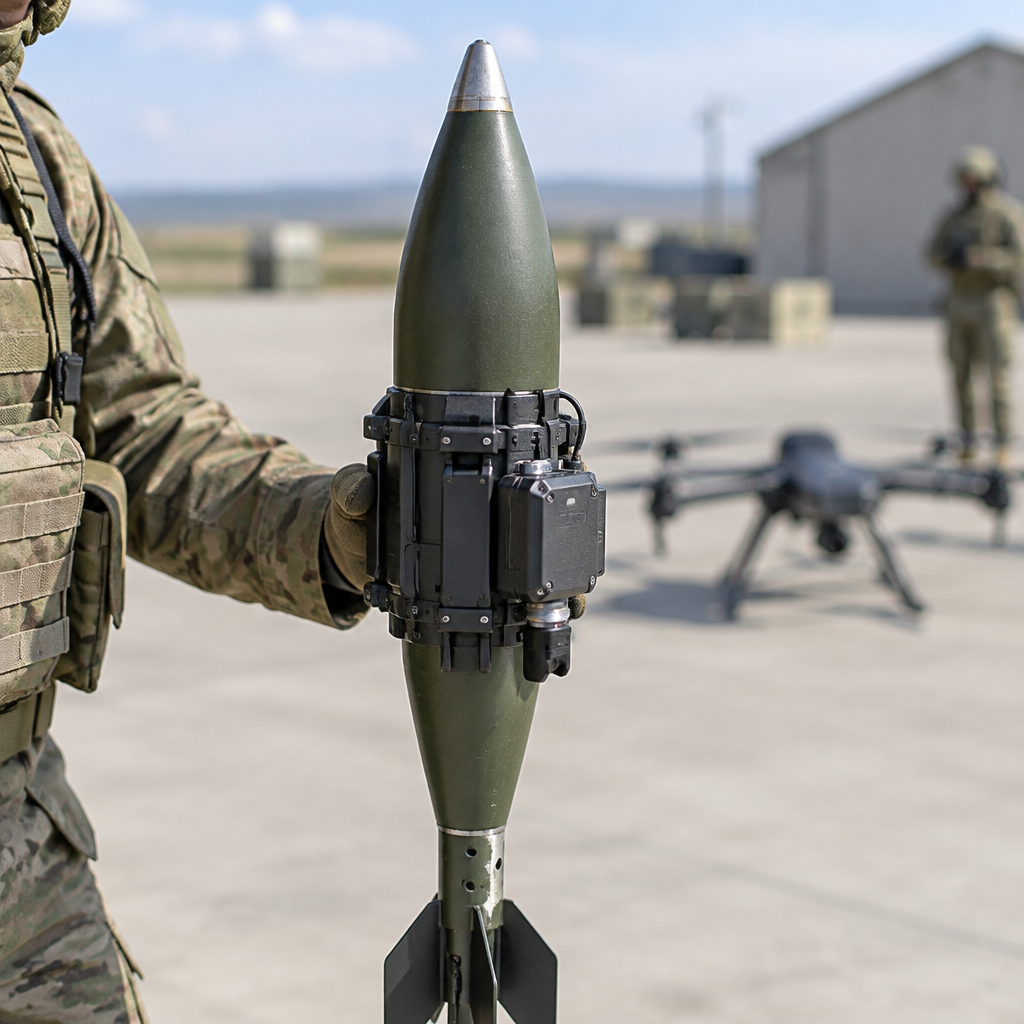
Work on the MALET system began in 2024, the Army explained in its announcement Wednesday morning.
What MALET is and why the Army built it
The Army unveiled the Munitions Air-dropped Lethal Effects Tool (MALET), a clip-on conversion kit that allows front-line troops to turn existing 60mm and 81mm mortar rounds into munitions that can be dropped from unmanned aircraft systems (UAS). The service presented MALET as part of the Picatinny Common Lethality Integration Kit (CLIK), a modular architecture intended to place lethal payloads on unmanned systems including small drones.
How the kit works: fuze, fins, and reversibility
According to the Army, MALET adds a fuze function and aerodynamic fins to a standard mortar cartridge. The clip-on kit “adds a fuze function to the round that allows it to be detonated after being dropped and includes fins to ensure ‘the aerodynamic stability required for a drone drop of the cartridge,’” the service said. The Army also emphasized that MALET “doesn’t damage the mortar, nor does removing it,” so rounds not expended can be returned to their original state and fired from a conventional mortar tube.

This site is the portfolio.
OSINTSights runs on Cloudflare Workers, D1, R2, and Vectorize, with an AI pipeline on Hetzner ARM. Nubivance designed, built, and operates it. We do the same for clients.
See what we buildRange claims, testing, and safety assertions
The Army framed MALET as a way to extend mortar reach: conventional tube-fired mortars have ranges of about “between two to 3.5 miles,” while a solicitation earlier this year sought MALET-compatible drones with a desired operational range of 20–40 km (about 12.5–25 miles). The Armaments Center’s Fuze and Mortar Divisions “recognized a critical opportunity” and began work in 2024, the Army said.
Recent test drops “have already shown the MALET’s effectiveness, successfully maturing both the system’s fuze function and its critical safety elements,” the service claimed. In the Army’s words: “The team just recently had a successful test where they demonstrated the performance of MALET with live 60mm mortars. The items were dropped from a UAS on the move; they oriented correctly and detonated within the desired target area.” The Army provided still images showing a released round and a subsequent impact, but the reporting notes that those images prevent independent confirmation of how well the system performed or how easy it is for soldiers to use.
Picatinny CLIK, AUDIBLE, and Gunslinger: an integration effort
MALET is one element of the broader Picatinny CLIK modular system. CLIK also incorporates the Armament UAS Delivered Immediate Battlefield Effects (AUDIBLE) Weapons Release System and the Gunslinger fire control software. The Army said AUDIBLE enables “quick change adapters to safely drop existing munitions, like the M67 grenade, providing a proven concept that is scalable to service a larger array of munition options.” Gunslinger, the service noted, was originally designed by the Armaments Center for the Future Vertical Lift – Future Attack Reconnaissance Aircraft XM915 20mm Cannon and provides fire control calculations that account for variables such as target or platform motion to improve aiming for a likely strike.
What this means for soldiers, the Army acquisition community, and adversaries
- Soldiers: The Army pitched MALET as a way to extend the reach of munitions that units already “have in abundance,” specifically 60mm and 81mm mortar rounds, without requiring purpose-built drone munitions. MALET’s reversibility — the ability to remove the kit and retain the mortar for tube firing — is a feature the service highlighted for operational flexibility.
- The acquisition and user communities: The Army plans to distribute the kit to major military exercises in the fall “to allow for soldier touchpoints and receive feedback.” The MALET Integrated Product Team (IPT) said it is exploring additional concepts “mostly close-hold for now,” and Senior Scientific Technical Manager for Indirect Fire Munitions Ryan Gorman described the work as leveraging “core competencies like fuze design, safety, and ammunition development” toward lethal UAS options.
- Adversaries and non-state actors: The Army framed MALET against a background in which drone-dropped munitions have been employed by diverse actors over the past decade. The source recounts that ISIS fighters began using this capability during the Battle of Mosul in 2016–2017 and that weaponized drones later appeared in Syria, Afghanistan, the Ukraine war, and in operations by drug cartels in Mexico. The article also describes improvised adaptations — for example, Ukrainians breaking down 155mm DPICM artillery shells to repurpose submunitions as drone-dropped devices — underscoring that the concept of adapting surplus munitions for aerial delivery has precedent beyond MALET.
As the Army continues live testing and plans to field MALET to exercises, the service positions the kit as a way to scale lethal UAS effects using existing stockpiles while preserving conventional mortar capability when needed. The next formal milestone the Army cited is distribution to major exercises this fall to collect soldier feedback and refine the concept.
Original story: https://www.twz.com/land/this-is-the-armys-new-malet-kit-that-turns-mortars-into-drone-dropped-weapons