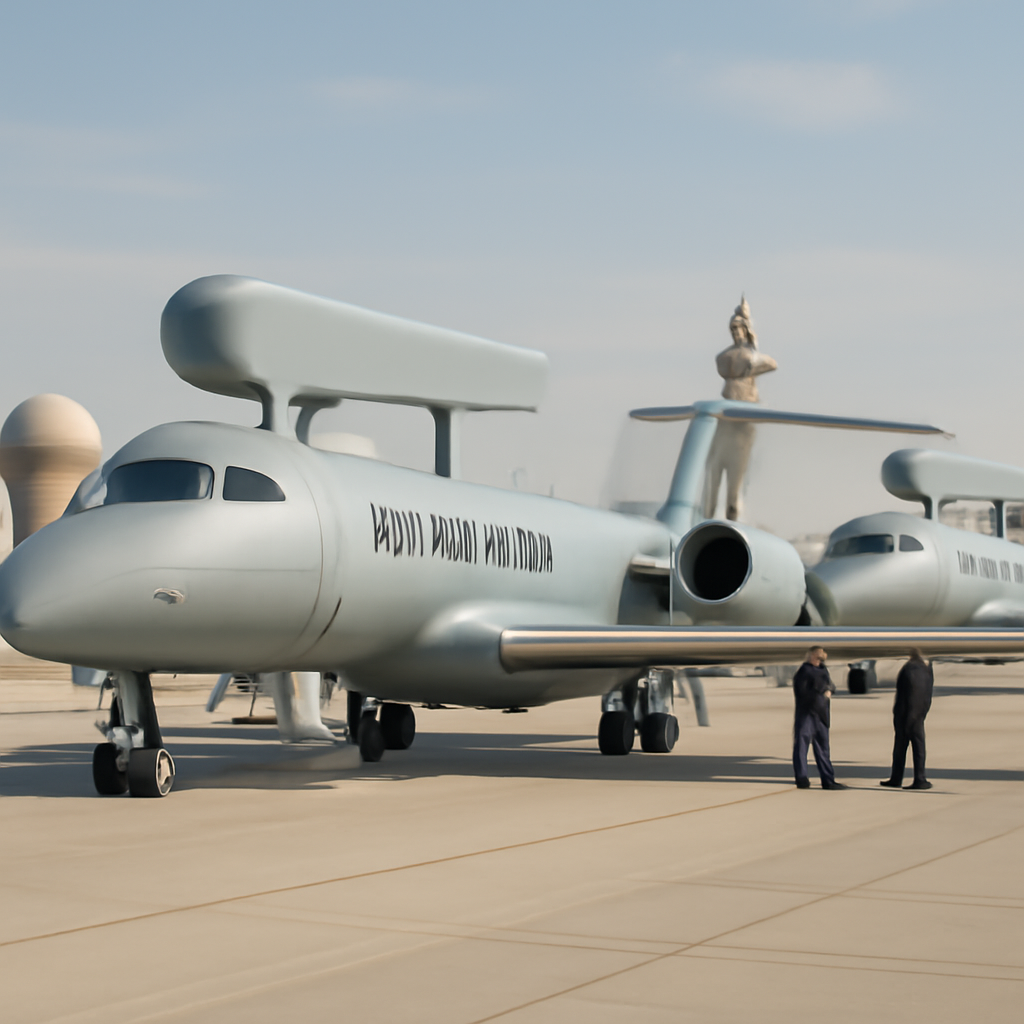
"underscores our commitment to providing customers with mission‑proven, multi‑domain AEW&C capability," Saab president and chief executive Micael Johansson said on 27 July 2026 after the company announced a US$1.04 billion (SEK 10.1 billion) order for two GlobalEye airborne early warning and control (AEW&C) aircraft from "a country in the Middle East region."
The contract: price, schedule, and deliberate anonymity
Saab disclosed the order value — US$1.04 billion — and said the two GlobalEye aircraft are due for delivery in 2030. Beyond that, the company provided limited detail: Saab described the buyer only as "a country in the Middle East region" and stated that "no further information regarding this order or the customer will be provided." The firm has not disclosed a signature date separate from the 27 July announcement, nor confirmed whether the package includes ground stations, training, or in‑service support that typically accompany GlobalEye sales.
GlobalEye’s capability profile and service record
Saab markets GlobalEye as a single platform that fuses air, maritime, and land surveillance. The aircraft is built on the Bombardier Global 6000 business‑jet airframe and carries Saab’s Erieye ER active electronically scanned array radar in a dorsal pod, alongside a Seaspray maritime radar and an electro‑optical/infrared sensor. Saab cites reported detection ranges up to roughly 550 kilometres and endurance beyond 11 hours.
Publicly disclosed operators include the United Arab Emirates (the launch customer), which took delivery of five aircraft between 2020 and 2024, and later orders from Sweden and France. France’s Direction Générale de l’Armement was named as the buyer of two aircraft plus two options in a deal valued at US$1.27 billion (SEK 12.3 billion).

The cyber insurance questionnaire just landed. Now what?
SOC 2, HIPAA, insurance renewals - someone has to own security strategy. Nubivance provides fractional CISO leadership without the full-time salary.
Get a security leadSaab’s Gulf campaign and regional precedents
Johansson has previously acknowledged active sales efforts in the Gulf, telling regional press “we are campaigning, and we have given them offers,” and specifically noting that “Qatar and Saudi Arabia have both shown interest.” Saab’s decision to withhold the customer’s name in this instance has a precedent: an earlier Saab sale to the Royal Saudi Air Force — two Saab 2000 Erieye aircraft ordered in 2010 — was initially not attributed publicly by Saab before Riyadh’s role became known. The company framed the latest order as separate from a NATO selection of GlobalEye earlier in July.
Contract timing and its relation to Saab’s quarterly results
Saab booked the Middle East order after the close of its second quarter, so the US$1.04 billion sits outside the US$7.04 billion (SEK 68,393 million) in reported order intake for April–June 2026. In its 17 July 2026 second‑quarter statement, Johansson said Saab had “delivered a strong second quarter with increased order bookings, high organic sales growth and a strengthened operating margin.” The later booking therefore augments Saab’s pipeline without changing the headline Q2 figures already released.
How Saudi Arabia, Qatar, and NATO are positioned
- Saudi Arabia: The Royal Saudi Air Force currently operates five Boeing E‑3 Sentry aircraft alongside two Saab 2000 Erieye aircraft ordered in 2010. For Riyadh, a GlobalEye purchase would most closely fit a fleet‑replacement profile, based on the presence of older AEW&C assets already in service.
- Qatar: The source notes Qatar has no confirmed existing AEW&C fleet; consequently, a GlobalEye purchase there would represent a larger, acquisitive capability leap compared with a straightforward replacement.
- NATO: Saab’s announcement emphasized this Middle East sale is distinct from NATO’s selection of GlobalEye on 7 July 2026 to replace up to 14 E‑3A Sentry aircraft across an 11‑nation consortium. The two programs are separate commercial and political tracks despite involving the same platform.
Saab framed the order as evidence of “increasing international interest in GlobalEye,” a strategic sales line that links the company’s Gulf campaigning to recent wins in Europe and with NATO. The specific contours of the new sale — whether it will include the customary ground systems, training, and sustainment — remain unreported by Saab, and the buyer’s identity is confirmed only by the company’s description. Deliveries are scheduled for 2030; until more detail is released, that delivery date, the price, and the buyer’s anonymity are the concrete facts shaping how militaries, procurement officials, and analysts will interpret the deal.