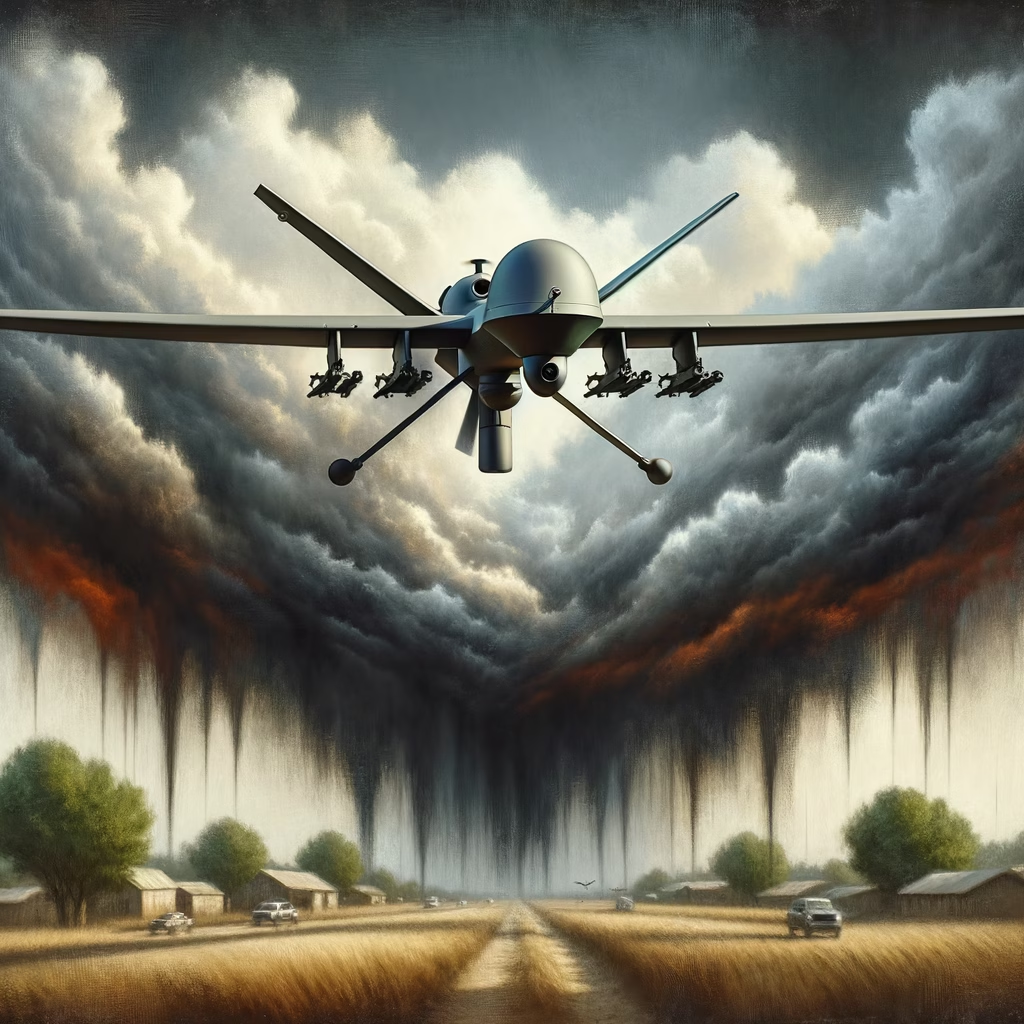
What happens when a battlefield innovation meets the pressures of modern warfare logistics? Recently, Russian forces have introduced a new player in the expanding world of loitering munitions: a compact, Shahed-style kamikaze drone. Smaller and designed specifically for short-range engagements, this drone signals a nuanced shift in drone warfare—a realm already crowded with evolving technologies and strategic adaptations.
The new drone was first identified by Serhiy Beskrestnov, a Ukrainian military expert known by his callsign “Serhiy Flesh.” Beskrestnov’s assessments, widely respected within defense circles, point to the drone’s visual and functional resemblance to the Iranian-made Shahed series but underscore its reduced size and scope. “Russian troops have actively deployed these one-way attack drones in recent operations,” he noted, highlighting an ongoing effort to diversify their tactical options in contested zones.
Loitering munitions, often dubbed “kamikaze drones,” are unmanned aerial vehicles designed to hover or loiter around a target area before striking with precision. The Iranian Shahed drones, notably used in various conflicts across the Middle East and recently in Ukraine, have already demonstrated the strategic value of these assets, blending reconnaissance with direct attack capabilities. Russia’s move to develop a smaller, more compact variant seems aimed at enhancing mobility, reducing costs, and increasing the frequency of deployment for short-range tactical scenarios.
Understanding the context is crucial. The ongoing conflict in Ukraine has accelerated the innovation and deployment of drones across multiple fronts. Both Russian and Ukrainian forces have leveraged unmanned technologies to mitigate risks to personnel while expanding battlefield awareness and strike options. The introduction of this compact Shahed-like drone reveals several underlying strategic priorities:
/ Streamlining supply chains by adopting smaller, more affordable drones
/ Increasing operational flexibility in densely contested or urban environments
/ Reducing the logistical footprint for rapid deployment and mass use
Technologists analyzing this development emphasize its potential to disrupt traditional force compositions. Dr. Olga Kolesnikova, a defense technology specialist at the Moscow Institute of International Relations, notes, “The size reduction of loitering munitions often entails trade-offs—primarily in payload and endurance—but increases tactical agility. It’s a sign that the battlefield is demanding faster, more cost-efficient solutions that can be deployed en masse.” From this perspective, Russia’s drone iteration reflects an adaptive response to the realities of protracted conflict and contested airspaces.
Policymakers and defense strategists will likely view the Russian move through a prism of escalation and arms proliferation. The miniaturization of kamikaze drones could lower the threshold for their use, potentially increasing strikes that are harder to attribute or intercept. This dynamic challenges existing air defense frameworks and necessitates upgrades in counter-drone technologies and doctrines. NATO analysts, speaking on condition of anonymity, have observed that “smaller, cheaper drones complicate defense calculations, forcing a rethink in how we protect critical infrastructure and forces on the ground.”
From the perspective of users on the battlefield, such drones represent both opportunity and risk. Operators gain a potent asset capable of precision strikes without endangering pilots. Yet, deploying kamikaze drones in high volumes requires robust command-and-control systems to avoid fratricide and ensure mission success. Ukrainian frontline reports suggest an increasing familiarity with these drones, with defenders adapting tactics and electronic warfare measures to mitigate the threat.
Adversaries, including Ukraine and its allies, must now prepare for the implications of a more saturated drone environment—one in which the sheer number of inexpensive, short-range strike drones could overwhelm traditional defenses. This development raises the stakes not only for military planners but also for civilian infrastructure in conflict zones, where such drones can be used for targeted attacks with devastating consequences.
In examining the broader picture, Russia’s unveiling of a compact Shahed-style kamikaze drone is emblematic of the evolving nature of modern warfare—where cost, speed, and adaptability can be as decisive as sheer firepower. It also underscores the expanding influence of Iranian drone technology as a source of inspiration and proliferation.
As the battlefields of the future continue to integrate unmanned systems, one must ask: How will the balance of power shift when the skies are filled not just with missiles or fighters but swarms of small, expendable drones? The answer to that question may well define the next chapter of 21st-century conflict.