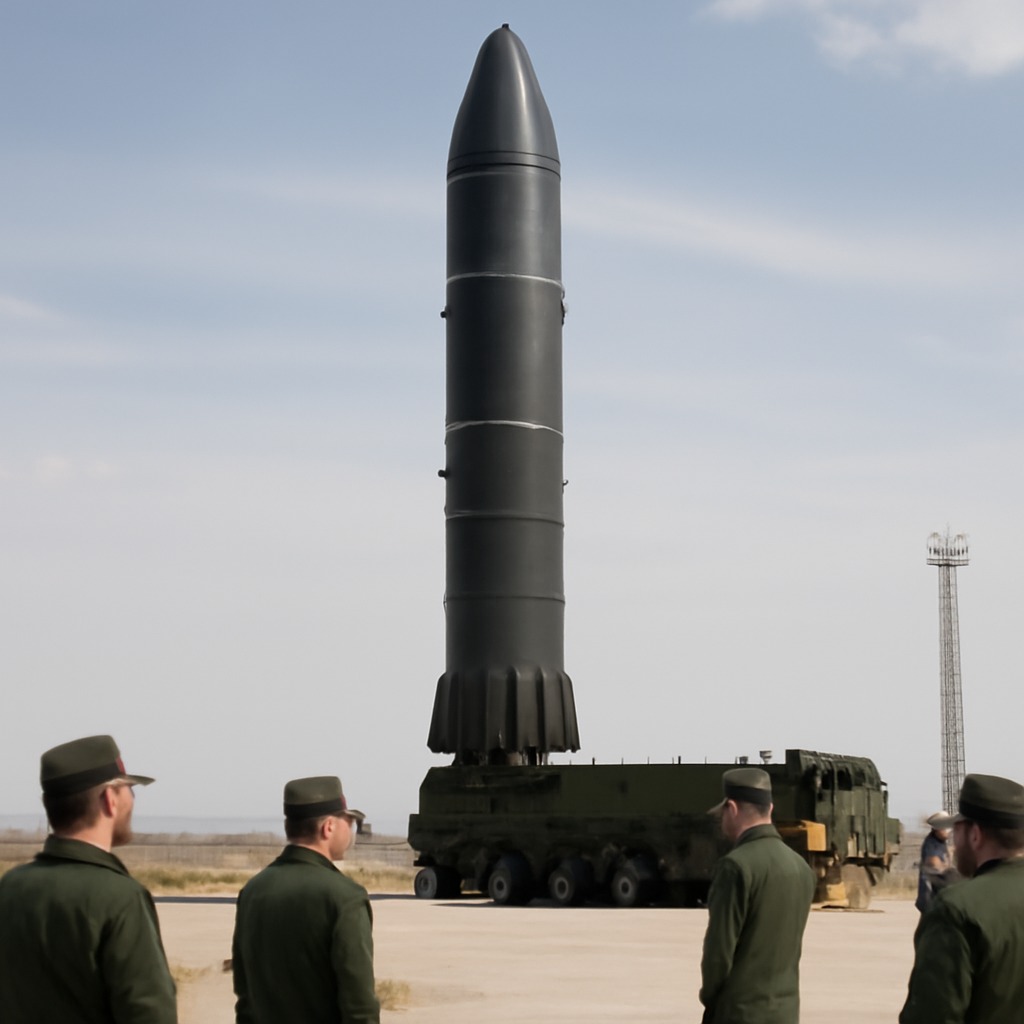
"A major event and unconditional success," Russian President Vladimir Putin said after the morning launch of the RS-28 Sarmat intercontinental ballistic missile, the Kremlin reported.
The test: Plesetsk launch, Kura impact — the timeline
According to the Kremlin, the Sarmat test-launch occurred from the Plesetsk Cosmodrome in the Arkhangelsk region at 11:15 a.m. Moscow time on May 12, 2026. Russian officials said roughly half an hour later the missile hit its target at the Kura test range on the Kamchatka Peninsula. The commander of the Strategic Rocket Forces, Sergei Karakayev, informed President Putin of the successful test while Putin monitored the launch via video link from his office bunker. A pool photograph distributed by Sputnik and credited to Mikhail METZEL / POOL / AFP shows Putin holding the videolinked meeting.
Sarmat (RS-28 / SS-29): claimed capabilities and design choices
The RS-28 Sarmat, known to NATO as SS-29 Satan II, is a new-generation heavy ICBM that Russia presents as a successor to the Soviet-era R-36M2 (SS-18 Satan). The Sarmat is a silo-launched, liquid-fueled, nuclear-armed ICBM. Russian statements and published material attribute to it a range that Putin said could exceed 35,000 kilometers (21,748 miles).
Russian descriptions and open reporting list several features intended to defeat ballistic missile defenses: decoys and other countermeasures; a fractional orbital bombardment capability; independent post-boost vehicles (IPBV); and, by some suggestions, the capacity to carry multiple hypersonic boost-glide vehicles. The program’s choice of a liquid propellant system is highlighted as a trade-off: while liquid-fueled designs are often seen as a Cold War throwback, the reporting notes that a hydrazine-based fuel with nitrogen tetroxide (NTO) as oxidizer can permit long-term storage in a fueled, ready state if paired with suitable materials and environmental controls.

This site is the portfolio.
OSINTSights runs on Cloudflare Workers, D1, R2, and Vectorize, with an AI pipeline on Hetzner ARM. Nubivance designed, built, and operates it. We do the same for clients.
See what we buildPatchy test record and the road to operational claims
The Sarmat’s test history has been uneven. The first successful test-launch took place in 2022 from Plesetsk, but the program experienced a failed test in February 2023 and an unsuccessful test in September 2024 that destroyed the Yubileynaya test silo at Plesetsk. The missile was originally planned to enter service in 2020, a date that was not met. The reporting cites a range of possible causes for the delays — technical problems, Russia’s sluggish economy, and, after 2022, international sanctions and strains on the defense industrial base — and says the delays likely reflect a combination of factors. The Kremlin’s announcement that the system will be operationally deployed later this year thus follows a mixed operational record and, so far, the claim has not been independently verified.
Deployment plan and the Strategic Rocket Forces
Putin said the Sarmat’s positive results would permit deployment of the first missile regiment to combat duty in the Uzhur formation of Krasnoyarsk Krai by the end of this year, specifically referring to the 62nd Red Banner Rocket Division at Uzhur in Siberia. The commander of the Strategic Rocket Forces, Sergei Karakayev, briefed Putin on the test, and Russian state media released footage and images tied to the event. Independent confirmation of the test’s success and of subsequent deployment timelines is not reported in the material supplied by Russian sources.
New START expiry, U.S. programs, and the risk of renewed competition
The reporting places the Sarmat’s prospective entry into service in the context of the New START treaty’s expiration in 2021. New START had set limits on the number of deployed and non-deployed land-based ICBMs, total available SLBM launch tubes, and nuclear-capable heavy bombers, and on total deployed and non-deployed systems. With those limits gone, the report notes, Russia would be able to replace the R-36M with Sarmat on a one-for-one basis while also maintaining other ICBMs and moving forward with other strategic modernization programs such as the Avangard hypersonic boost-glide vehicle.
The article also references contemporary U.S. developments: the LGM-35A Sentinel ICBM program has faced major delays, rising costs, and infrastructure challenges, and at this point it is unclear whether Sentinel missiles will carry multiple warheads. The reporting states that ongoing U.S. modernization work on Sentinel is, in turn, spurring work on the Sarmat program. Taken together, the account warns that if Sarmat can be perfected, it could pave the way for Russia to deploy more strategic missiles and potentially trigger a new arms race.
What this means for the Strategic Rocket Forces, the United States, and regional posture
- Strategic Rocket Forces: The service is positioned to receive the first Sarmat regiment at Uzhur by the end of the year if the Kremlin’s timeline holds; commanders briefed the president and Russian media are emphasizing operational success.
- The United States: Reporting links the Sarmat program’s momentum to parallel U.S. modernization pressures, noting uncertainties in the LGM-35A Sentinel program’s warhead posture and infrastructure-driven delays.
- Regional and global strategic posture: The expiration of New START and an operational Sarmat would remove treaty constraints cited in the report and could enable one-for-one replacement of older missiles, with implications for broader strategic balance and modernization choices.
The Kremlin’s announced success is a notable step for a program that has experienced high-profile failures and long delays. Whether the test proves sufficient to put the RS-28 Sarmat on combat duty by the end of 2026, and what that will mean for force structure and international reaction, remains to be demonstrated in the months ahead.
https://www.twz.com/nuclear/russia-plans-to-deploy-sarmat-icbm-operationally-later-this-year