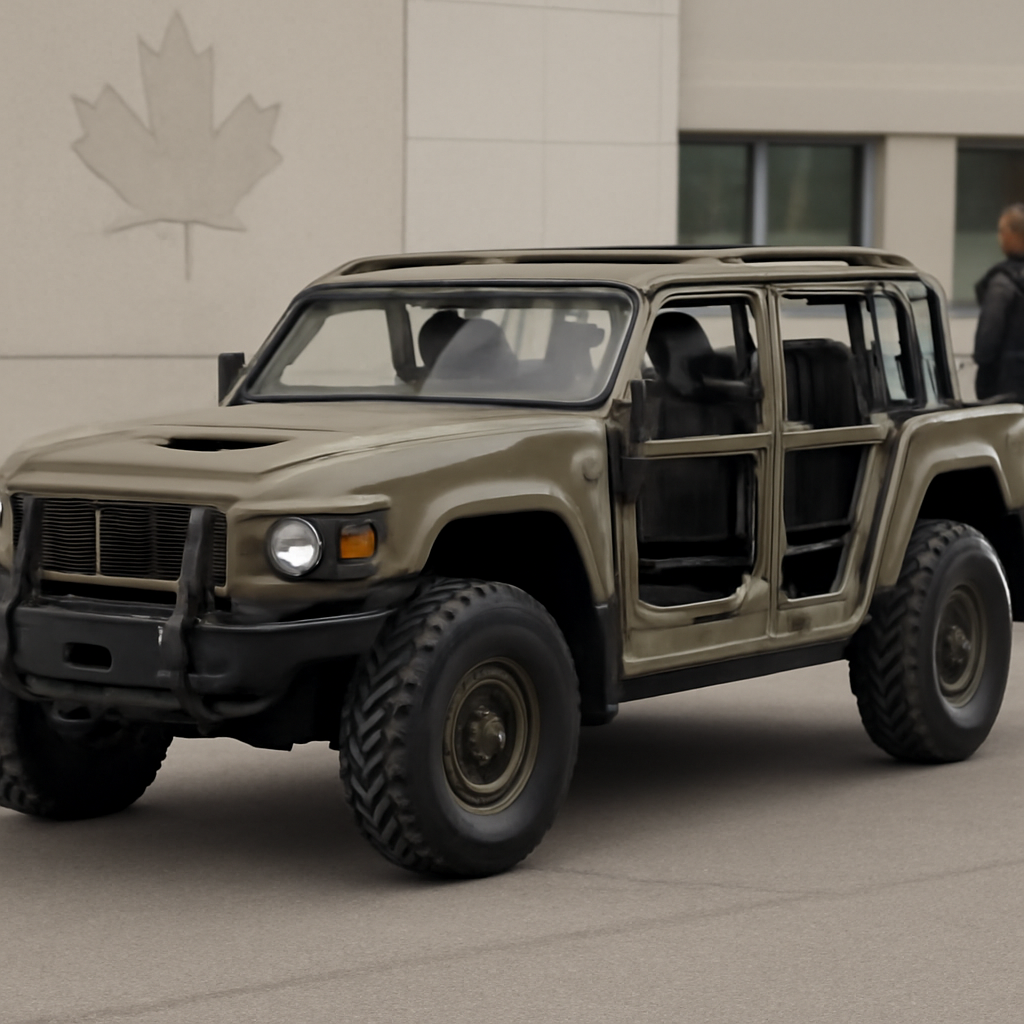
"we weren’t able to sell to our own government," Roman Shimonov told CityNews — a sharp line he used to frame Roshel’s bid after Ottawa narrowed Canada’s Light Utility Vehicle competition to two domestic firms on 8 July 2026.
Ottawa’s decision and the narrowed competition
The Prime Minister’s Office confirmed on 8 July 2026 that the Light Utility Vehicle (LUV) project has been restricted to two Canadian defence industry suppliers competing to deliver between 1,600 and 2,100 vehicles, plus 400 to 500 light utility trailers. CBC News reported the program is worth up to US$3.5 billion (C$4.9 billion). Public Services and Procurement Canada (PSPC) and the Department of National Defence (DND) have not published the identity of the second finalist publicly; defence reporting cited by Defence Blog and CityNews names Brampton, Ontario-based Roshel Inc. as one of the two remaining bidders. PSPC and DND declined to comment to CBC.
Roshel’s pitch: production history, capacity, and timing claims
Roshel, founded in Toronto in 2016 by chief executive Roman Shimonov, builds its Senator armoured platform at a roughly US$46‑million (C$65‑million) facility in Brampton. The company told CityNews it has produced more than 2,500 vehicles for Ukraine alone, a figure Shimonov used to argue that Roshel is “the largest armoured vehicle manufacturer in the world” by that measure. Roshel has exported the Senator to the United States, United Kingdom, Germany, France and several other countries, but — Shimonov emphasized — it has never before sold a vehicle to the Canadian Armed Forces.
On delivery speed, Roshel told local media it could begin LUV deliveries within 2026 itself, a schedule the company presented as well ahead of the project’s earlier delivery target of 2029.

Audit-ready is a season. It shouldn't be.
Evidence in spreadsheets, controls drifting between audits, frameworks multiplying on flat headcount. Nubivance runs continuous compliance on Rapid7 Cyber GRC - SOC 2, HIPAA, ISO 27001, PCI, CMMC.
End the scrambleProgram requirements and the capability baseline
The LUV project is intended to replace the Canadian Army’s Mercedes‑Benz G‑Wagon Special Military Pattern vehicles across four variants: command and reconnaissance, utility, military police, and cable‑laying roles. The competition specifies a requirement for STANAG 4569 Level II ballistic protection and a base chassis already in militarized service with a NATO or Five Eyes partner. Major Varun Vahal, the LUV Project Director, told Canadian Army Today in December 2025 that, under the program’s prior structure, troops would receive the vehicles “as originally scheduled, between 2030 and 2034.” The recent restriction to two Canadian firms marks a material change from the program’s open international origin.
Industrial policy, partners, and who was sidelined
The narrowed contest reflects Ottawa’s broader industrial emphasis: the government’s Defence Industrial Strategy targets directing 70 percent of defence acquisitions to Canadian firms. CBC reported that PSPC had sidelined the two American finalists, AM General and Oshkosh Defence, leaving only domestic firms in contention. Roshel has explicitly tied its domestic footprint to the Buy Canadian evaluation, urging decision‑makers to “choose real Canadian companies” rather than bidders that promise to relocate or establish Canadian operations only if they win.
In April 2026 Roshel formalized a partnership with Algoma Steel to build LUV vehicles using Canadian‑made ballistic steel. Algoma chief executive Rajat Marwah described the arrangement as a way to bring “our production capabilities, our workforce, and our Sault Ste. Marie facilities directly in service of Canada’s national security.”
How Roshel, the Canadian Armed Forces, and Algoma Steel are affected
- Roshel: The company stands to win its first-ever Canadian Armed Forces vehicle contract, leveraging a high Ukraine production count, a new domestic steel supply arrangement, and a Brampton production facility. Roshel’s public timeline claim — deliveries beginning in 2026 — frames speed as a competitive advantage.
- Canadian Armed Forces: The CAF is positioned to receive a domestically sourced replacement for its aging G‑Wagon Special Military Pattern fleet, meeting specified STANAG 4569 Level II protection and variant requirements; whether deliveries will adhere to the previously stated 2030–2034 timeframe depends on the outcome of the restricted competition and any revised award timeline from PSPC or DND.
- Algoma Steel: The company’s April 2026 partnership with Roshel ties its Sault Ste. Marie facilities and workforce directly to a potential high‑value defence production line for ballistic steel, aligning industrial capacity with Ottawa’s Buy Canadian emphasis.
The facts released so far sketch a decisive pivot: a program that began as an open international tender has been restructured into a two‑bidder, Canadian‑only contest. What remains concrete in public reporting is the scale of the award (1,600–2,100 vehicles and 400–500 trailers, up to US$3.5 billion), Roshel’s production claims and domestic partnership with Algoma Steel, and the sidelining of AM General and Oshkosh Defence. What is not yet public — and will shape the next chapter — is the identity of the unnamed second Canadian finalist and the restricted tender’s award timeline, neither of which PSPC or DND have confirmed.