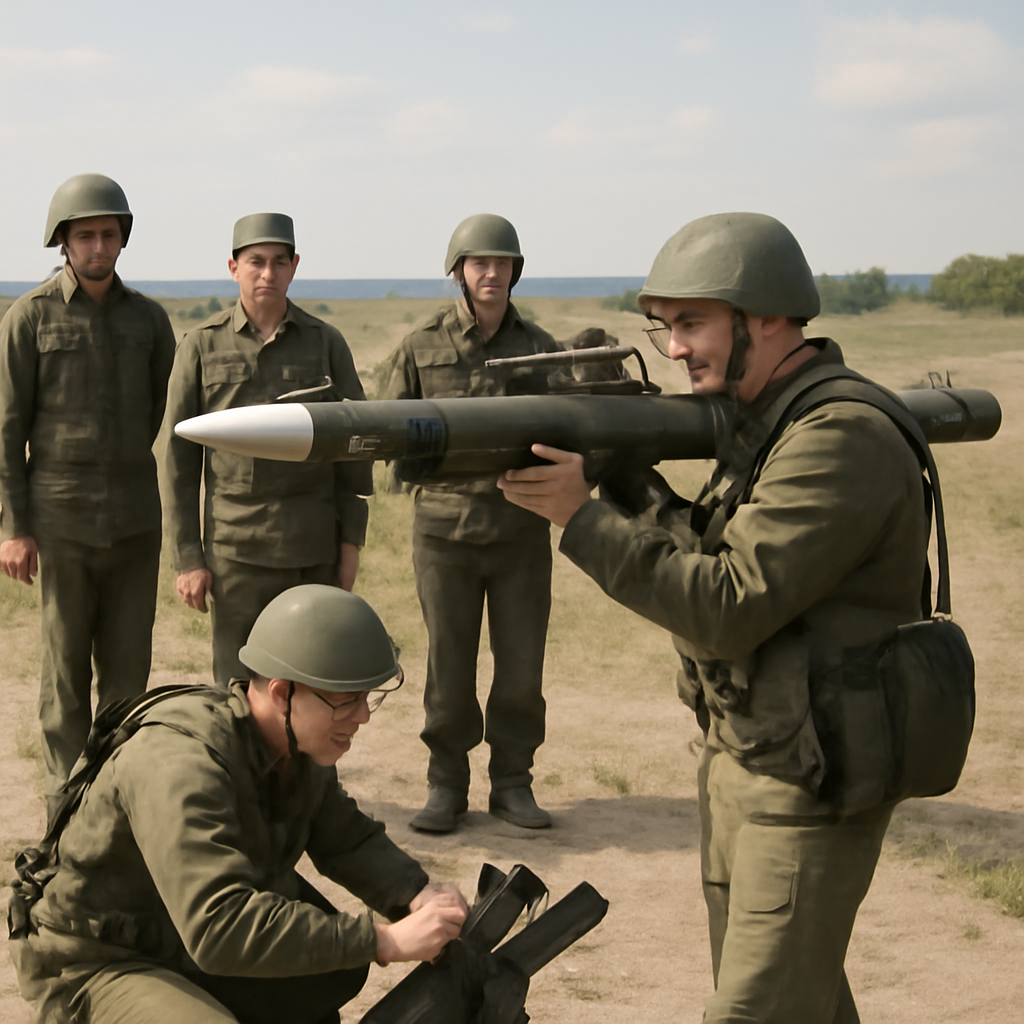
Russian state television footage from Rostov Oblast recently showed a mobile air-defense team displaying a shoulder-fired missile system that does not match familiar Russian MANPADS families — and whose origin, observers say, could be Chinese, Iranian, or a hybrid derivative.
What the footage shows and where it surfaced
The launcher appeared in television footage covering a mobile air-defense group operating in the Rostov region on Russia’s border with Ukraine; the segment identified the unit as “one of the mobile fire groups of the 51st Air Defense Division.” Russian personnel in the material reportedly called the system “Iva,” and an operator was interviewed on the Russia‑1 channel. The imagery includes close-ups of the front of the launcher and scenes of launchers disassembled and packed in a container for transport. The footage was highlighted on the X account TheDeadDistrict and subsequently picked up by open-source analysts.
Distinctive visual features and comparison to Chinese and Iranian systems
Visual analysis cited in reporting compared the unknown launcher to Iranian Misagh-series systems and Chinese QW-series MANPADS, particularly the QW-18/QW-18A and QW-19. Analysts note a box-like component below the forward section of the tubbed launcher that aligns more closely with photographs of Chinese QW-series systems than with the Misagh examples available in public imagery. At the same time, reporting emphasizes scarcity of imagery of later Iranian variants, meaning an Iranian design cannot be conclusively excluded. The Misagh family itself is described as derived from or heavily influenced by Chinese designs, complicating straightforward attribution by appearance alone.

The cyber insurance questionnaire just landed. Now what?
SOC 2, HIPAA, insurance renewals - someone has to own security strategy. Nubivance provides fractional CISO leadership without the full-time salary.
Get a security leadRegional supply links: Beijing, Tehran, and third-party routes
The appearance of a likely Chinese- or Iranian-derived MANPADS in Russian hands is discussed against a backdrop of increasingly close military-technical interactions among Moscow, Beijing, and Tehran. Since 2022, Russia’s relationship with China has deepened, including expanded cooperation and an acknowledged “no limits” partnership, while the two sides have engaged in exercises and growing technical ties. U.S. officials have accused China of supplying components used in Russian weapons production; China has rejected accusations of providing lethal military assistance.
Iran has also expanded military ties with Russia: Moscow has used Iranian‑designed Shahed-series attack drones in Ukraine and has cooperated with Tehran on local production and adaptation. In January 2025 Russia and Iran formalized a comprehensive strategic partnership treaty that includes military-technical cooperation and joint exercises.
Separately, Reuters reporting in July said Iran was expected to receive an initial shipment from a deal covering 300–400 Chinese-made MANPADS, identified by sources as including QW-12 and FN-16 systems, procured through a Hong Kong‑based intermediary with planned transit through Pakistan; Pakistan denied involvement and China’s Foreign Ministry called the report “groundless.” A European security source told Reuters authorities were aware of several contracts under discussion for QW-12, QW-18, and QW-19 sales to Iran, and a Middle Eastern security source said Iran had been seeking QW-18 systems.
Past proliferation, parallel appearances, and routes into conflict zones
Chinese-designed MANPADS have a noted history of appearing beyond conventional inventories. Research cited in the reporting—by the Small Arms Survey and other monitors—documents multiple cases of QW-series weapons moving through illicit networks, including a 2013 interception of the vessel Jihan that investigators assessed as likely carrying QW-18-pattern MANPADS and identified Iran as the probable source. UN investigators, the U.S. government, and Conflict Armament Research were named in that assessment.
Chinese-manufactured systems have also been photographed in Ukraine in late 2025 and 2026, including FN-6 and FN-16 examples, but the routes by which those weapons reached Ukrainian units remain unclear and could include third-party transfers or diverted shipments. Those precedents are cited as context for why a Chinese-pattern system might appear in unexpected inventories.
What this means for Russian defense planners, China and Iran, and Western analysts
- Russian defense planners: Additional shoulder‑fired systems — whether imported, locally produced derivatives, or captured — could be used to supplement domestic production under wartime strain, particularly for mobile fire groups that counter low-altitude drones and other local aerial threats.
- Chinese and Iranian officials: Reports of Chinese-origin MANPADS moving to Iran and the presence of Chinese-pattern systems in multiple theaters place focus on intermediary procurement routes; Beijing has publicly rejected allegations of supplying lethal assistance, and Pakistan denied involvement in reported transit routes.
- Western security analysts and investigative groups: Continued imagery and subsequent appearances of the launcher will be crucial. Open-source comparison to known QW-series and Misagh photos, together with supply-chain reporting from outlets such as Reuters and pattern analysis by groups like the Small Arms Survey and Conflict Armament Research, will shape attribution efforts.
For now the launcher’s precise make and provenance remain unconfirmed. The system does not closely match known Russian MANPADS families and its Chinese- or Iranian‑pattern features are notable; further appearances and additional imagery will be required to determine whether this is an imported system, an Iranian-produced derivative, a Chinese evaluation item, a captured weapon, or an unrecognized Russian configuration.