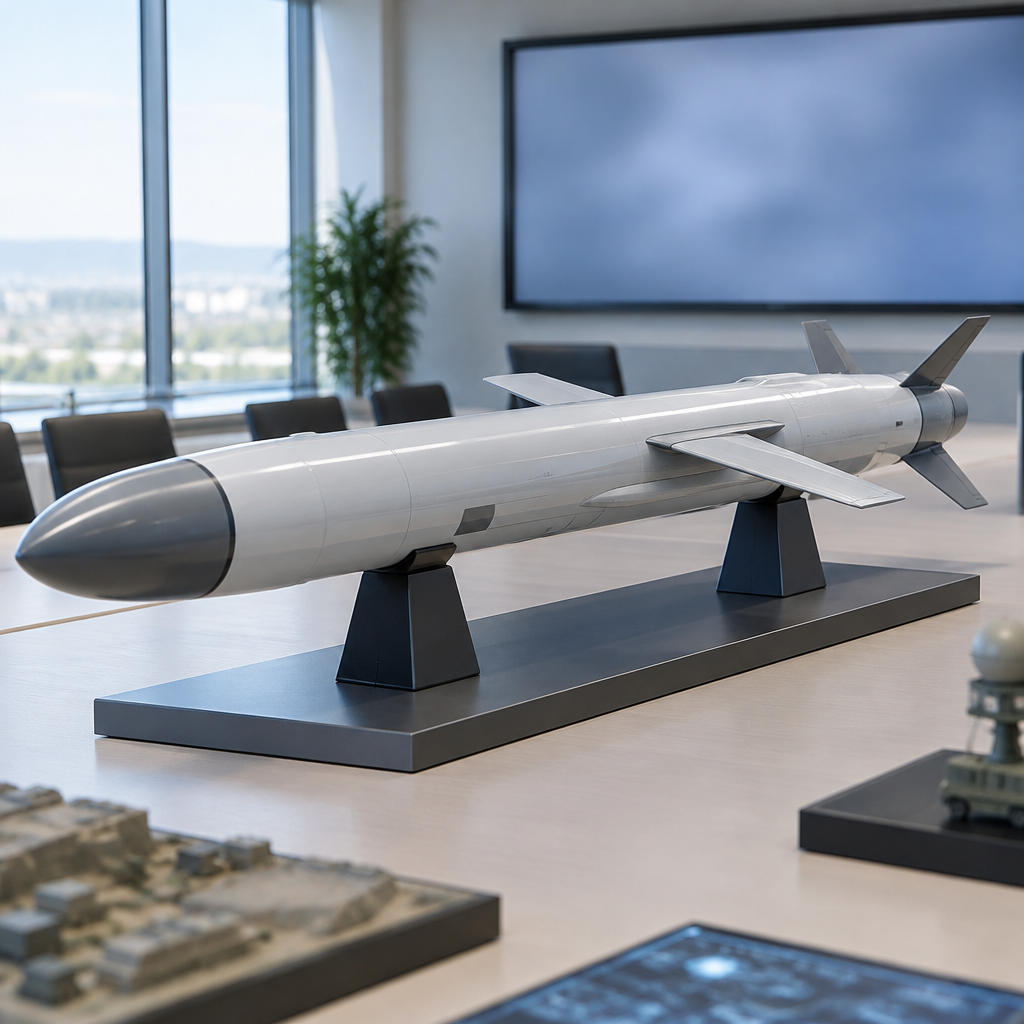
"The best cruise missile of its kind in the world. It offers an ideal solution for long-range stand-off strikes against high-value targets, including air-defense systems," said Yuval Steinitz, Rafael’s chairman, as the company unveiled the new missile it calls Super Ice.
What Rafael presented: a larger, strategic cruise missile
Rafael revealed the Super Ice on November 11, describing it as a new, larger member of its cruise-missile family and labeling the weapon "strategic." The firm said the missile carries a 1,000‑pound warhead and can be launched from air, land or sea. A company-produced video shown to media ahead of the public release depicted Super Ice engaging hardened targets — including a bunker — as well as a ballistic missile launch site and large naval vessels.
Size, lineage and range framing
Rafael positioned Super Ice as noticeably larger than its earlier systems. The company contrasted it with Sea Breaker (introduced in 2021) and Ice Breaker (introduced in 2023), saying Super Ice will have a longer range than those two. Sea Breaker’s published reference point in Rafael materials is roughly a 300‑kilometer range with a 250‑pound warhead; Rafael did not provide a numerical range for Super Ice. Rafael also stated the new missile is comparable in size to the American-made Tomahawk.

Audit-ready is a season. It shouldn't be.
Evidence in spreadsheets, controls drifting between audits, frameworks multiplying on flat headcount. Nubivance runs continuous compliance on Rapid7 Cyber GRC - SOC 2, HIPAA, ISO 27001, PCI, CMMC.
End the scrambleGuidance, survivability and performance claims
According to Rafael, Super Ice includes artificial-intelligence capabilities, high‑accuracy image‑matching technology, low‑observable features, and the ability to navigate at low altitude. The company described the missile as able to contend with electronic-warfare challenges and to operate in GNSS‑denied environments, while flying at a high sub‑sonic speed. Rafael characterized Super Ice as a "fifth‑generation cruise missile characterized by its extended range and exceptional accuracy."
Compatibility with platforms and logistics
Rafael stated Super Ice is "MK83 compatible," which the company said would indicate launchability from platforms that use the MK83 bomb — specifically naming F‑15s, F‑16s, Tornados or Typhoon aircraft in its release. Rafael also said the missile is comparable with existing launch systems for Sea and Ice Breaker weapons and emphasized a "common architecture" to enable customers to expand operational capabilities while leveraging existing infrastructure and achieving more efficient life‑cycle cost (LCC) management.
Market context and Rafael’s production claims
Rafael placed the announcement against a wider market described as growing, with newer firms such as Covenant and Anduril introducing competing designs while established suppliers expand production. In its presentation, Rafael highlighted commercial success for its cruise‑missile family: the company said it hit $1 billion in orders for those weapons in 2023 and had sold more than 1,000 units by 2024. Rafael also noted its broader missile portfolio, including Python and Derby air‑to‑air missiles, the Spike family of ground‑launched smaller missiles, the larger Popeye air‑to‑ground missile, the Spice family of air‑to‑ground systems, and the large Sparrow target missile.
How air forces, navies, and procurement leaders may react
- Air forces: The MK83 compatibility claim — and the specific mention of F‑15s, F‑16s, Tornados and Typhoon aircraft — gives air arms a clear technical cue to assess whether Super Ice could integrate with existing strike fleets and ordnance handling. They will also note the larger 1,000‑pound warhead and Rafael’s assertion of extended range when weighing mission roles.
- Navies: Rafael’s video imagery and the stated ability to attack large naval vessels will draw naval attention to maritime strike options and to the missile’s low‑altitude, low‑observable and EW‑resilient navigation claims.
- Procurement leaders: Rafael’s emphasis on a common architecture for Sea, Ice and Super Ice, plus the company’s LCC argument, frames procurement decisions around reuse of existing infrastructure and potential cost savings across lifecycle management.
Rafael’s public materials and executive remarks frame Super Ice as both a technological step up and a commercially minded product: larger, longer‑ranged than prior family members, MK83‑compatible, and offered with an emphasis on commonality and lifecycle cost. The company did not confirm whether the system is operational, and Rafael did not respond by press time to that specific question. The announcement leaves two concrete facts at its center — a 1,000‑pound warhead and claims of extended range and advanced guidance — and positions Super Ice as a new option for customers seeking stand‑off strike against hardened and high‑value targets.