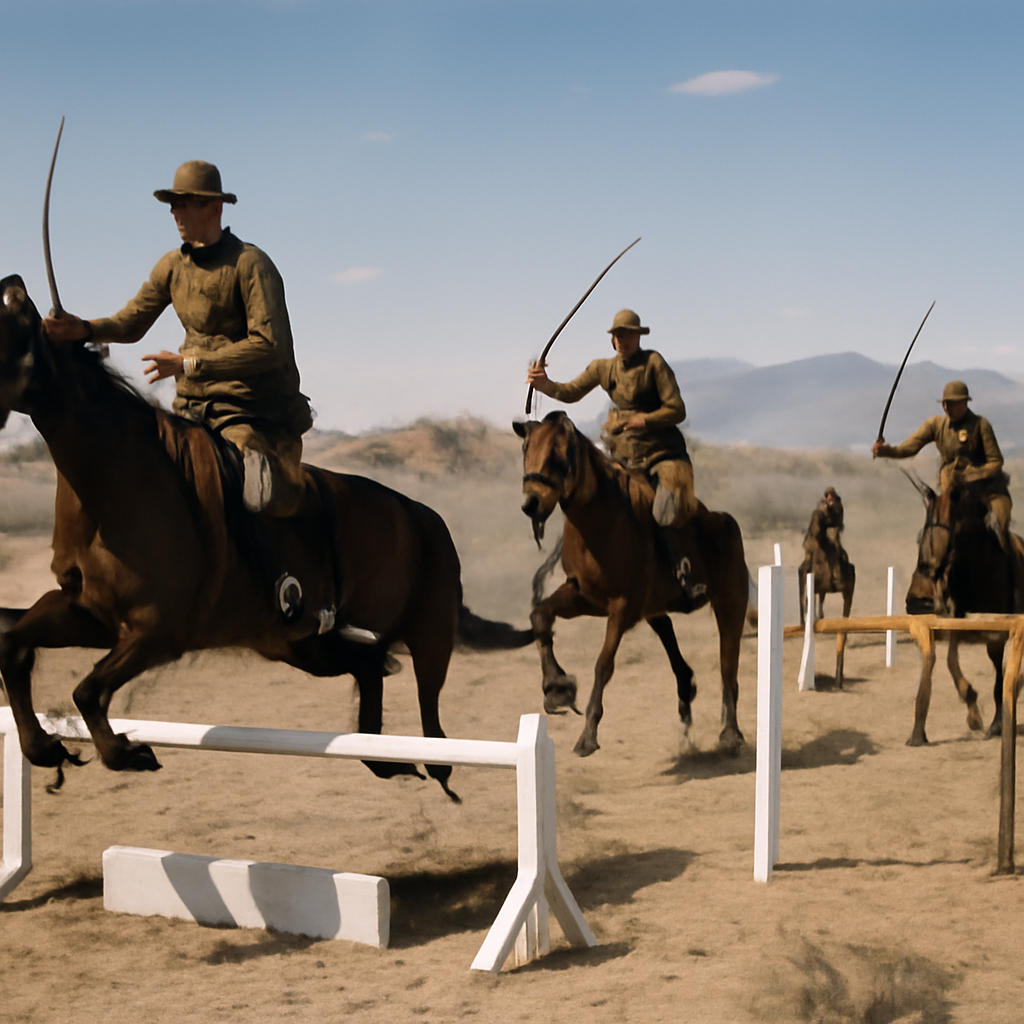
Around one hundred troopers participated in the Xinjiang Military Command’s inaugural cavalry training course, the post reports — a compact cohort testing mounted saber combat and obstacle jumping under a banner that insists the PLA remains a cavalry force.
Xinjiang Military Command cavalry training
The blog reports that the Xinjiang Military Command “concluded its inaugural cavalry training course” with roughly one hundred troopers undergoing “intensive drills tailored for border control missions.” The published imagery accompanying the announcement, according to the post, shows mounted saber drills and obstacle‑jumping exercises — the activities named in the official press release.
Equipment shortfalls: armor, weapons, and communications
What the release does not show, the author argues, is protective equipment or a wider weapon mix. The published photos, the post says, display virtually no armor protection: “no sign of chainmail, scale armor, lamellar armor, or even the sort of improvised protection” visible. The main armament in the images appears to be a saber; bows, lances, shields, or heavy mail are not apparent. Earlier posts collected in the same feed reiterate similar concerns: a PLA light cavalry photographed in October 2024 is described as carrying only a saber and a composite bow, “with neither shield or lance to be found,” and lacking squadron‑level two‑way communications such as Ram Horn.

This site is the portfolio.
OSINTSights runs on Cloudflare Workers, D1, R2, and Vectorize, with an AI pipeline on Hetzner ARM. Nubivance designed, built, and operates it. We do the same for clients.
See what we buildCombat implications against mounted opponents and institutional experience
The post draws direct tactical comparisons. Without bows the author contends these cavalrymen would be “badly outranged” by traditional Mongol horse archers; the critique extends to Russian‑style steppe cavalry and to European heavy cavalry such as the Polish Winged Hussars. The piece also invokes a deliberately theatrical “nightmare scenario”: contact with the Rohirrim. On institutional depth, the blog repeats a widely voiced criticism among professional PLA watchers: the PLA “has not conducted a truly significant cavalry charge in roughly two centuries,” with the last comparable operations traced back to the Qing era. That historical gap, the author argues, leaves the force “untested” in large‑scale mounted warfare and dependent on exercises, presentations, and training drills rather than operational experience.
Doctrine cross‑pollination: phalanx, heavy infantry, and the Mandarin Duck Formation
The entry places the cavalry discussion alongside other recent doctrinal moves. Earlier posts cited in the same feed document a PLA shift toward heavy shield units and “long‑pike, tight phalanx‑style formations,” noting newly standardized armor and additional leg and elbow protection for frontier defense heavy infantry. Separately, the blog reports internal advocacy for adapting historic close‑quarters squads — Qi Jiguang’s 12‑man Mandarin Duck Formation — to maritime boarding work for the China Coast Guard. The July 2026 imagery the post links to shows China Coast Guard personnel confronting Philippine Navy sailors at Second Thomas Shoal; the author frames the Mandarin Duck idea as a compact, disciplined boarding team suited to deck‑level confrontations rather than a nostalgic curiosity.
What this means for the Xinjiang Military Command, PLA cavalry units, and the China Coast Guard
- Xinjiang Military Command: The training demonstrates a declared intent to preserve mounted capability, but the photos highlighted in the post suggest the command will be scrutinized for force protection and equipment choices if cavalry are expected to operate against archers or well‑armored opponents.
- PLA cavalry units and planners: The blog’s account underscores a broader institutional gap in large‑scale mounted warfare experience; the author and cited analysts suggest that doctrine, equipment, and communications systems would need substantive modernization before such units could be expected to succeed against historically proven mounted threats.
- China Coast Guard: The post’s advocacy for adopting Mandarin Duck‑style boarding teams signals a parallel debate about tailoring historical close‑quarters tactics to modern maritime boarding operations — an issue the blog ties directly to recent South China Sea incidents such as the Second Thomas Shoal confrontation.
Until the PLA’s horsemen demonstrate the ability to defeat a mounted archer formation or, to borrow the post’s rhetorical flourish, “an angry king of Rohan shouting 'Death!',” the blog leaves readers with a simple, skeptical judgment: capability claims on cavalry remain open to doubt. The photographs and doctrinal tidbits collected in the feed make clear what the author thinks must change — gear, weapons mix, and experience — before cavalry can be more than a ceremonial or niche capability.