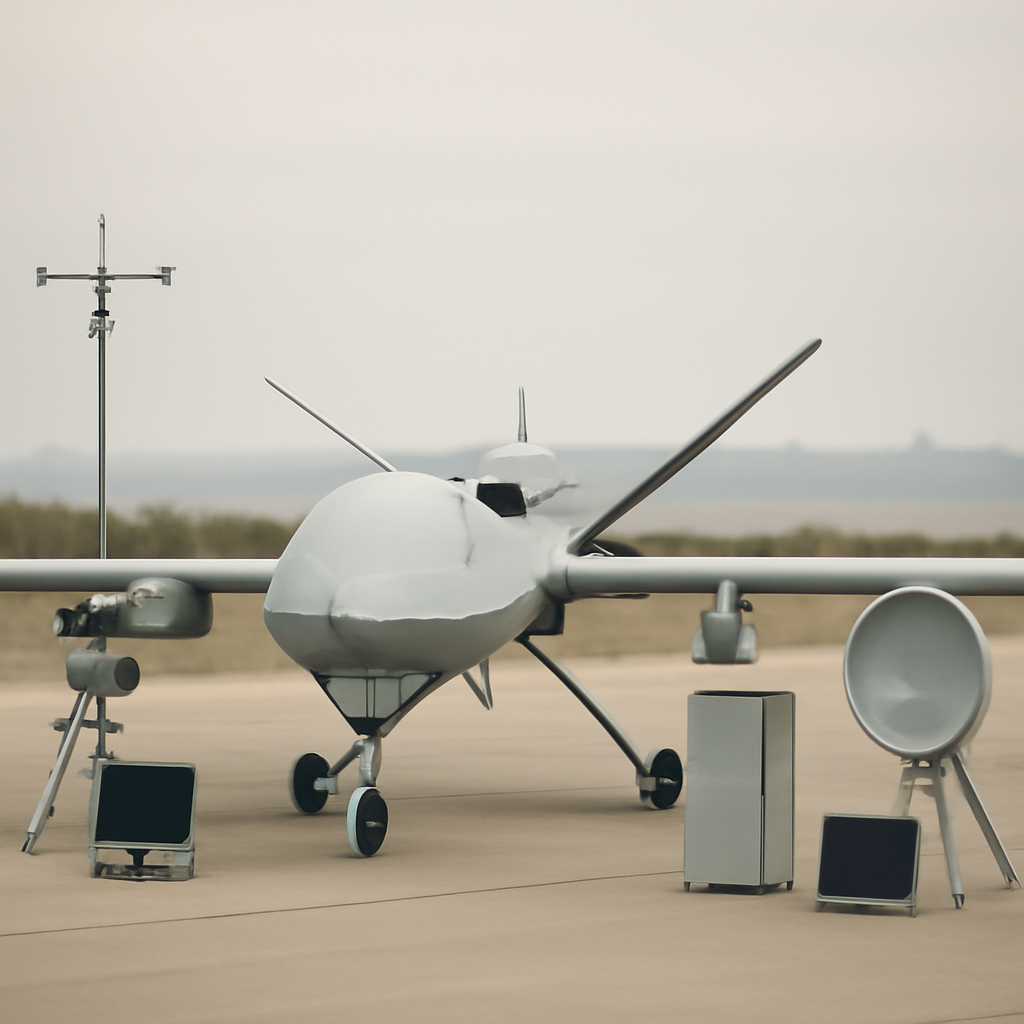
"We felt that was a sweet spot in the market," David Markert said of Ideal Aerosmith's decision to build a one-way attack drone.
Ideal Aerosmith's pivot from test gear to offensive systems
Founded in 1938 and based in North Dakota, Ideal Aerosmith has long operated on the margins of defense contracting. The company, which in recent years made test equipment for navigation systems, described its modern posture as "defense adjacent," David Markert, Ideal's senior vice president and general manager of government systems, told Breaking Defense in an Oct. 2 interview. About three years ago, Markert said, the firm deliberately shifted to pursue military customers directly and selected a low-cost, one-way attack drone as its first in-house system.
Troublemaker: dimensions, performance, and design choices
Ideal Aerosmith publicly unveiled the drone, dubbed Troublemaker, on Thursday as a chief platform to market to prospective customers. The company classifies Troublemaker as a Group 3 system with a 15-foot wingspan. According to company statements, the drone can be launched from a catapult or a truck, operate in swarms, fly over 750 nautical miles (863 miles), sustain endurance exceeding 10 hours, and carry a 30-pound payload for missions ranging from attack to reconnaissance.
Markert emphasized a set of design choices that the company believes separate Troublemaker from low-cost cruise missiles and other strike options. Unlike a cruise missile, the drone can be recovered via a skid landing and thus can be reused; that post-flight option, he argued, is a meaningful point of differentiation. Troublemaker's ability to launch without ship-based or aircraft platforms was also presented as a deliberate market decision.

Audit-ready is a season. It shouldn't be.
Evidence in spreadsheets, controls drifting between audits, frameworks multiplying on flat headcount. Nubivance runs continuous compliance on Rapid7 Cyber GRC - SOC 2, HIPAA, ISO 27001, PCI, CMMC.
End the scrambleProduction rate, inventory, and contract posture
Ideal is entering low-rate production for Troublemaker, Markert said. To date the company has built 26 Troublemakers and is manufacturing at a rate of two per week. He added that, with sufficient demand, the firm could scale production to as many as 20 Troublemakers weekly using existing infrastructure. When asked about contracts, Markert said the company has a "Department of the Navy sponsor" for the system.
Beyond Troublemaker, Markert said Ideal is working on additional systems with greater range and payload capacity, indicating the firm intends to broaden its product line if market conditions and funding permit.
Continuing resolution and near-term funding constraints
Ideal's plans face a fiscal constraint the company flagged directly: a continuing resolution (CR) that began Oct. 1. The CR freezes new-start programs and holds funding at prior-year levels, a condition Markert described as having tangible effects on the company's solicitations and near-term opportunities. "Clearly, the CR has impact," he said. Ideal has entered relevant solicitations but is awaiting clarity about how those bids will fare under the constrained funding posture; as Markert put it, "we're kind of keeping our fingers crossed and holding our breath that this stuff was funded under the [fiscal 2026] budget."
What this means for technologists, the Department of the Navy, and procurement leaders
- Technologists and systems engineers: Troublemaker's stated mix of range, endurance, reusable recovery via skid landing, and 30-pound payload will attract attention from teams focused on integrating sensors and modular munitions that fit Group 3 launch and recovery profiles.
- The Department of the Navy (as sponsor): The designation of a "Department of the Navy sponsor" and the firm's stated low-rate production indicate a pathway for experimentation or limited fielding — but that pathway is subject to the constraints of the CR and the fiscal 2026 budget outcomes.
- Procurement leaders and program offices: The company's ability to scale from two to 20 units per week "within existing infrastructure" makes Troublemaker a potential fit for buyers looking for rapid, low-cost massing. At the same time, the freeze on new-start programs under the CR complicates near-term acquisition choices.
Troublemaker is, by Ideal Aerosmith's account, both a product and a strategic statement: a small firm's deliberate entry into a crowded market by emphasizing recoverability, low launch infrastructure needs, and a production profile that can scale if demand — and funding — align. The company's immediate prospects now hinge on whether solicitations it has entered move forward under current budget rules and how much demand materializes for its 26 units already built and the expanded manufacturing cadence the firm says it can achieve.
Original story: https://breakingdefense.com/2026/10/ideal-aerosmith-debuts-troublemaker-for-one-way-attack/