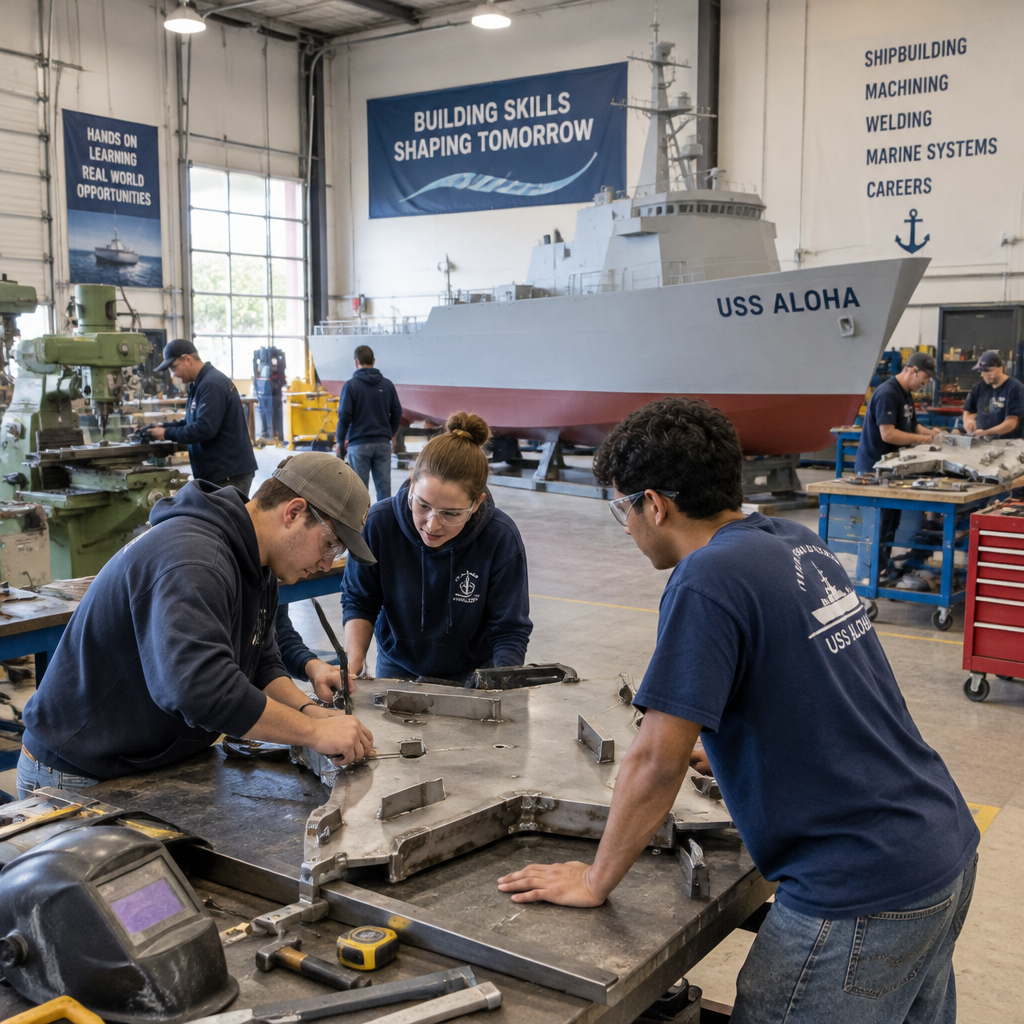
"Our shop here is, in my professional opinion, one of the most advanced and well-rounded…training facilities out there, hands down," said master instructor Jake LaBonte, describing a Pentagon-funded machining and shipbuilding training program in Honolulu.
Honolulu Community College, IBAS, Ku’i Hao, and BG Workforce
The program is a collaboration between Honolulu Community College, the Pentagon’s Industrial Base Analysis and Sustainment (IBAS) program, and a Hawaii-wide workforce initiative called Ku’i Hao, with training delivered by BG Workforce. IBAS invested $7 million in the project, establishing a locally based training pipeline intended to grow shipbuilding and defense manufacturing capability in the Pacific.
Hands-on curriculum and the model "USS Aloha"
Inside a warehouse less than 10 miles from Pearl Harbor Naval Shipyard, students move from blueprint reading to operating manual and automated machines. At course end they build parts and assemble a model submarine, the "USS Aloha," to demonstrate full-process mastery. The first cohort arrived in August 2025; cohorts are limited to eight students each and include military members, local students, and people already employed by local companies. Two of the current students are trainers at Pearl Harbor Naval Shipyard.
In response to local feedback, instructors substantially revised the curriculum between the first and second cohorts. Where the initial plan relied on about 80 percent classroom time, the rewritten curriculum places students in the shop for about 80 percent of their time. Students start with machining fundamentals, may take machining with automated machines, and can progress into shorter bootcamp-style courses for specific skills, program staff said.

This site is the portfolio.
OSINTSights runs on Cloudflare Workers, D1, R2, and Vectorize, with an AI pipeline on Hetzner ARM. Nubivance designed, built, and operates it. We do the same for clients.
See what we buildReverse-engineering parts, time saved, and dramatic cost reductions
The facility has already produced tangible logistics wins. BG Workforce’s chief operating officer, Kevin Beamish, described an island unit that faced replacement parts priced at $42,000 each and a two- to three-year wait if ordered from the mainland. Program instructors reverse-engineered the parts, produced prototypes for the unit’s engineer to quality, and then integrated those parts into the machining curriculum. Students now manufacture the commonly failing replacement parts locally, creating an on-island stock of spares.
LaBonte noted the local production cost is dramatically lower: the same parts that would cost $42,000 from the mainland can be produced on Oahu for about $100 or $200 each, according to the program's account of the work.
Connections to Pearl Harbor needs and expeditionary manufacturing
Program leaders framed the effort as a response to projected hiring and sustainment needs at Pearl Harbor. "We understand that Pearl Harbor is looking to hire thousands of employees over the coming years," Beamish said, arguing that individual local employers cannot meet that scale of training demand. He added that the Pentagon’s investment allows growth of the ship repair and manufacturing base to "support the force here."
BG Workforce is also the implementing contractor for The Forge, described in program materials as U.S. Pacific Command’s expeditionary foundry on Oahu. On the program’s proximity to operations, Beamish quoted Adm. [Sam] Paparo: "It’s got to be closer to the fight, I think is what Adm. [Sam] Paparo would say," referring to the PACOM commander.
What this means for military units, local companies, and trainees
- Military units: Faster access to locally produced replacement parts and reduced downtime for assets, through on-island reverse-engineering and production integrated into training.
- Local companies: Access to a pipeline of workers with hands-on machining skills that local in-house training capacity could not match, addressing an anticipated surge in hiring at Pearl Harbor.
- Trainees: A curriculum reoriented toward shop time and practical outcomes—progressing from fundamentals to automated machining and bootcamp modules—offers direct pathways into shipyard work and related manufacturing roles.
The program has drawn attention in Washington. In September, Assistant Defense Secretary for Industrial Base Policy Mike Cadenazzi highlighted the initiative during a House Appropriations Committee hearing, saying the training capacity "has not existed in Hawaii since the 1970s." He framed the approach as community-centered: "We feel our workforce programs are best structured as tied directly to the needs of the community," adding that the programs are "definitely localized and tailored….We’re really thrilled wherever we can do it."
The Honolulu Community College initiative presents a compact, funded experiment in relocating parts of the defense manufacturing pipeline to the islands: a $7 million IBAS investment; small, repeatable cohorts; hands-on machining tied to real unit needs; and already demonstrable cost and time savings for at least one unit. Whether the model scales to meet the "thousands" of hires Beamish referenced—by expanding cohort size, adding instructors, or replicating foundry-style operations—remains the practical challenge the program's architects will have to solve next.