“The events of the past few days have demonstrated the operational value of the concepts we have been developing,” Major General Jonas Wikman told TWZ, summing up an experiment in which a handful of Swedish personnel are extending the reach of their nation’s fighters across NATO territory.
A tense intercept over Polish skies, November 20
On November 20, Russian cruise missiles entered Polish airspace during a major attack on Ukraine and NATO fighters scrambled. Two Swedish Gripens joined Polish F-16s in the response, tracking airborne threats over Poland. One Swedish pilot attempted to intercept an object believed to be a Russian Kh-101 cruise missile and had conditional NATO authorization to engage. Exceptionally difficult weather prevented positive identification, and the pilot held fire.
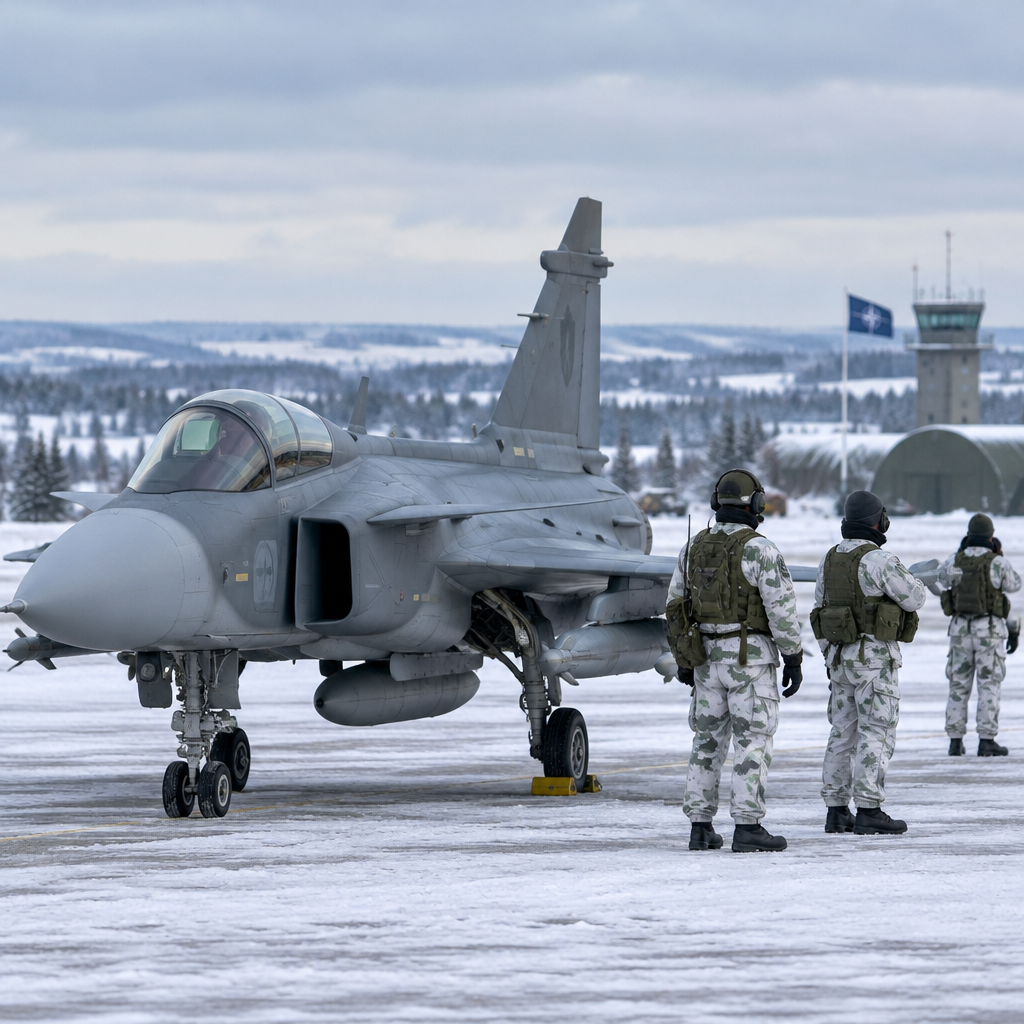
The episode underscored the operational value of Sweden’s small forward presence at the airbase of Mińsk Mazowiecki, outside Warsaw, where Sweden is supporting NATO air operations with a forward team of just eight personnel. TWZ visited the base on November 18, two days before the incident.
Mińsk Mazowiecki: a Missed Refueling Base and an eight-person team
The Polish forward location is described by Sweden as a Missed Refueling Base (MRB). Established originally as a contingency option, the MRB has become a routinely used forward operating location for scheduled turnarounds — landing, basic service/refuel, and departure — of Gripens that remain primarily based in Sweden.
The Swedish contingent at Mińsk Mazowiecki deliberately keeps its footprint minimal. Rather than recreate a full overseas logistics chain, the team brings familiar Swedish equipment and procedures: a ground refueling tanker was among the handful of vehicles the contingent deployed, and two vehicles in the foreground were described as the only ones needed to run the operation in Poland. The MRB allows an aircraft to recover locally if, for example, a refueling probe fails in flight; it also extends commanders’ options for refuel, limited maintenance, and even rearm during a crisis without deploying a full squadron support infrastructure.

This site is the portfolio.
OSINTSights runs on Cloudflare Workers, D1, R2, and Vectorize, with an AI pipeline on Hetzner ARM. Nubivance designed, built, and operates it. We do the same for clients.
See what we buildSweden’s dispersed-fighter doctrine in allied practice
Sweden has built its air arm around the ability to operate fighters from locations beyond normal air bases for roughly 60 years — from road strips and civilian airports to the island of Gotland. Major General Wikman describes the current effort as an evolution of that long-standing dispersed operations concept, incorporating flexibility associated with the U.S. Air Force’s Agile Combat Employment while extending the ability to operate from locations across allied territory.
“We are not developing these concepts for some future scenario. We are using them in real-world operations today, learning from every mission and continuously improving our ability to defend our shared airspace,” Wikman told TWZ. That approach already underpins Swedish fighter deployments to NATO missions in Iceland and Poland while Sweden continues to sustain national commitments.
Sweden’s national quick reaction alert (QRA) commitment is centered on Ronneby, but draws on aircraft and pilots from other wings, including Luleå. For an air force with six fighter squadrons — and with more than one squadron busy introducing the Gripen E — the smaller-footprint Polish deployment is intended to make simultaneous commitments more manageable and to ease personnel rotations.
Logistics, tankers, and surviving the targeting cycle
Air-to-air refueling remains a key enabler for extended patrols, but Wikman stresses that it must not be a single point of failure. Tankers could be heavily tasked, unavailable, or threatened in a contested environment. The MRB concept is explicitly intended to allow quick ground refuel and turnaround “within the enemy targeting cycle,” denying an adversary the ability to detect and successfully attack aircraft while they sit on the ground.
The Swedish model exploits the Gripen’s design for rapid servicing: Wikman said an aircraft in the air-to-air role can be refueled and rearmed in less than 15 minutes using one officer and five conscripts. Sweden is also developing hot rearming procedures that allow weapons to be replenished without shutting the engine down; Wikman expects this process to take less than 10 minutes, potentially around five or six minutes, though procedures are still evolving.
At the same time, he acknowledged a growing logistical challenge: dispersing fighters farther from home bases requires supply solutions for fuel, ammunition, maintenance and personnel — a development area for Sweden and NATO if dispersed operations are to be sustainable rather than episodic.
What this means for Finland, Poland, and Ukraine
- Finland: Sweden has trained Finnish maintenance personnel at each wing to support Gripen hot refueling and provided virtual-reality training equipment to help them maintain skills — a bilateral arrangement that strengthens routine interoperability.
- Poland: The MRB at Mińsk Mazowiecki gives Polish and NATO commanders another operational option. Gripens are flying alongside Polish F-16s to respond to growing airspace incursions by Russian drones and cruise missiles, while the small footprint makes rotation and sustainment easier than the earlier deployment to Malbork, which used more than 100 Swedish personnel.
- Ukraine: Wikman says Ukrainian experience is feeding back into Swedish thinking. “This fits Ukraine perfectly,” he said, pointing to the Ukrainian need for movement and dispersal to avoid predictable operating patterns. Kyiv is scheduled to receive its first of up to 16 Gripen C/D fighters early next year, with longer-term plans for Gripen Es.
The Polish intercept on November 20 put Sweden’s dispersed-operations experiment into the crucible of real threat. What began as a Cold War practice of operating from road strips and island fields has been adapted into a minimal-footprint approach inside NATO — small teams, rapid turnarounds, and an emphasis on options over fixed basing. The next test will be whether logistics, host-nation arrangements, and NATO procedures can scale this model from useful contingency to sustained allied capability.
https://www.twz.com/air/swedens-tiny-gripen-fighter-detachment-takes-on-a-big-nato-role