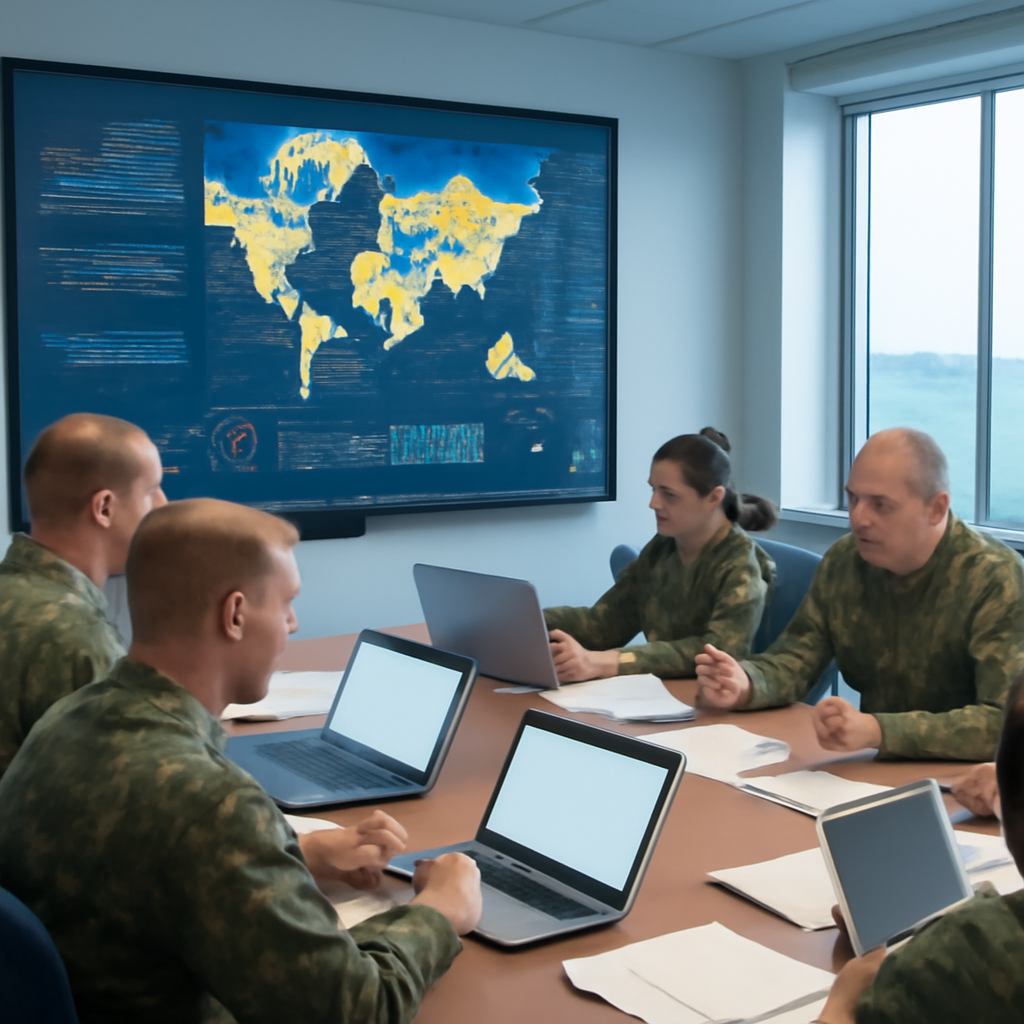
"Basically, we need to make better decisions faster with data," Cameron Stanley said Tuesday at the Billington CyberSecurity Summit in Washington, D.C., summarizing why the Pentagon is leaning on an AI-driven command-and-control system known as Maven Smart System.
Maven Smart System (MSS): from intelligence bridge to department-wide tool
What began as a tool to link intelligence and operations has expanded. According to Stanley, MSS — already used by all U.S. combatant commands for intelligence and operations data analysis — is being pushed into logistics, force readiness, supply chain and budgeting data, plus modeling and simulation to aid decision-making. He described this as a move toward a "horizontal integration" of directorates' data functions and the creation of a "golden thread" of data from sensors through aggregation, visualization, decision-making and action.
Replacing “six, eight, ten” legacy systems and accelerating imagery-to-decision
Stanley said MSS has replaced "six, eight, ten" legacy systems that personnel once used to analyze data. He pointed to a concrete operational effect: commanders who used to wait hours for new satellite imagery now receive images complete with target detection in minutes — a shift that he said forces a rethink of military decision-making processes. The system’s earlier public profile included facilitating strikes "on thousands of targets in lightning-quick succession" in the early days of President Donald Trump’s war with Iran, a moment Stanley referenced as illustrative of operational demands.

This site is the portfolio.
OSINTSights runs on Cloudflare Workers, D1, R2, and Vectorize, with an AI pipeline on Hetzner ARM. Nubivance designed, built, and operates it. We do the same for clients.
See what we buildGenAI.mil and commercial AI models inside government networks
Stanley highlighted GenAI.mil, the Pentagon’s primary portal for AI tools, noting it recently added offerings from OpenAI and xAI alongside Google’s Gemini. He framed the effort as deploying "real, no-kidding frontier AI algorithms, and the full user experience, inside of a government environment." More broadly, he said the department will adopt commercial AI models, use its own data to customize them for DOD use cases, and build bespoke capabilities when necessary. The department is moving toward a "commercial-first" posture: paying licenses instead of owning software and iterating within license periods rather than developing from scratch.
Tradewinds, other transaction authorities, and procurement timelines
On acquisition, Stanley said recent use of other transaction authorities and digital marketplaces has shortened vendor selection from "months to single-digit days" compared with traditional requests for information and proposals. He recommended vendors use Tradewinds, DOD’s digital marketplace, asserting that a five-minute video "satisfies the competitive requirement" and is "way better than writing a bunch of RFIs and RFPs." The department is also piloting AI tools to support drafting and concluding contracts and to offer legal advice, while keeping humans in the loop; Stanley noted that "90%" of the language used in other transaction agreements or Federal Acquisition Regulation-based contracts is standard and amenable to AI-assisted updating.
Authority-to-operate bottlenecks and timelines
Stanley identified interim authority to test and authority to operate on department networks as "one of those clear bottlenecks that are really really hard to get around." He said AI pilot programs are being trialed to speed approval times. He added that the full timeline from a broad agency announcement to authority to operate could be 18 months, and that his office is "progressively looking at every single piece of that schedule."
How Five Eyes, "a few" NATO and Asian allies, and the DOD itself are engaged
- Five Eyes partners: Stanley said the department is actively working with the Five Eyes (the U.S., U.K., Canada, Australia, and New Zealand) to understand allies’ needs and help them avoid mistakes DOD has made.
- NATO and Asian allies: He added that DOD is engaging "a few" NATO and Asian allies on similar issues, extending assistance where resources, experience, or scale differ.
- The department: Stanley emphasized organizational change, arguing that units that integrate AI and alter how they operate — rather than simply automating existing processes — have been most successful. He warned that digitizing older processes and integrating AI into decision-making will be necessary because "the way we've always done it is not the least risky option. The way we've always done it is the most risky course of action."
Stanley framed a clear trajectory: expand MSS across functional lines, host frontier AI within government networks via GenAI.mil, lean on commercial models and marketplaces, and chip away at long approval schedules. He identified specific procurement and authority hurdles and said the office is actively addressing each piece of the schedule — a measure of how the Pentagon intends to stitch AI into day-to-day operations.
Read the original Defense One story: https://www.defenseone.com/technology/2026/09/maven-becoming-pentagons-everything-app/415882/