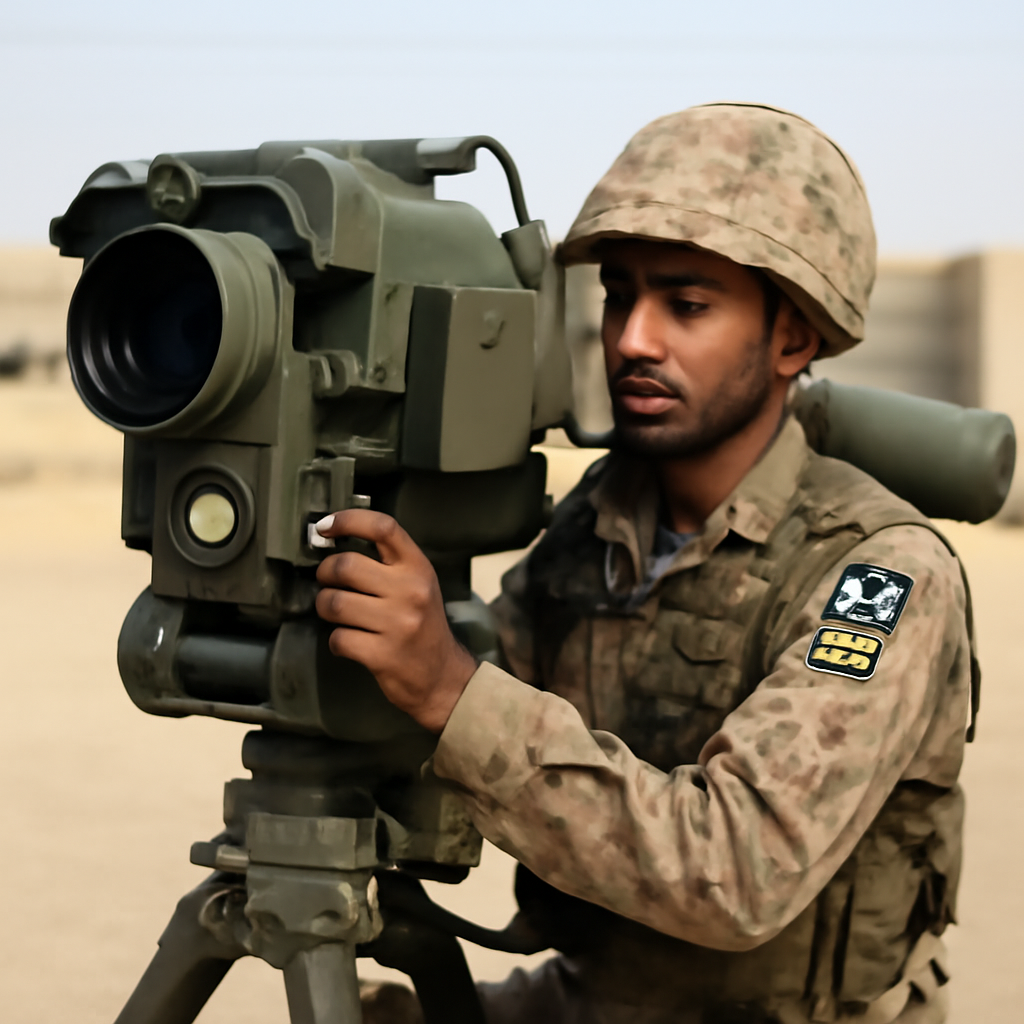
Pakistan’s army operates approximately 200 RBS 70 short-range air-defence systems — a fact that frames a practical dilemma: a countermeasure-resistant missile designed for high-threat manoeuvre formations, deployed in an era when cheap drones and cruise weapons change the economics of air defence.
How the RBS 70’s laser beam-riding guidance shapes tactical trade‑offs
The RBS 70’s defining technical choice is laser beam-riding (SACLOS). The operator tracks the target through the sight unit and fires; the missile “rides” a coded laser beam projected from the sight to the target. That architecture makes the missile virtually immune to infrared countermeasures such as flares and DIRCM — countermeasures that defeat IR-seeking MANPADS. The trade-off is clear in the system’s doctrine: because the operator must maintain the laser on target throughout flight, the shooter remains exposed and salvo rates are limited.
Upgrades change that calculus. The RBS 70 NG, introduced in 2011, adds an integrated thermal imager and automatic target tracking that “automatically maintain[s] the laser on the target after initial acquisition,” cutting operator workload and improving hit probability against faster, more manoeuvring threats.
The Mouz: M113-mounted mobility and concealment
Pakistan’s answer to the need for mobile, formation-level air defence is the Mouz — an M113 APC modified to carry the RBS 70. Saab tested the vehicle-mounted system in March 1988 to meet a Pakistan Army requirement, and the configuration was ready for production in Pakistan by 2002. In Mouz service the launcher is transported folded down so the M113 resembles a standard APC from above and is raised only for engagement, giving armoured formations an organic, VSHORAD-capable system while attempting to limit battlefield detection.
Pakistan also manufactures some RBS 70 components under licence, one of the few examples of Western missile component production in the country’s defence industrial base.

Audit-ready is a season. It shouldn't be.
Evidence in spreadsheets, controls drifting between audits, frameworks multiplying on flat headcount. Nubivance runs continuous compliance on Rapid7 Cyber GRC - SOC 2, HIPAA, ISO 27001, PCI, CMMC.
End the scramblePlacement inside Pakistan’s CLIAD and comparison with Anza MANPADS
Within Pakistan’s Comprehensive Layered Integrated Air Defence (CLIAD) framework, the RBS 70 sits at the VSHORAD tier — the lowest layer — deployed to protect manoeuvre units and armoured brigades against attack helicopters, low‑flying strike aircraft, and tactical UAVs. It operates below the FM‑90 (listed in the source as 15 km range) and alongside Pakistan’s indigenous Anza MANPADS family.
Operational doctrine pairs the two: the Anza (Mk‑I, Mk‑II, Mk‑III) is lighter, shoulder‑fired and uses infrared homing for distributed VSHORAD coverage; the RBS 70 is heavier, tripod- or vehicle-mounted, and used where resistance to IR countermeasures matters — at critical nodes and with armoured strike corps.
Combat record and the Russo‑Ukrainian validation
The RBS 70’s combat history spans three conflicts in the source record: the Iran‑Iraq War, the November 1992 Venezuelan coup attempt (where a Venezuelan Army RBS 70 shot down a rebel OV‑10 Bronco), and extensive use in the Russo‑Ukrainian War. In Ukraine, the system has reportedly been used to shoot down Ka‑52 attack helicopters, Su‑24 and Su‑25 strike aircraft, Mi‑8 helicopters, and various UAVs — a body of use that Quwa cites as validating layered air defence down to the VSHORAD tier.
That battlefield record illustrates both the advantage of countermeasure resistance and the vulnerability born of the SACLOS requirement: the missile itself cannot be spoofed by IR countermeasures, but the operator can be suppressed while exposed.
Upgrade paths and a changing missile landscape
Pakistan’s installed RBS 70 Mk II fleet has clear upgrade options. NG standard (thermal imager and auto‑tracking) would raise hit probability; Saab’s MSHORAD package pairs the RBS 70 NG with the Giraffe 1X radar and an armoured vehicle command-and-control to create a semi‑autonomous, sensor‑cued system. Sweden and Lithuania ordered MSHORAD in 2024; the Czech Republic placed a €170 million order for 24 MSHORAD vehicles in 2025.
Missile evolution continues too: the Bolide missile family (Mach 2) extended range, and the Bolide 2 — launched in May 2026 — is described as designed to counter evolving threats including drones and cruise missiles. The RBS 70 NG with the Bolide missile is given a range of 250 m to 9 km and an altitude ceiling of 5,000 m; earlier Mk‑1/2 variants had ranges around 5–6 km.
But Quwa highlights an economic friction familiar to C‑UAS planners: a 2023 price cited in the source of €3.3 million per unit makes missile-based VSHORAD an expensive option against low-cost drones, creating an unfavourable cost‑exchange that procurement planners must weigh.
What this means for Pakistan’s procurement leaders, mechanised brigades, and aircrews
- Procurement leaders: decide whether to upgrade to NG/MSHORAD and whether Pakistani production lines should expand beyond component manufacture — balancing the improved capability of auto‑tracking and radar integration against cost and platform counts.
- Mechanised brigades (armoured formations): the Mouz offers organic, vehicle‑mounted VSHORAD that conceals its role during movement and can be raised for engagement — a force multiplier if integrated with radar cueing.
- Aircrews and strike planners (adversary forces): aircraft equipped with infrared countermeasure suites will find the RBS 70’s beam‑riding guidance harder to defeat, shifting the tactical considerations for low‑altitude attack profiles.
Pakistan fields one of the larger global fleets of RBS 70 systems; choices now are concrete. Upgrade to NG and MSHORAD would convert a manually aimed, tripod‑based weapon into a radar‑integrated, sensor‑cued system better suited to modern, networked battlefields. Decline to upgrade leaves the army with a highly capable counter‑countermeasure weapon that nonetheless must be used sparingly against massed, low‑cost drone threats. The arrival of the Bolide 2 in May 2026 tightens that choice: it extends the RBS 70’s technical envelope, but not the economics of mass employment.