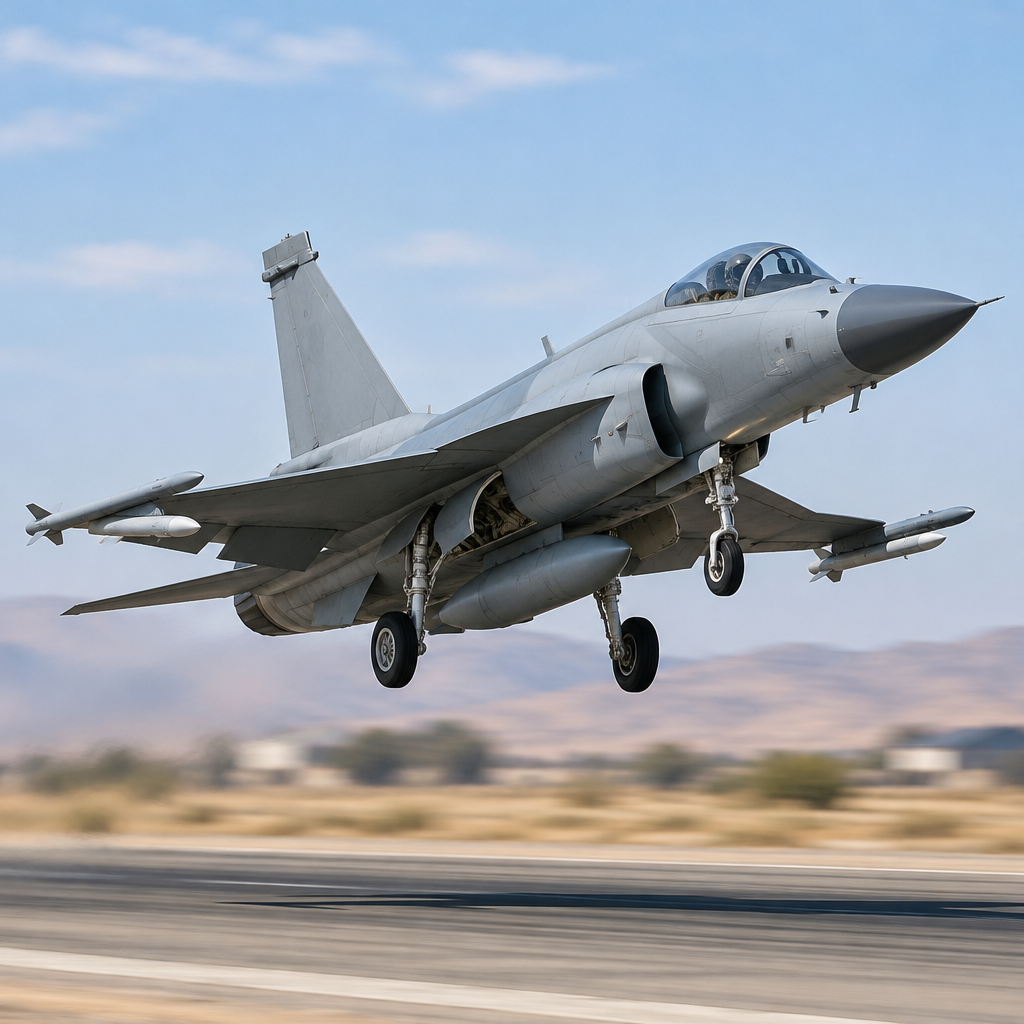
On November 3, Pakistan successfully tested the country’s first indigenously developed air-to-air beyond-visual-range (BVR) missile, Fa’az.
November 3 test: technical profile and immediate claims
The Pakistan Air Force (PAF) launched the Fa’az from a JF-17 combat fighter, presenting what Pakistan’s military media described as an advanced terminal guidance system capable of engaging aerial targets at extended ranges. Imagery and official descriptions indicate the tested variant was the Fa’az-IIR — an imaging infrared seeker version — with a reported top speed of Mach 3.5, a seeker detection range of about 40 km, and an overall operational range of more than 100 km.
The Fa’az-IIR is described as a dual-mode engagement weapon: it depends on the launching aircraft’s fire-control radar for mid-course updates and activates its internal infrared seeker for terminal guidance. That architecture makes the missile different from an active radar-guided BVR missile and, according to the source material, more resistant to electronic jamming in its terminal phase.
How Fa’az fits with Pakistan’s Pl-15E capability
The Fa’az test arrives after a period in which Pakistan has already demonstrated effectiveness with radar-guided BVR weapons. The PAF successfully engaged multiple Indian Air Force (IAF) jets on the night of May 6–7, 2025, using Pl-15E radar-guided BVR missiles, including shooting down a Rafale. The addition of an infrared-guided Fa’az to PAF inventories means Pakistani combat aircraft can field a mix of seeker technologies — radar-guided Pl-15E plus infrared-guided Fa’az — in the same engagement.
From a tactical standpoint, the source argues that forcing an adversary to evade both radar-guided and infrared-guided missiles complicates defensive measures. The source frames that combination as enlarging the PAF’s kill chain and increasing its ability to deter and defeat incoming fighters.

This site is the portfolio.
OSINTSights runs on Cloudflare Workers, D1, R2, and Vectorize, with an AI pipeline on Hetzner ARM. Nubivance designed, built, and operates it. We do the same for clients.
See what we buildCountering India’s Rafales and the CATS Warrior UCAV concept
The Fa’az is tied in the source to two parallel Indian developments. First, India plans to buy 114 additional Rafales valued at $3.24 trillion, likely to the F4 standard — described as more advanced than the F3R currently in service and better able to operate in heavy jamming environments. Second, the IAF is working to operationalize CATS Warrior unmanned combat aerial vehicles (UCAVs) and to integrate them with manned fighters, using manned jets as “mother ships” to control and guide UCAVs to strike targets while reducing exposure of frontline fighters.
The source argues that cheap, indigenous UCAVs deployed in large numbers create a proliferating aerial threat that makes large stockpiles of air-to-air munitions important. For the PAF, homegrown Fa’az production is presented as a path to maintaining the volume of BVR missiles required to counter both manned fighters and massed UCAV employment — an answer, the source says, to high foreign procurement costs and competitive constraints.
From air-to-air to ground-based SAMs: conversion and wider air-defense implications
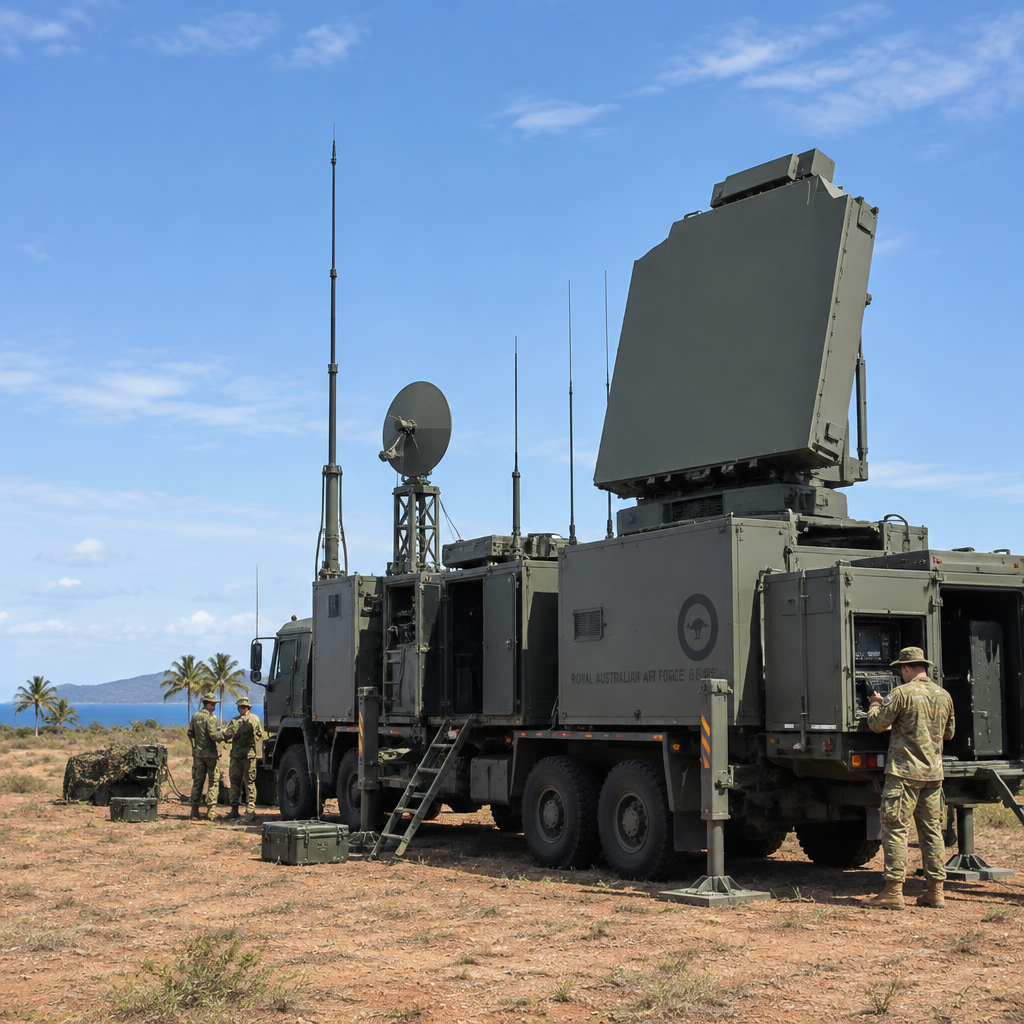
The Fa’az is also presented as a potential building block for Pakistan’s first indigenous mobile medium-range surface-to-air missile (SAM). The source notes that militaries have converted air-to-air missiles to ground-based roles — citing U.S. NASAMS and Indian SAMAR as precedent — and suggests Pakistan “is most probably going to use the Fa’az” for such development.
That shift is framed against a changing battlefield where drones, loitering munitions, and missiles have grown in strike prominence. The Fa’az’s infrared seeker plus mid-course update architecture could, the source contends, be integrated with AWACS or other sensor networks to counter low-observable platforms; the piece points to recent reporting that Iranian ground-based air defenses using infrared search-and-track systems targeted an F-35 of the U.S. air force a few months ago as an instructive parallel.
What this means for Pakistan, India, and regional air-defense planners
- Pakistan (PAF): The Fa’az lets the PAF claim indigenous BVR production, potentially enabling large, locally produced stockpiles of missiles and reducing reliance on expensive foreign procurement. The source frames the missile as part of a PAF policy of “minimalist means” and technological offsets to conventional asymmetry on the eastern border.
- India (IAF): The combination of Pakistan’s Pl-15E and Fa’az presents a dual-threat environment — radar-guided and infrared-guided missiles — that the source says complicates mission planning and defensive options, especially as India fields more Rafales and scales UCAV employment after losses cited during Operation Sindoor.
- Regional air-defense planners: The Fa’az test underscores two trends to watch, per the source — integration of multi-sensor networks (AWACS plus airborne and ground sensors) to cue infrared seekers, and the adaptation of air-to-air weapons into ground-based SAM systems to address the proliferation of drones and loitering munitions.
Taken together, the Fa’az test places Pakistan among a small group of nations claiming indigenous BVR air-to-air capability and signals intent to pair that capability with existing radar-guided missiles and broader air-defense adaptations. Whether the missile will be produced at scale, integrated operationally with the PAF’s sensor and command architecture, or adapted into a fielded medium-range SAM are concrete next steps the source highlights but does not document as complete — making operationalization the clearest question left by the announcement.