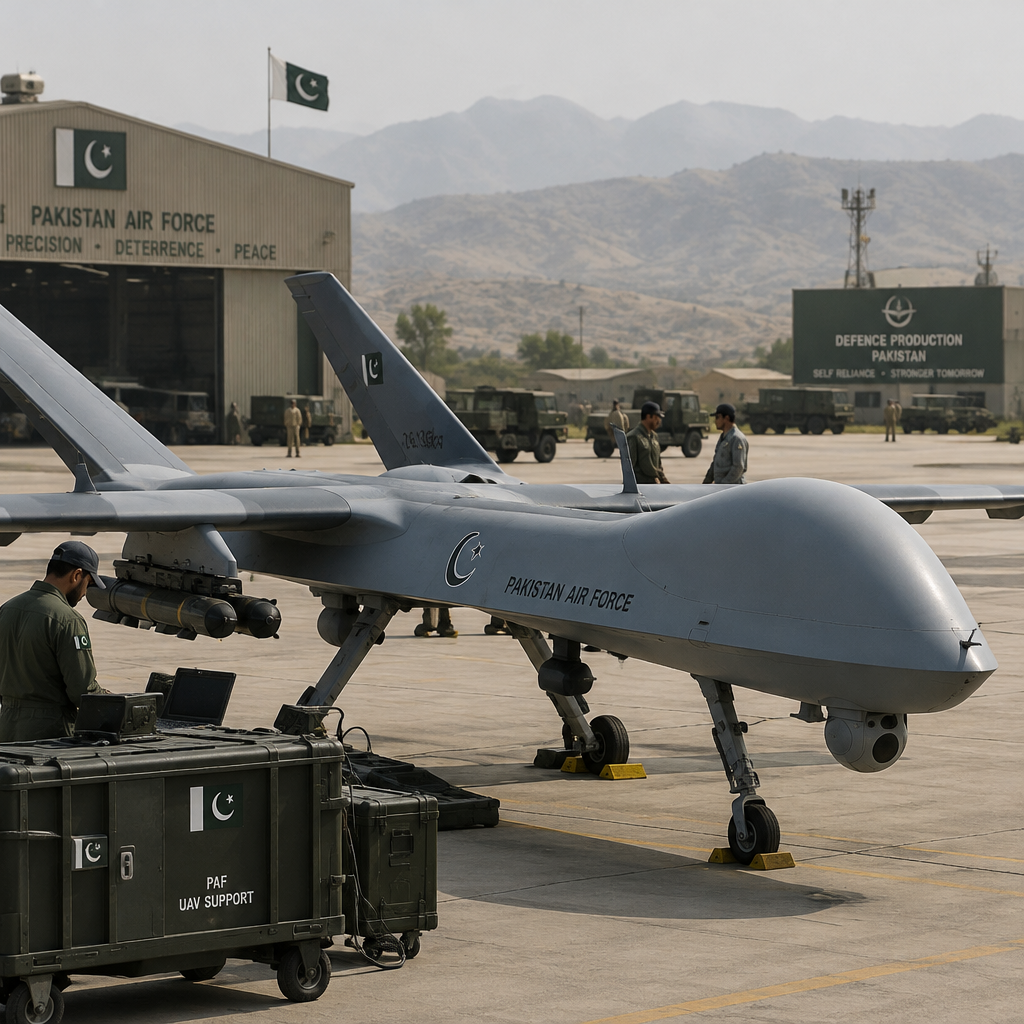
“Pakistan is building the foundations of a conventional strike force capable of operating at greater scale.” That assessment, laid out in a recent industry brief, captures a deliberate shift: Islamabad is investing in the sensors, munitions and, crucially, the platform mix needed to turn precision weapons into a massed, survivable strike capability.
ISTAR buildup: satellites, radars, ESM and drones
The brief documents concrete investments that expand Pakistan’s intelligence, surveillance, target acquisition and reconnaissance (ISTAR) infrastructure. Between January 2025 and April 2026, Pakistan launched PRSC-EO1, EO2 and EO3 optical-imaging satellites. HS-1 provides hyperspectral imaging, while PRSC-S1 is assessed by Quwa to carry synthetic aperture radar (SAR). The paper also notes Pakistan’s planned PIESAT InSAR constellation purchase as a separate radar capability.
Quwa’s overview stresses that these programs “broaden the types of information potentially available to military users,” and it distinguishes the launched systems from the planned PIESAT radar constellation, which “should not be counted as operational capacity.” In short: sensor variety is increasing now, while some promised radar capacity remains a procurement objective rather than fielded capability.
Fatah series and one-way attack drones expand long-range options
On the delivery side, Pakistan is widening its options beyond traditional missiles and manned aircraft. The brief identifies the Fatah-2 and Fatah-4 systems and “a growing range of one-way attack (OWA) drones” as contributors to Pakistan’s long-range, guided-attack toolkit. Those systems change the calculus of how precision effects can be projected over distance without relying solely on repeatable, high-cost platforms.

The cyber insurance questionnaire just landed. Now what?
SOC 2, HIPAA, insurance renewals - someone has to own security strategy. Nubivance provides fractional CISO leadership without the full-time salary.
Get a security leadPlatform distribution after India’s strikes on PAF bases
The report links operational risk directly to platform availability: producing more missiles increases firepower, “but their availability still depends on the platforms that carry them.” It cites India’s missile strikes on various Pakistan Air Force (PAF) bases as evidence that concentrating weapons on particular airbases, aircraft or specialized launch vehicles leaves the wider force exposed.
That exposure, the brief argues, “adds urgency to the idea of distributing the availability of new strike platforms to not only the other service arms, but likely simpler and lower-cost systems.” The central problem is not only how many munitions exist, but how many viable, survivable launch options remain after an adversary targets a subset of bases or platforms.
Economic logic: low-cost platforms to connect mass and survivability
The paper lays out a clear twofold progression Pakistan is likely to follow. First, broaden the platform mix supporting the strike inventory. Second, develop future munitions “with that wider deployment concept in mind.” The intended outcome is explicit: connect affordable mass to survivability. More weapons increase precision-strike volume; more launch options make it much harder for an adversary to suppress that volume.
Put another way, the brief frames survivability as a distribution problem solvable in part by lowering the per-shot logistics and platform cost so weapons can be fielded across a wider array of systems and locations — from other service arms to simpler launch architectures.
What this means for Pakistan military planners, procurement leaders, and India
- Pakistan military planners: The brief suggests planners will prioritize dispersal of strike capability across services and simpler platforms to reduce single-point exposure revealed by strikes on PAF bases. That requires operational concepts that assume launch options are distributed rather than concentrated.
- Procurement and industry leaders: The analysis implies demand for lower-cost platforms and munitions designed for wide deployment, alongside continued investment in sensors (optical, hyperspectral and SAR) to support target acquisition at scale.
- India as an adversary: The report notes that previous strikes on PAF bases “exposed this risk,” and that a distributed, low-cost platform mix would make it more difficult for adversaries to suppress Pakistan’s precision-strike volume going forward.
The brief lays out a pragmatic, technical pathway: build the sensors to see more targets, expand the range of delivery options, and align munitions design with a dispersed deployment concept so quantity and survivability reinforce one another. The important unanswered, operational questions — how quickly PIESAT becomes operational, how fast low-cost platforms can be produced, and how doctrine will change across services — are left implicit in that progression. But the arithmetic Quwa presents is plain: without broader launch options, more missiles alone will remain vulnerable; with them, affordable mass becomes a strategic lever.