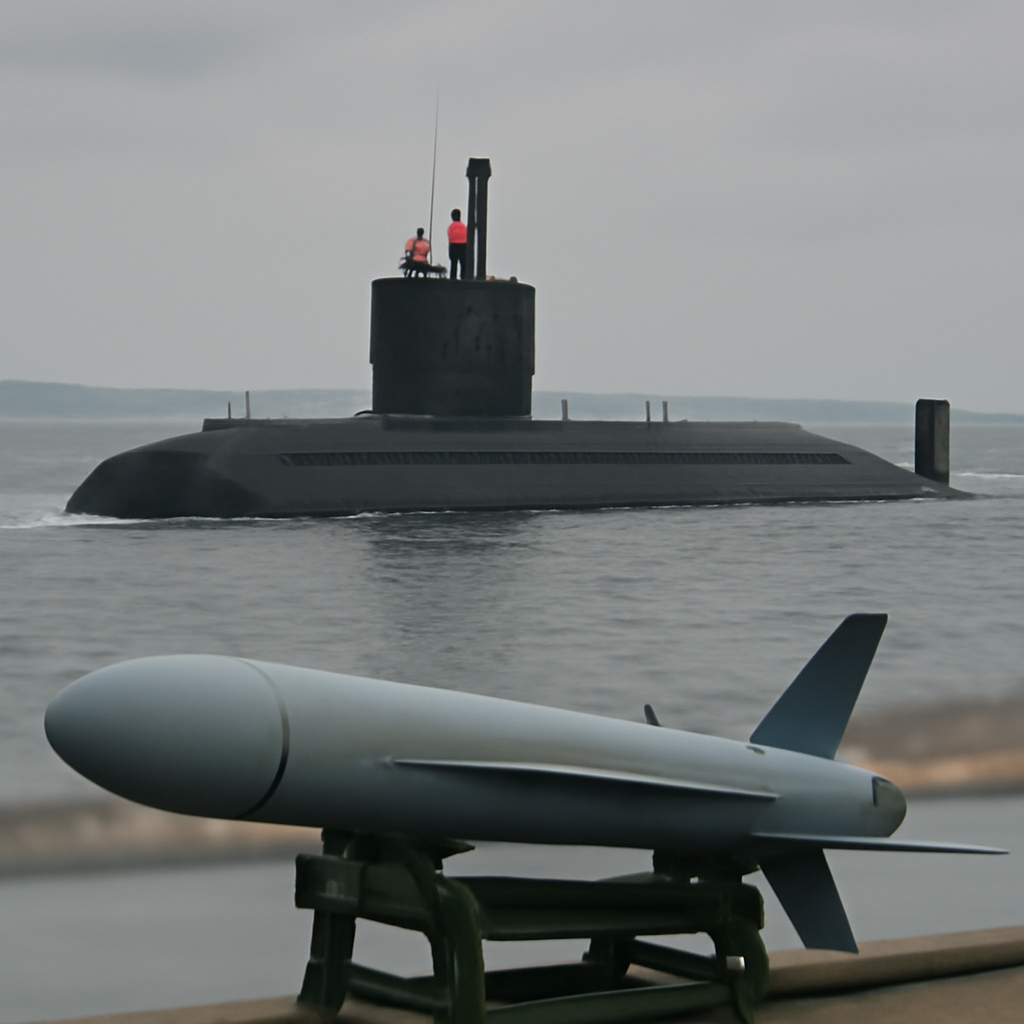
"Pakistan would “gain expertise in advanced submarine design, construction techniques, systems integration and quality control processes,” Admiral Naveed Ashraf told Asian Defence Journal.
Admiral Naveed Ashraf and the Pakistan Navy's stated endgame
The Chief of Naval Staff made explicit what the Pakistan Navy (PN) has been quietly working toward: once the Hangor-class (S26) boats are inducted, the PN intends to design an original submarine. Admiral Naveed Ashraf framed the effort as the logical terminus of a longer vision to become a “submarine-building navy,” putting an original, domestically led design at the end of a multi-stage process rather than the start.
The CNS also left the technical choice clear: the future boat is to be a conventional submarine rather than a nuclear one. The class it is intended to succeed is the Khalid-class (Agosta 90B), whose manufacturer support from Naval Group (formerly DCNS) is already thinning — a long-term sustainment concern that helps explain the drive to domestic design and repair capacity.
KSEW, the Syncrolift, and building a production line
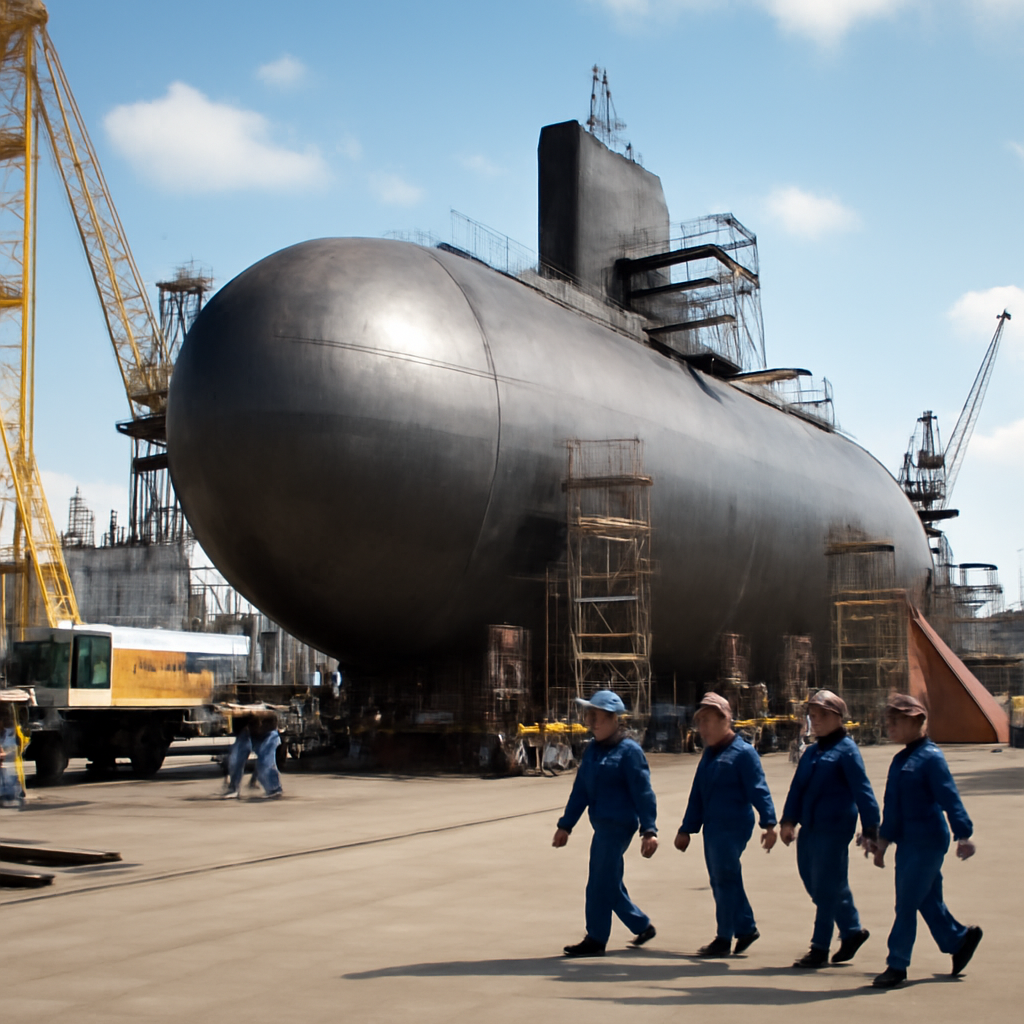
Central to the PN’s plan is Karachi Shipyard & Engineering Works (KSEW). With Chinese assistance the Hangor programme moved construction away from the cramped naval dockyard and into KSEW, which in 2017 acquired a Syncrolift from Norway’s TTS Group configured to feed 13 inland workstations. That arrangement allows hulls to be assembled on land and launched only for trials, removing coastal bottlenecks and exposing fewer working faces to weather and security constraints.
That same inland infrastructure already serves surface construction — a Babur-class (MILGEM) corvette occupied one of the stations — and the PN is using the model to stand up both production throughput and the maintenance, repair and overhaul (MRO) capacity submarines demand. The Hangor programme, therefore, is as much an industrial campaign as it is a class acquisition: it builds supply-chain sequencing, production skills, and the domestic means to keep boats operational.

This site is the portfolio.
OSINTSights runs on Cloudflare Workers, D1, R2, and Vectorize, with an AI pipeline on Hetzner ARM. Nubivance designed, built, and operates it. We do the same for clients.
See what we buildSize, stealth, and the technical contours of an original design
Based on how the PN’s requirement has developed, the original design is likely to be smaller than the Hangor and closer to the Agosta 90B’s 1,700–2,000-ton displacement — a compact, stealth-focused hull optimized for anti-ship and anti-submarine work in a near-littoral, anti-access/area-denial (A2/AD) role rather than long-range blue-water patrols.
Stealth priorities are explicit. The PN appears to favour acoustic quieting, and the source material names likely subsystem choices: a fuel-cell air-independent propulsion (AIP) architecture as the quietest plausible option (contrasted with the Hangor’s Stirling AIP and the Agosta 90B’s MESMA), lithium-ion batteries for greater charge retention, and more advanced hull steels. Those component choices are the rationale for wanting hands-on design control rather than long-term dependence on an OEM’s subsystem selections.
NRDI, technology transfer partners, and the SWATS bridge
The Pakistan Navy has put the Naval Research and Development Institute (NRDI), also known as the Platform Design Wing (PDW), at the centre of the effort to turn production capability into native design capacity. NRDI’s method is to pair with foreign original-equipment manufacturers on terms that require transfer of design-and-development capability alongside production know-how. Partners named in that approach include Türkiye’s ASFAT, South Africa’s Paramount Group and Italy’s Leonardo; Turkish Aerospace has also been a signatory to agreements.
Mindful of NRDI’s admitted novice status — it still needs substantial help integrating multiple-origin systems and managing suppliers — the PN is pursuing a quieter, parallel route: the Shallow Water Attack Submarine (SWATS) programme. Offers for SWATS have come from China (a small single-hull design floated around 2017–2018), Türkiye’s STM-500 (now under construction to Pakistani requirements), and Italy’s Fincantieri (the S800, a scaled-down S-1000). Fincantieri’s promotion of the Type 212 NFS at IDEAS 2024 — comparable to the xTS-1700 concept displayed by Türkiye’s STM at IDEAS 2018 — shows how a SWATS partnership could bring fuel cells, steels and batteries into domestic practice. The expected outcome: near-littoral boats to replace older Agosta 70s and a partner to help NRDI design the follow-on original submarine.
What NRDI, KSEW, and the Pakistan Navy will do next
- NRDI (Platform Design Wing): continue to absorb transferred design capability under to‑T arrangements, build in-house systems-integration skills, and mature toward acting as the OEM that specifies and procures subsystems.
- KSEW: expand inland workstation and MRO capacity, use the Syncrolift-enabled production flow to carry multiple builds (Hangor and corvette work already demonstrate the model), and support local overhauls of Hangor derivatives or second-hand boats.
- The Pakistan Navy leadership: retain the option to add more Hangor boats, accept second-hand Chinese hulls for local overhaul if needed, and sequence SWATS and ToT partnerships to ensure a domestic original design emerges on schedule.
Taken together, the PN’s moves — the Hangor production shift to KSEW, the SWATS procurement bridge, and NRDI’s incremental ToT-based learning — map a plausible path from licensed assembly to indigenous design. Admiral Ashraf has placed the original submarine at the end of that path; whether NRDI reaches OEM-level maturity before Agosta support becomes untenable will be the concrete test of the strategy. The record on the table shows a navy building not just boats but the industrial and institutional means to design them.