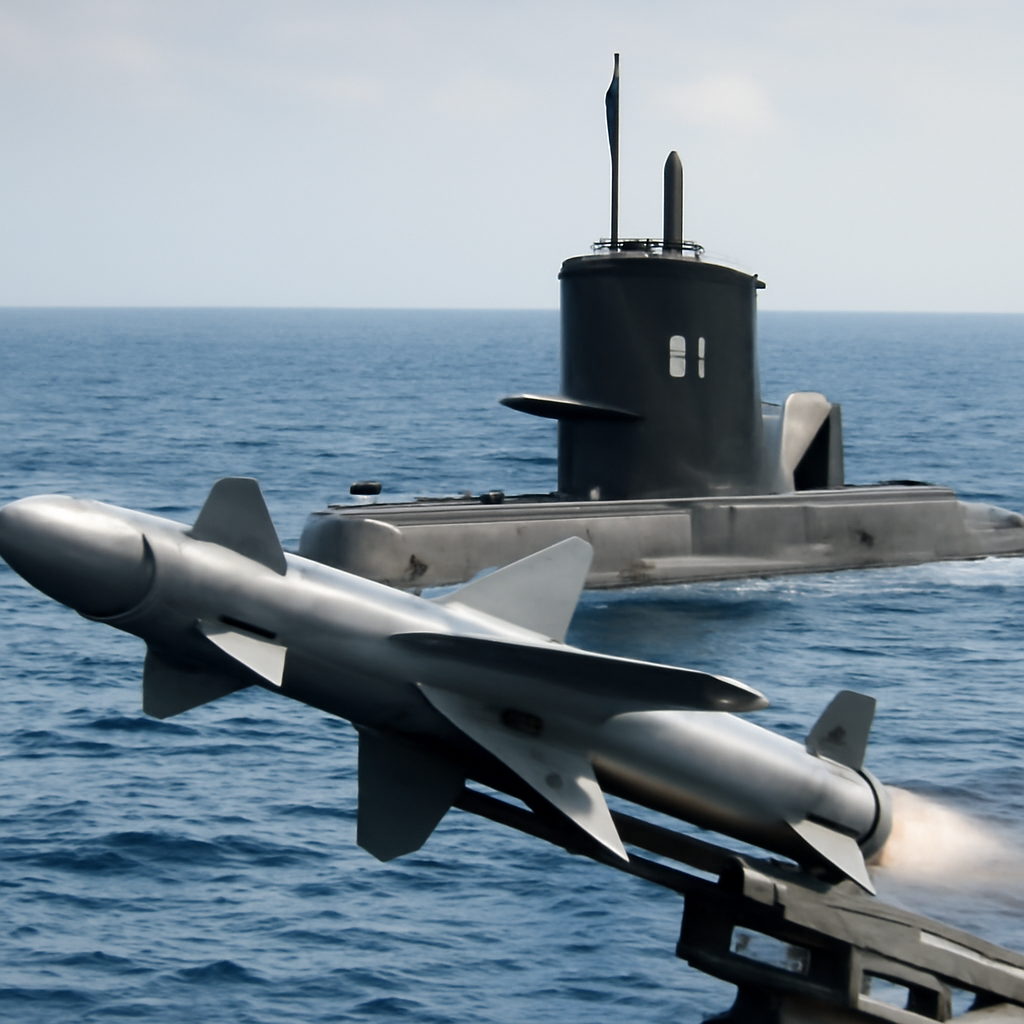
On 27 September, the Pakistan Navy announced that PNS/M Hangor successfully test‑fired an anti‑ship cruise missile in the North Arabian Sea; video released by the navy’s Directorate General of Public Relations shows the munition to be a CM‑708UNB, confirming the submarine carries that weapon.
PNS/M Hangor test and public confirmation
The Pakistan Navy’s DGPR posted the test announcement on social media on 27 September and accompanied the message with video footage. While the DGPR did not name the missile model in its text, the imagery clearly shows the CM‑708UNB being launched from the lead Hangor‑class boat. The presence of that weapon on PNS/M Hangor indicates the Pakistan Navy procured an unspecified number of CM‑708UNB munitions for the class.
CM‑708UNB: range, launch mode, and tactical role
The CM‑708UNB, revealed in 2016 by the China Aerospace Science and Industry Corporation (CASIC), carries a stated range of 290 km and is designed to be launched from a submarine’s torpedo tubes. CASIC positioned the weapon as a complement to heavyweight torpedoes for anti‑ship warfare. In the Pakistan Navy’s context, the CM‑708UNB provides a first‑response, long‑range precision‑attack option that can be employed while a submarine remains submerged.
The source material outlines a likely employment pattern: an external sensor or platform identifies a surface target, passes that targeting data to a decision maker, and the submarine receives the cue either via very‑low frequency (VLF) transmission while submerged or via tactical data‑links when surfaced. The missile’s extended range is framed as offering a stand‑off engagement option that keeps the submarine away from the immediate threat environment of enemy anti‑submarine warfare assets.

Audit-ready is a season. It shouldn't be.
Evidence in spreadsheets, controls drifting between audits, frameworks multiplying on flat headcount. Nubivance runs continuous compliance on Rapid7 Cyber GRC - SOC 2, HIPAA, ISO 27001, PCI, CMMC.
End the scrambleHangor‑class submarine: size, endurance, and payload
PNS/M Hangor is the lead boat of the Hangor‑class (Type 039B / S26) and was commissioned in April 2026 in Sanya, China, before arriving in Pakistan in June 2026. The class is built on China Shipbuilding & Offshore International Co. Ltd’s S26 export design (derived from the PLAN’s Type 039A/B Yuan‑class), displaces 2,800 tons, and measures 76 m in length — making it the largest submarine the Pakistan Navy has operated.
The Hangor‑class uses a Stirling‑cycle air‑independent propulsion (AIP) system that the source says enables it to remain submerged for potentially several weeks, a capability the Pakistan Navy can pair with weapons like the CM‑708UNB and heavyweight torpedoes. Each boat has six torpedo tubes; the source also notes those tubes could support the Babur‑3 submarine‑launched cruise missile should the navy choose to fit it.
Program timeline, industrial base, and delays
Pakistan ordered eight Hangor‑class boats with an original target to induct all eight by 2028. The program has slipped. The DGPR reports that three additional boats — PNS/M Shushuk, PNS/M Mangro, and PNS/M Ghazi — are in sea trials and in the “final stages” of handover, with likely induction in 2027–2028 at the latest. Karachi Shipyard & Engineering Works (KSEW) is responsible for building the remaining four boats and is currently manufacturing the fifth and sixth hulls; if current pace continues, deliveries from KSEW would likely occur in the early 2030s at the earliest.
The source attributes delay causes to the COVID pandemic and to Germany’s refusal to release MTU diesel engines, which forced a switch to Chinese CHD620 diesel engines. The reporting also notes that KSEW is acquiring substantial new submarine manufacturing know‑how through the program, a learning curve the Pakistan Navy leadership has linked to a longer‑term ambition of designing a next‑generation indigenous submarine.
What this means for Pakistani naval planners, KSEW, and the Indian Navy
- Pakistani naval planners: The CM‑708UNB expands a submerged, long‑range precision strike option for Hangor‑class boats and reinforces a conventional anti‑ship and anti‑submarine focus for the class rather than a hybrid strategic role. The navy appears set to reserve strategic/nuclear missions for future dedicated nuclear‑powered platforms, according to the reporting.
- Karachi Shipyard & Engineering Works (KSEW): Delays notwithstanding, KSEW is gaining manufacturing capability that the navy views as foundational to future indigenous submarine design — a capability development that may shape procurement and force‑structure timelines into the 2030s.
- Indian Navy (IN): The Hangor class’ larger size, AIP endurance, and stand‑off anti‑ship missiles are described as elements that will complicate any IN effort to control or secure the Arabian Sea in a conflict; the reporting frames the class as bolstering Pakistan’s anti‑access/area‑denial posture.
The Hangor’s CM‑708UNB test is, in the source’s account, a concrete step in fielding a conventional submarine force with longer reach and submerged strike options. Remaining questions the reporting leaves for the near term include the pace at which the remaining boats are handed over, whether Karachi Shipyard & Engineering Works can accelerate local production, and whether the Pakistan Navy will seek interim measures — for example, second‑hand or leasable submarines from China — to counter the delay in reaching planned fleet numbers.
Original report: https://quwa.org/pakistan-navy-pns-m-hangor-submarine-tests-cm-708unb-anti-ship-missile/