"[The Pakistan Navy intends to] greatly expand its surveillance coverage via autonomous USV, autonomous underwater vehicle (AUV), and unmanned aerial systems (UAS)," sources told Quwa — a compact sentence that sums a wider push the service has begun to assemble across surface, sub-surface and airborne unmanned platforms.
The Israr: a small coastal AUV made public at PIMEC 2025
The most publicly documented Pakistani AUV to date is the Israr, developed by Beyond Koncept and unveiled at the Pakistan International Maritime Expo and Conference (PIMEC) in 2025, Quwa reported. Published specifications place the Israr in the small coastal AUV category: it measures 3.0 m in length and 0.3 m in diameter, reaches speeds of up to 7 knots, and dives to a maximum depth of 300 m. Endurance is four hours on rechargeable lithium‑ion batteries.
Navigation is handled by an autopilot using GPS and a Doppler Velocity Log (DVL). Its sensor payload, per Quwa, includes a camera with lights, side‑scanning and forward‑looking sonars, a CTD (conductivity, temperature, depth) probe, a water ingress detector, and TPM (temperature‑humidity‑pressure) sensors. Beyond Koncept lists mission roles as intelligence, surveillance, and reconnaissance (ISR); underwater exploration; harbour and channel monitoring; ocean‑floor mapping and bathymetric survey; and seawater profiling.
Quwa noted the Israr is not a combat system: it does not carry weapons or deploy countermeasures. Its principal value is data collection — autonomous, pre‑programmed missions that return sonar imagery and environmental data into the Pakistan Navy’s (PN) operational picture. The side‑scan sonar also gives the platform a mine countermeasures (MCM) role: the Israr could detect mine‑like objects and mark them for follow‑on inspection by a separate asset, mirroring how small AUVs are used by Western navies.
Domestic unmanned maritime ecosystem: USVs, AUVs, and airborne links
The Israr sits alongside at least three other Pakistani maritime unmanned platforms that Quwa documented at PIMEC 2025. These include the Beyond Koncept "Muhassir" USV (ISR‑focused), a Stingray Technologies USV described as an intercept‑capable armed surface vessel, and a Woot‑Tech USV developed jointly with the Naval Research & Development Institute (NRDI) Platform Design Wing. Quwa reported the Woot‑Tech USV was produced in response to an urgent PN requirement and was integrated and tested within two months.
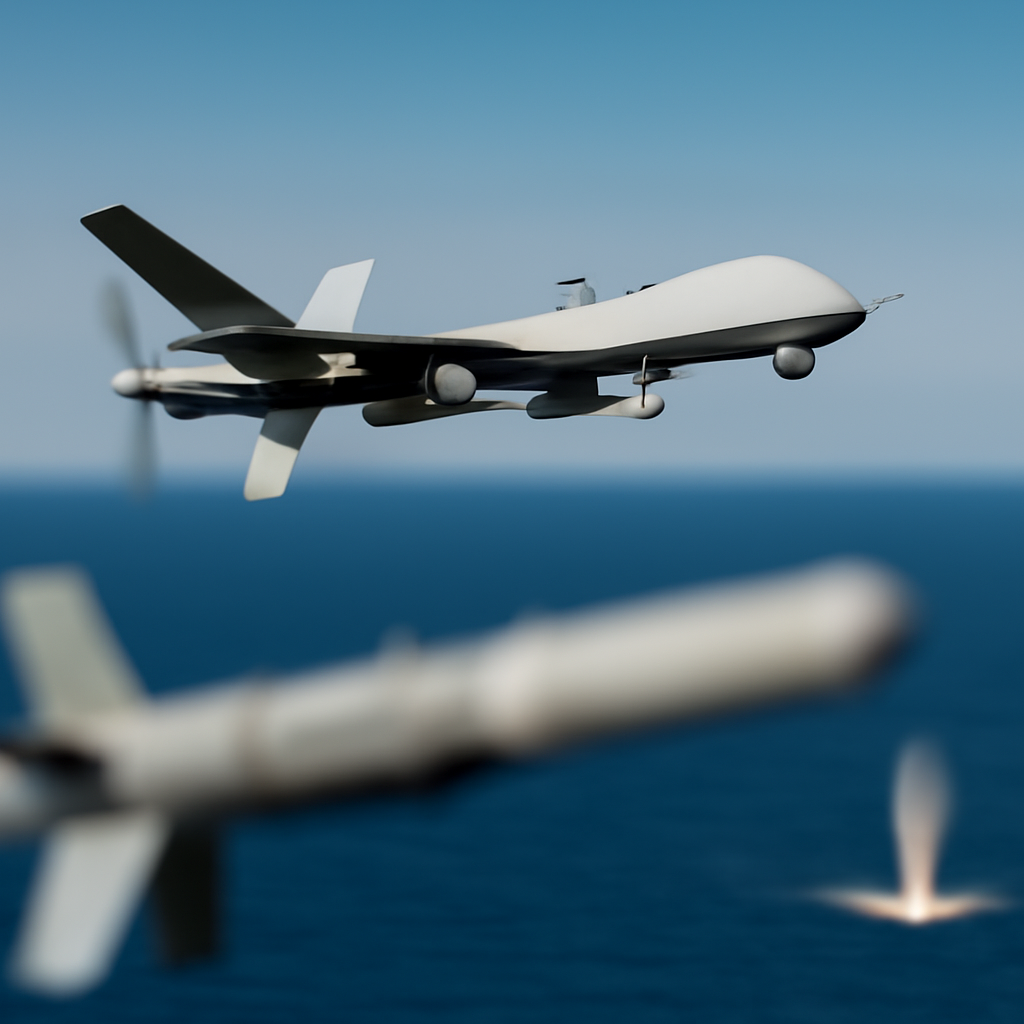
The airborne layer is also being adapted to maritime missions. GIDS showcased a maritime variant of the Shahpar‑III UAS at PIMEC 2025; Quwa reported it has a redesigned front fuselage, a miniature synthetic aperture radar (SAR), an ESM suite with ELINT capability, sonobuoy pods, and lightweight ASW torpedoes. Quwa suggested the Shahpar‑III maritime variant could operate in concert with AUVs — providing wide‑area surveillance and sonobuoy deployment while AUVs perform focused sub‑surface survey and mapping.

This site is the portfolio.
OSINTSights runs on Cloudflare Workers, D1, R2, and Vectorize, with an AI pipeline on Hetzner ARM. Nubivance designed, built, and operates it. We do the same for clients.
See what we buildForeign suppliers, partnerships, and industrial capacity
Quwa’s reporting emphasizes that the PN’s AUV track is not being pursued in isolation from foreign suppliers. Türkiye’s STM has marketed the NETA AUV and displayed it alongside the STM500 submarine; given STM’s existing relationship with the PN, Quwa positioned STM’s systems as potential complementary solutions. Dearsan of Türkiye has also promoted sub‑surface options to the PN, Quwa reported.
Germany’s Atlas Elektronik — already a supplier of the ISUS‑100 sonar and the DM2A4 torpedo to the PN via the Agosta 90B mid‑life upgrade — offers the SeaCat family of UUVs designed for MCM and ISR. Damen, Fincantieri and Turkey’s ASFAT A.Ş. are engaged through the Pakistan Maritime Science and Technology Park (PMSTP), a facility intended to support naval technology development. Quwa concluded foreign assistance could enable Pakistan to develop larger AUV and extra‑large UUV (XLUUV) designs beyond the Israr’s coastal survey scope.
Operational concepts: MCM, seabed mapping, harbour security, and manned‑unmanned teaming
Quwa identified four primary operational concepts the PN appears to be shaping for AUV employment in its littoral environment: mine countermeasures (route survey and minefield mapping in approaches to Karachi and Gwadar); ISR and seabed mapping (pre‑conflict surveys along the Makran coast and approaches to naval bases); harbour and infrastructure security (autonomous patrols around piers, submarine pens, undersea cables and Gwadar port); and manned‑unmanned teaming (deploying AUVs from Hangor‑class submarines or from the planned SWATS to extend sensor reach).
Quwa observed the PN’s current AUV track focuses on coastal ISR and MCM, while expressing confidence the PN will pursue larger, deeper‑diving designs — potentially XLUUV‑class platforms or AUVs with greater pressure resistance — to support submarine‑deployed operations.
What this means for technologists, procurement leaders, and naval commanders
- Technologists and defence firms: expect demand for interoperable autonomy, DVL/GPS navigation solutions, side‑scan sonar integration and battery endurance improvements for coastal missions; larger payload and pressure‑resistant designs would be the next technical frontier.
- Procurement leaders and policymakers: the critical constraint Quwa identified is industrial capacity — decisions will pivot between scaling an indigenous small AUV fleet and selectively procuring larger foreign AUVs or XLUUVs to meet submarine‑deployed requirements.
- Naval commanders and planners: short‑term gains are likely in persistent harbour security and ISR from small AUVs; the more ambitious manned‑unmanned teaming concepts will depend on larger platforms, deployment mechanisms and vetted operational doctrines.
The Pakistan Navy’s AUV program is young and modular: an indigenous prototype for coastal work, a cluster of domestic USV efforts, airborne sensors converted for maritime use, and foreign vendors circling to offer larger solutions. The immediate reality is data collection and harbour surveillance; the broader ambition — deeper, submarine‑deployable AUVs and XLUUVs — will test Pakistan’s industrial and acquisition choices in the years ahead.