Nearly PKR 3 trillion — about $10.76 billion — is Pakistan’s defence allocation for FY2026-27, a headline record in dollar terms that the podcast hosts Bilal Khan and Arslan Khan say conceals a different reality once the rupee’s slide and spending patterns are unpacked.
The budget breakdown: personnel, operations, and a 39% jump in “physical assets”
The federal allocation lands at roughly PKR 3 trillion, with functional lines the hosts cite at PKR 967 billion for personnel, PKR 743 billion for operations, and PKR 925 billion for “physical assets” — the last up about 39% year-on-year. The tri-service split reported by ARY News is roughly PKR 1.28 trillion for the Army, PKR 573 billion for the Pakistan Air Force, and PKR 293 billion for the Pakistan Navy. Bilal and Arslan stress that the rupee’s weakness has eroded much of the apparent dollar gain, and that the composition of the “physical assets” line matters more than the headline increase.
Why Bilal and Arslan read the rise in physical assets as munitions and rockets, not a stealth fighter buy
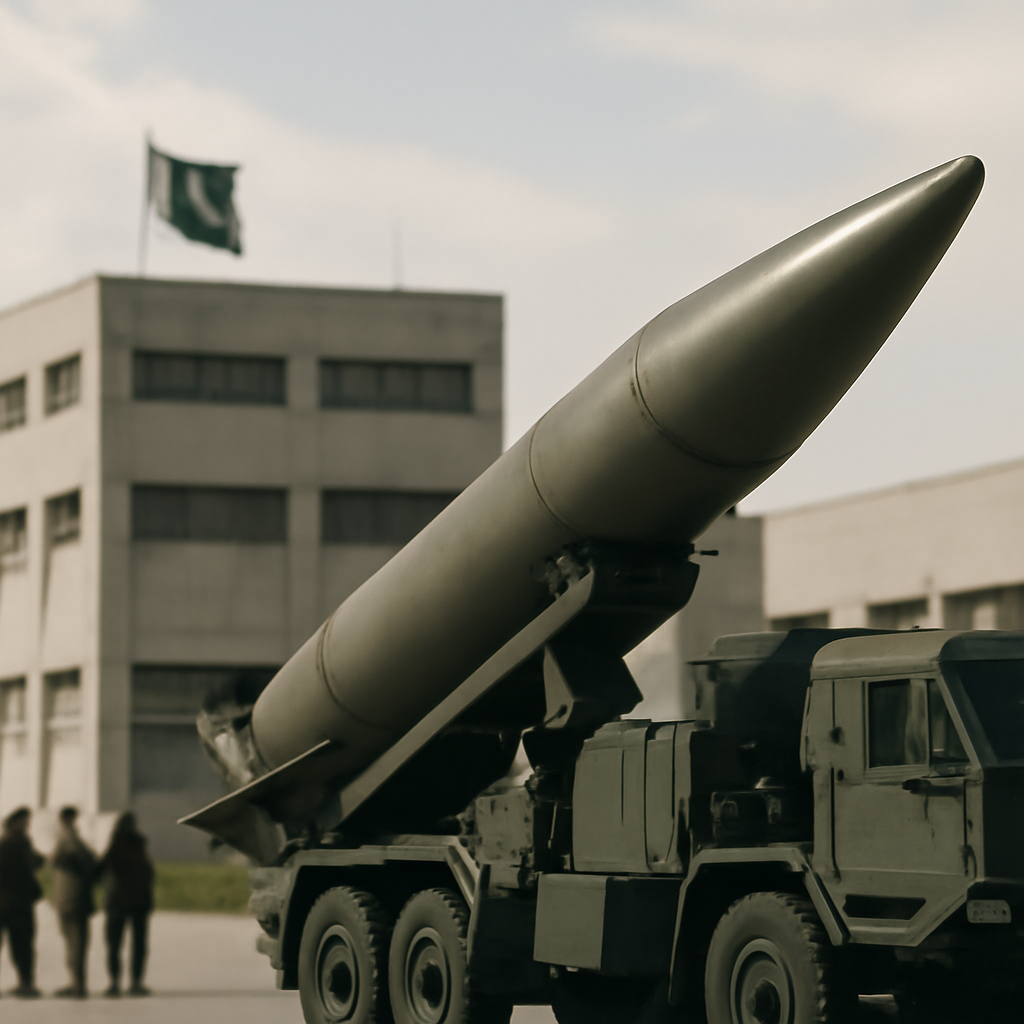
The hosts argue the bulk — which they estimate at 60–70% — of the physical-assets increase will fund indigenous munitions and the Pakistan Rocket Force rather than a single large platform purchase such as a J-35 stealth fighter. Their reasoning: platform buys still rely on imported engines, alloys and avionics, so rupee spending hits a hard-dollar ceiling; by contrast, indigenized munitions like the Fatah series scale more readily on a rupee-denominated budget. The episode points to a relentless cadence of missile tests and the rapid iteration of the Fatah family — new intakes, warheads, guidance stacks — as evidence that production scale is the priority.

The cyber insurance questionnaire just landed. Now what?
SOC 2, HIPAA, insurance renewals - someone has to own security strategy. Nubivance provides fractional CISO leadership without the full-time salary.
Get a security leadPNS Hangor’s arrival and what eight Type 039B boats imply for the Pakistan Navy
PNS Hangor, the first of eight Hangor-class Type 039B submarines, arrived in Karachi on 11 June 2026 after being commissioned in Sanya, China, on 30 April. The hosts describe this as the start of a delivery run that should see all eight boats — half built in China, half at Karachi Shipyard — in service by the early 2030s, giving the Pakistan Navy a fleet of eleven AIP-equipped submarines and a denser electronic-intelligence net across the Arabian Sea. Beyond the hull, Bilal and Arslan emphasise the logistics tail: heavyweight torpedoes and missile loads are expensive (a single DM2A4 torpedo is cited at about $3.5 million), Hangors are believed to carry YJ-18 anti-ship missiles as a stopgap, and the Navy is eyeing indigenous torpedoes, supersonic missiles and unmanned underwater vehicles. They also identify parallel programmes — the Shallow Water Attack Submarine (SWATS) programme, a future original-submarine replacement for the Agostas, and UUV development — as the Navy’s likely focus.
Army Aviation’s long-running fragmentation and the T129 ATAK case study
A recent Pakistan Army Mi-17 loss — attributed by ISPR to a technical fault on takeoff — frames the hosts’ critique of Army Aviation as Pakistan’s most neglected force. Bilal traces a model of episodic growth driven by counterinsurgency and foreign aid, followed by stagnation. The T129 ATAK episode is presented as illustrative: Pakistan ordered 30 in 2018 on a deal in which Türkiye financed the loan and planned a regional MRO and training hub; when Washington blocked the engine export, Pakistan reportedly owed nothing but lost the longer-term industrial opportunity. Meanwhile, limited national funding went to other programmes — the VT-4 tank, the Haider programme and the SH-15 howitzer — and a lone Z-10ME remains under evaluation. Bilal’s prescription is consolidation: he argues for standardising on a single 9–10 tonne utility platform to create a 100–150 unit requirement for the Army (150–200 if Navy and Air Force orders were folded in), a scale he says is needed to unlock offsets, joint local production and re-export prospects.
The FCAS collapse in early June 2026 and a reopened France–India possibility
Europe’s Franco‑German Future Combat Air System (FCAS) collapsed in early June 2026 after Paris and Berlin failed to bridge a leadership and workshare dispute between Dassault and Airbus. Bilal raises the prospect that France, seeking a funding and R&D partner, could approach India to co-develop a sixth‑generation platform. He sketches India’s defence-industrial landscape as three competing camps — an operationally rigid Indian Air Force, a state-owned HAL-and‑Russia establishment, and a private-sector “nation-builder” bloc behind programmes like AMCA and Tejas — and argues a net‑new FCAS with no incumbent workshare could be positioned to speak to all three simultaneously. The hosts note that whether New Delhi accepts such an approach is an open question; the collapse simply reopens the diplomatic and industrial possibility.
What this means for the Pakistan Navy, Pakistan Army Aviation, and regional planners
- Pakistan Navy: Expect a focus on consumables, sensors and distributed targeting — torpedoes, supersonic anti-ship missiles, UUVs and a web of airborne and space-based sensors (Sea Sultan/Sea Eagle patrol aircraft, Shahpar-3 drones, unmanned surface vessels, PRSC-EO3 and PRSC-S1 satellites with PISAT to come) to close over-the-horizon kill chains.
- Pakistan Army Aviation (PAA): Pressure to consolidate rotary-wing fleets and seek a high-volume, 9–10 tonne utility platform to create negotiating leverage for offsets, local production and regional MRO roles.
- Regional planners and defence-industrial actors: The FCAS collapse shifts one European option into a potential France–India conversation while Pakistan’s budget choices point to a near-term emphasis on indigenized munitions and rocket production rather than marquee platform buys.
Taken together, the FY2026‑27 budget, PNS Hangor’s arrival and the FCAS rupture sketch a regional trajectory where stockpiles, sensors and indigenous munitions gain weight alongside selective platform modernisation. The central question the hosts leave: can rupee-denominated increases be turned into sustainable domestic production and the logistics to use those weapons effectively at sea, on land and in the air?
Source: Quwa — Pakistan’s $10.76 Billion Defence Budget, PNS Hangor, and the FCAS Collapse