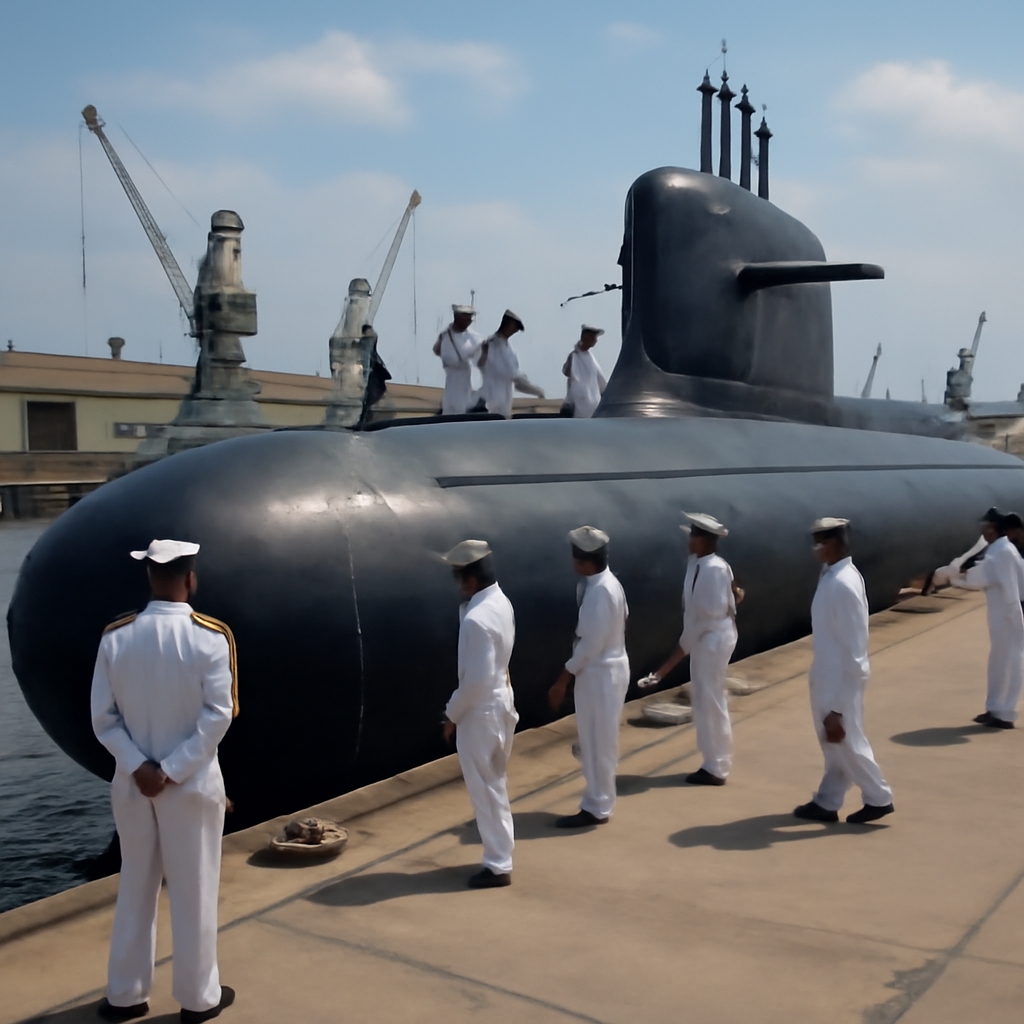
On 11 June 2026 the Pakistan Navy’s first Hangor-class submarine, PNS/M Hangor, arrived at Karachi and was received at the PN Dockyard in a ceremony led by Commander Pakistan Fleet, Vice Admiral Abdul Munib. The boat had been commissioned six weeks earlier, on 30 April, at Sanya, China, in an event attended by President Asif Ali Zardari and the Chief of the Naval Staff, Admiral Naveed Ashraf.
The procurement arc: from a near-Type 214 deal to China’s S26/S20 package
The Hangor program closes a procurement arc that began with a 2004 requirement and a technical preference for Germany’s Type 214. By November 2008 HDW’s chief executive, Walter Freitag, told Pakistani media the commercial contract was “95 per cent” final for three boats to be built at Karachi. That deal unraveled between 2009 and 2011 amid Pakistan’s deteriorating fiscal position, an IMF program that removed financing, and Berlin conditioning export approval on a National Security Council review of “political and regional aspects.”
With the German route closed, Pakistan opened talks with China’s CSOC around 2011. In April 2015 Islamabad approved the purchase — notably for eight submarines rather than the six initially discussed — and Pakistan finalized the deal and financing in 2016. Press reporting at the time put the wider package at $4–5 billion, though that figure may have bundled other ship purchases such as four Tughril-class frigates, complicating efforts to isolate the submarines’ standalone cost.
Design, systems and the MTU engine disruption
The Hangor-class is derived from CSOC’s S26, itself descended from the PLAN’s Type 039A/B Yuan-class. KSEW’s IDEAS 2018 mock-up and CSOC marketing data indicate the Hangor displaces about 2,800 tonnes, measures roughly 76 m in length, has a draught of 6.2 m and a surfaced speed of 10 knots — making it the largest submarine the Pakistan Navy has operated.
The boats were specified to use AIP technology similar to the S26’s Stirling-cycle system, a capability the PN values because it extends submerged endurance. The program faced a mid-course disruption when German MTU 12V 396 diesels lost export approval after MTU engines were found on Chinese warships in violation of an EU embargo. CSOC substituted the CHD620, a licensed derivative of the MTU design; similar substitutions appeared in Thailand’s S26T program.

Audit-ready is a season. It shouldn't be.
Evidence in spreadsheets, controls drifting between audits, frameworks multiplying on flat headcount. Nubivance runs continuous compliance on Rapid7 Cyber GRC - SOC 2, HIPAA, ISO 27001, PCI, CMMC.
End the scrambleWeapons, sensors and the Khalid-class upgrade as a planning template
The Hangor carries six torpedo tubes likely sized for 533 mm weapons and configured for heavyweight torpedoes and anti-ship cruise missiles; the tubes would also support submarine-launched cruise missiles in principle. Pakistan’s Babur-3 SLCM was tested from a submerged platform in January 2017 with an ISPR-stated range of 450 km, and a 2018 test showed horizontal ejection compatible with torpedo-tube launch.
Because the PN has disclosed little about the Hangor’s combat systems, reading the navy’s recent Agosta 90B mid-life upgrade gives insight into likely priorities. In 2016 the MoDP contracted Türkiye’s STM for a $350 million modernization that replaced sonar, periscopes, fire control, radar, ESM and command-and-control systems. The MLU package notably included Aselsan’s ARES-2SC ESM, Havelsan’s SEDA sensor-fusion C2, and Aselsan’s ZARGANA torpedo countermeasures; the upgraded Agosta-class has since proven operationally—PNS/M Hamza sank a decommissioned Tariq-class frigate with a DM2A4 torpedo during SEASPARK-2022. The implication in Quwa’s reporting is clear: the PN has recently invested in fused situational awareness plus layered self-protection, and those priorities are likely to inform Hangor fit-outs.
How PNS/M Hangor fits the Pakistan Navy’s 11-boat AIP roadmap and A2/AD logic
Once eight Hangors and three upgraded Khalid-class boats are in service, the PN will field at least 11 AIP-equipped submarines — a fleet size Quwa describes as among the largest AIP fleets in Asia. The service’s doctrinal logic, as recounted in the reporting, treats submarines as the centrepiece of an anti-access/area-denial approach: longer submerged endurance creates a persistent contested zone that compels an adversary to commit disproportionate ASW resources. Admiral Naveed Ashraf framed Hangor’s induction around protection of sea lines of communication across the Arabian Sea and Indian Ocean, and Quwa argues the Hangor pushes the PN’s defensive line outward from coastal defence toward denial at reach.
That strategic shift is paired with a complementary requirement for a shallow-water attack submarine (SWATS). The PN’s 2021 disclosure that it sought a SWATS — with STM’s STM500 and Fincantieri’s S800 noted as candidates in coverage — indicates a deliberate two-tier fleet: larger Hangors for blue-water presence, and smaller boats for littoral duties.
What this means for KSEW, the Pakistan Navy, and the Indian Navy
- KSEW: The shipyard’s ToT role is the programme’s long-term test. KSEW cut steel on the fifth boat in December 2021 and laid the keel of the sixth in February 2025; meeting the original 2028 domestic delivery target remains in question and will be a critical metric of whether Pakistan can become a “submarine-building navy.”
- Pakistan Navy (NHQ): The PN gains the capability to sustain a persistent subsurface presence at reach and to anchor an A2/AD layer; it faces programmatic choices about subsystem standardization, SWATS partner selection, and whether to keep a clear demarcation between conventional and any future sea-based nuclear role.
- Indian Navy: Quwa’s analysis anticipates the IN will be forced to spread ASW assets — named examples include P-8I maritime patrol aircraft, MH-60R helicopters and escort screens — across a wider area in response to a larger, longer-endurance PN submarine presence.
The arrival of PNS/M Hangor completes the lead-boat milestone but opens a sequence of program-level tests: can KSEW deliver four domestic hulls on a credible timeline; which partner will supply a SWATS; will the PN standardize subsystems around domestic or foreign suppliers; and will a dedicated nuclear-powered platform ever move from aspiration to program? Each answer will shape whether the Hangor remains a single step or becomes the hinge of a sustained subsurface transformation.