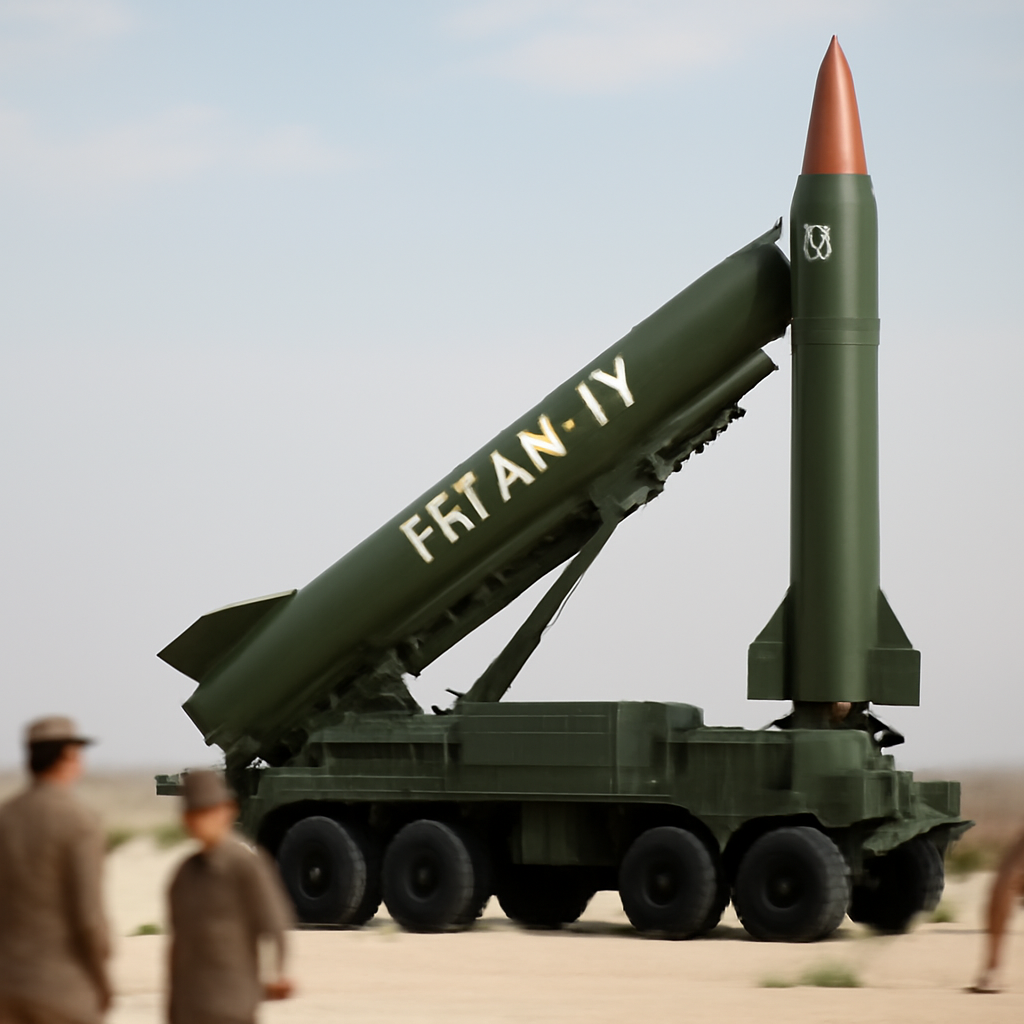
On October 6, Pakistan conducted the third launch of the Fatah‑IV cruise missile — this time an extended‑range (ER) variant reported to have a range of more than 750 kilometers.
October 6 test and the Fatah‑IV program timeline
The October 6 flight was the third public launch of the Fatah‑IV system; the previous test took place in May 2026. Pakistan first unveiled the Fatah‑IV during its Independence Day event on August 14, 2025, and the system has been presented by Pakistani reporting as a response to the India‑Pakistan clashes of 2025. The missile was introduced as a conventionally armed cruise capability intended to bolster Pakistan’s counterforce options.
Design changes visible in the ER variant
The ER version differs visibly from earlier Fatah‑IV imagery. The reporting notes wings positioned on the underbelly instead of centered on the fuselage, and a slightly larger airframe to hold more fuel. The baseline Fatah‑IV is described as terrain‑hugging to reduce radar detection, with a maximum speed of Mach 0.7 and a 330 kilogram blast‑fragmentation warhead. Based on available imagery, analysts cited in the reporting estimate the ER Fatah‑IV could have a range around 1,000 km, even though the immediate announcement characterized the range as more than 750 km.

Audit-ready is a season. It shouldn't be.
Evidence in spreadsheets, controls drifting between audits, frameworks multiplying on flat headcount. Nubivance runs continuous compliance on Rapid7 Cyber GRC - SOC 2, HIPAA, ISO 27001, PCI, CMMC.
End the scrambleER Fatah‑IV as a response to standoff strike and airpower concerns
The reporting lays out several rationales Pakistan may have for developing an ER version. First, Islamabad appears intent on countering the prospect that the Indian Air Force (IAF) will adopt a standoff posture: moving assets to rear bases and launching air‑launched missiles from greater distances. That prospect, the article argues, is partially rooted in the May 6–7, 2025 episode when the IAF "lost multiple jets in air‑to‑air engagement with the PAF," a loss the reporting says the IAF may seek to avoid in future confrontations.
Contributing to those concerns is reporting that the Indian government has sanctioned an increase in range for the BrahMos supersonic cruise missile, with some reports estimating a new range around 800 km. The article contends Pakistan’s existing air‑launched options — including the Taimoor — and other conventional systems were inadequate to threaten IAF installations deep inside India, and that an ER Fatah‑IV would fill that gap by enabling strikes on radars and fighter fleets deployed at rear bases.
Reciprocity and urban‑center reach: Mumbai and beyond
The reporting stresses geography as a strategic factor: many of India’s major metropolitan and commercial hubs lie deep inside the subcontinent, while Pakistan’s urban centers are closer to the border. The original Fatah‑IV already altered that balance; the ER variant, the article suggests, brings India’s principal business metropolis, Mumbai, "within range of Pakistan’s conventional strike force." Pakistan’s reported logic is that making Mumbai vulnerable to conventional strike would dissuade New Delhi from seeking conventional counter‑value attacks on Pakistani cities, for both reputational and morale reasons.
Penetrating layered air defenses and signaling deterrence
Another justification cited in the reporting is the growing density of Indian air defenses in the "post‑Operation Sindoor era." The article says the Indian military ordered more systems including the S‑400, tested long‑range interceptors like Kusha, and announced integration of multiple systems under "Mission Sudarshan Chakra" to create an impenetrable missile‑defense shield. To operate against such layered defenses, the reporting argues Pakistan needs systems that reduce radar detection; the terrain‑hugging Fatah‑IV is presented as meeting that requirement, pari passu with longer range in the ER version.
What this means for the Indian Air Force, the Pakistan military, and regional policymakers
- Indian Air Force: The reporting implies the IAF may reassess basing, dispersal and stand‑off strike doctrine if Pakistan fields longer‑range cruise options; future IAF posture decisions are framed as a principal driver behind the ER development.
- Pakistan military and policymakers: The article portrays the ER Fatah‑IV as a deliberate effort to strengthen conventional deterrence and to signal that "the old days are gone now" for deep‑inside‑India sanctuary — a rhetorical framing the reporting uses to explain Islamabad’s intent.
- Regional policymakers: With both sides augmenting strike and defensive layers, the reporting suggests a mutual escalation dynamic in which strikes on military nodes and threats to major urban centers will factor more heavily into political calculations.
The October 6 test is presented in the reporting as more than a technical evolution: it is a strategic message. Whether the ER Fatah‑IV will realize the specific range and penetration characteristics estimated from imagery, and how New Delhi will respond in posture, procurement, or doctrine, are policy questions the reporting leaves as the next moves for both capitals. The article closes by situating the development within a broader narrative of reciprocal capability growth and explicit signaling — a posture Pakistan frames as necessary after what it calls "unprovoked" attacks in May last year and against a backdrop where, the reporting notes, India’s army chief General Dhiraj Seth has been cited as reflecting a campaign mindset in conflict.