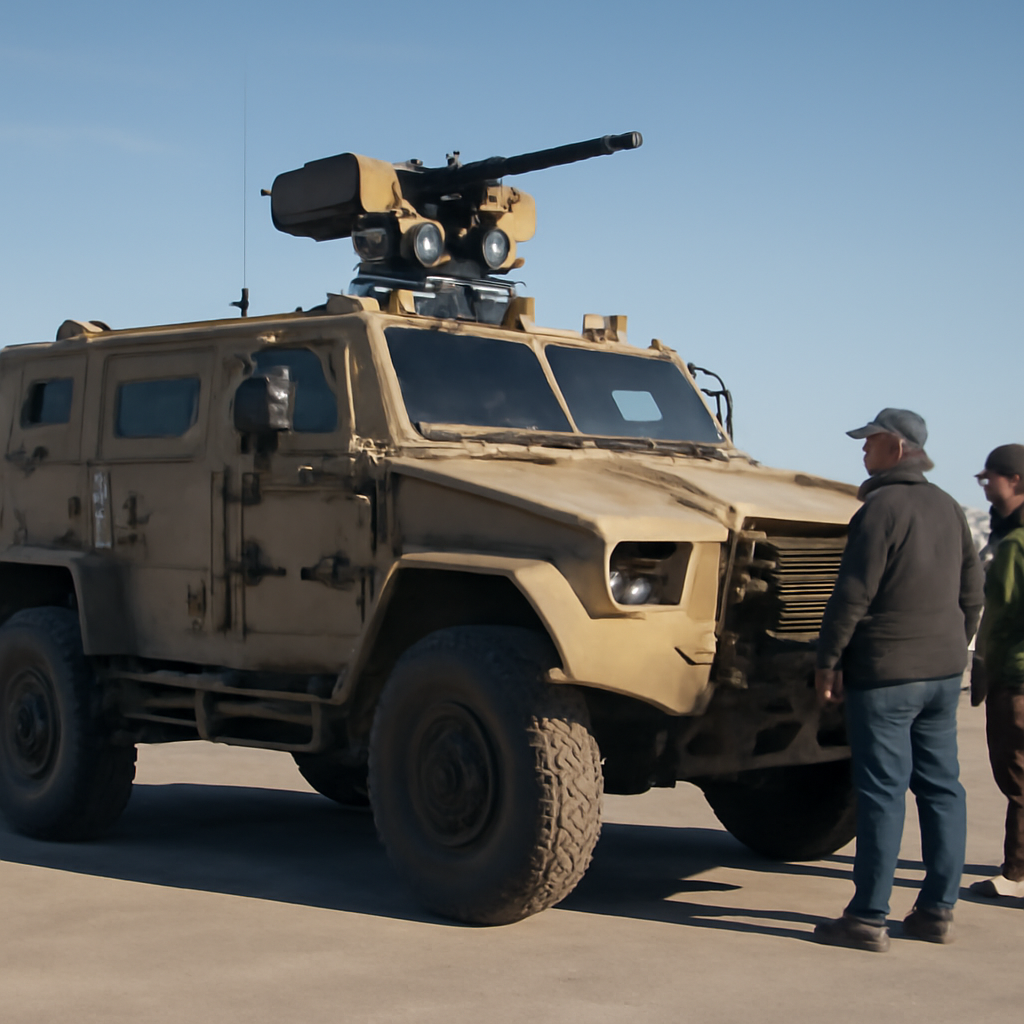
On 17 July 2026, Margalla Heavy Industries Limited (MHIL), an emerging commercial wing of Heavy Industries Taxila (HIT), unveiled its new ‘Liger’ armoured security vehicle (ASV).
MHIL unveils the Liger: basic facts
MHIL presented the Liger as a 4×4 armoured security vehicle intended for tactical mobility and rapid strike. The company describes the platform as weighing 7,600 kg with a payload of 2,000 kg and the capacity to carry up to 10 personnel (4 crew and 6 passengers). The vehicle is fitted with a remote weapon station (RWS) armed with a 12.7 mm gun and incorporates eight firing ports. Ballistic protection is listed at B-6. Propulsion comes from a 320 hp engine that gives the Liger a top speed of 110 km/hour on level ground and 70 km/hour in all-terrain conditions.
How the Liger fits into Pakistan’s recent wheeled armoured portfolio
The Liger is the latest entry to a growing set of wheeled armoured vehicles from the HIT/MHIL ecosystem. It joins HIT’s Hisar mine-resistant ambush-protected (MRAP) vehicle and the Faaris 6×6 armoured fighting vehicle (AFV). MHIL is marketing the Liger specifically as a tactical mobility and rapid strike vehicle, a role that situates it alongside light and medium wheeled platforms rather than heavy tracked systems.

This site is the portfolio.
OSINTSights runs on Cloudflare Workers, D1, R2, and Vectorize, with an AI pipeline on Hetzner ARM. Nubivance designed, built, and operates it. We do the same for clients.
See what we buildAdoption remains an open question for the Pakistan Army
While MHIL portrays the Liger as a potential replacement for light tactical trucks and some existing armoured platforms, the source is clear that adoption by the Pakistan Army (PA) is uncertain. The Liger “could” be used in place of pick-up trucks or even existing armoured platforms, such as the HIT Muhafiz series, if the Army were to adopt it. The Army, however, has encountered difficulty acquiring large numbers of new wheeled armoured vehicles despite initiating multiple tenders and tests—difficulties that the source links to the aftermath of counterinsurgency (COIN) and counter-terrorism (CT) operations in the early‑to‑mid‑2010s.
Security imperatives in Balochistan and Khyber‑Pakhtunkhwa (KP)
The source points to contemporary COIN/CT imperatives in both Balochistan and the formerly Federally Administered Tribal Areas—now Khyber‑Pakhtunkhwa (KP)—as the operational pressures that may drive procurement of new wheeled armoured vehicles. Those operational needs are framed as potential demand drivers for vehicles across the segments offered by MHIL and HIT, including MRAPs, 6×6 AFVs and lighter 4×4 tactical mobility platforms like the Liger.
What this means for the Pakistan Army, MHIL/HIT, and operations in Balochistan and KP
- The Pakistan Army: The Army will be watching how the Liger and other HIT/MHIL platforms perform against tender requirements and operational tests. Given prior difficulty acquiring large numbers of wheeled armoured vehicles, procurement officials must weigh whether a 4×4 tactical mobility vehicle with B‑6 protection and a 12.7 mm RWS satisfies the mix of protection, mobility and cost they need for COIN/CT operations.
- MHIL and Heavy Industries Taxila (HIT): MHIL has expanded the HIT portfolio into a commercial wing and is positioning the Liger to fill gaps in tactical mobility and rapid response. The company’s ability to translate a platform unveiling into contracts will depend on how the Liger compares with the Hisar MRAP and the Faaris 6×6 AFV in procurement competitions and operational trials.
- Operations in Balochistan and KP: Forces operating in these regions may find the Liger’s mix of speed, passenger capacity and light ballistic protection relevant to COIN/CT mission profiles. Whether those operational imperatives translate into procurements depends on the Army’s decisions and on how the Liger’s protection and payload balance against threats and terrain.
The unveiling of the Liger underscores two clear realities recorded in the source: Pakistan’s wheeled armoured vehicle portfolio is expanding, and procurement choices remain unsettled. MHIL has placed a new option on the table—a 4×4 platform with B‑6 ballistic protection, a 12.7 mm RWS, space for 10 personnel and a claimed top speed of 110 km/hour on road—but whether the Pakistan Army will incorporate the Liger into fleet plans, and at what scale, is still unresolved. The decisive factors, as the source frames them, will be how the platform measures up during tenders and tests and whether current COIN/CT needs in Balochistan and KP prompt renewed buying at scale.
Original story: https://quwa.org/pakistan/market-intelligence/movement-in-the-pakistan-armys-wheeled-armoured-vehicle-programs/