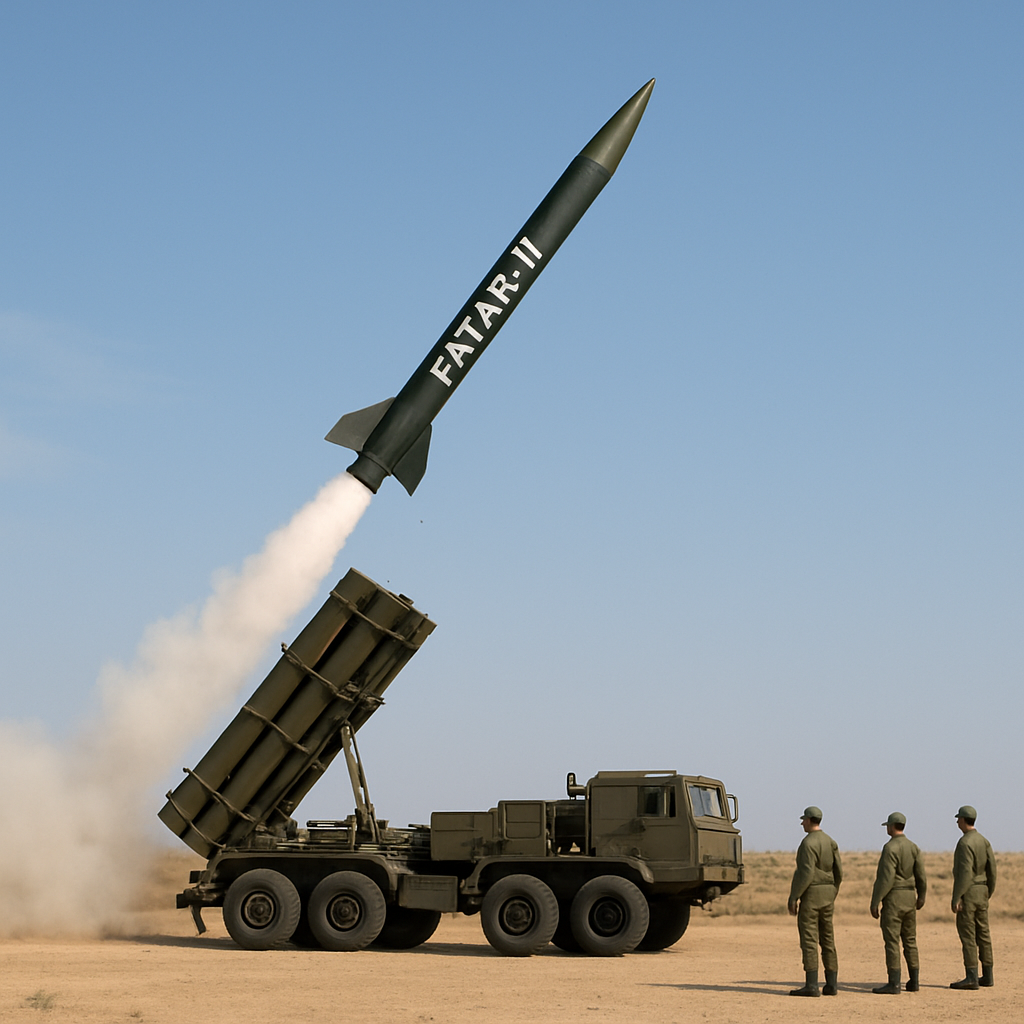
"unique trajectory," the Inter Services Public Relations (ISPR) wrote on 28 April 2026, describing the Army Rocket Force Command’s latest training launch of the Fatah‑II missile. That phrase, brief and technical, signals what the ISPR framed as an operational milestone: a system now exercised for crew proficiency and readiness rather than core design testing.
The ISPR announcement and who watched
On 28 April 2026 the ISPR announced a successful training launch of the Fatah‑II surface‑to‑surface missile. The release said the launch aimed to train troops, validate key technical parameters, and evaluate sub‑systems intended to improve accuracy and survivability. The ISPR did not disclose the launch location, the evaluation criteria, or the results. Senior officials from the Strategic Plans Division (SPD), the Army Rocket Force Command (ARFC), and the Pakistan Army (PA) witnessed the event; scientists and engineers from Pakistan’s strategic organisations were present. President Asif Ali Zardari, Prime Minister Shehbaz Sharif, and Chief of Defence Forces and Chief of Army Staff Field Marshal Asim Munir commended the teams involved.
Fatah‑II: technical profile in the official record
The Fatah‑II is presented in official and marketing material as a supersonic, non‑ballistic guided missile with “all‑course manoeuvre” capability. That marketing description—published by Global Industrial and Defence Solutions (GIDS)—and the ISPR’s emphasis on a “unique trajectory” align: the missile is claimed to be capable of executing evasive manoeuvres throughout flight rather than only in the terminal phase.
Available specifications attribute the following characteristics to the system. The ISPR has consistently cited a 400 km range for the Fatah‑II. GIDS’s export specification lists a shorter export‑variant range (100–290 km), a 365 kg unitary blast or blast‑fragmentation warhead, a length of 7.5 m, and an accuracy of 50 m circular error probable (CEP) or better. The airframe diameter is 600 mm; propulsion is a single‑stage dual‑thrust solid rocket motor with an indigenous thermal protection system. Guidance integrates inertial navigation (INS) with satellite navigation (GNSS) and supports programmable trajectories.

Audit-ready is a season. It shouldn't be.
Evidence in spreadsheets, controls drifting between audits, frameworks multiplying on flat headcount. Nubivance runs continuous compliance on Rapid7 Cyber GRC - SOC 2, HIPAA, ISO 27001, PCI, CMMC.
End the scrambleLauncher, modes, and force structure implications
The Fatah‑II launcher is a twin‑cell oblique‑launch canister on an 8×8 wheeled chassis with auto aiming, levelling, positioning, and orientation capabilities. That two‑round configuration contrasts with the smaller‑diameter, eight‑cell Fatah‑I launcher and reflects the Fatah‑II’s larger airframe and heavier payload. Launchers support both salvo and non‑salvo firing modes, giving the ARFC flexibility between rapid volleys and deliberate single shots.
Quwa situates the Fatah‑II within a disclosed ARFC strike portfolio alongside the 140 km‑range Fatah‑I GMLRS and the 750 km‑range Fatah‑IV ground‑launched cruise missile (GLCM). Together those three variants form a layered conventional strike capability spanning roughly 140 km to 750 km—intended to cover targets from forward formations to deep‑rear infrastructure—and to reduce reliance on air assets for stand‑off strikes.
Production, supply chain, and NESCOM’s industrial challenge
Quwa’s analysis stresses that deploying a handful of missile types is only the first step; sustaining a high‑tempo precision‑strike posture requires large pre‑stocked inventories and the capacity to replenish quickly. NESCOM’s standardisation choices—sharing a common core platform across Fatah family variants and naval derivatives—can simplify supply chains and amortise development costs, but moving to mass conventional production is a different industrial problem than limited strategic provisioning.
Quwa identifies tighter supply‑chain integration with China as the most feasible near‑term pathway to scale Fatah‑II output: NESCOM would remain systems integrator while sourcing critical inputs (rocket motors, guidance electronics) from Chinese suppliers at volume pricing. Over time the article expects gradual localisation beginning with lower‑technology items (canisters, vehicles, handling equipment) and moving toward more complex components.
What this means for the Strategic Plans Division, NESCOM, and China
- Strategic Plans Division, ARFC, and Pakistan Army: The training launch, framed as readiness validation, signals internal confirmation that the Fatah‑II has entered operational service—used to rehearse crews, validate subsystems, and integrate the missile into doctrine that emphasises precision‑fire and precision‑strike.
- NESCOM: The organisation faces pressure to scale production from demonstration and limited stockpiles to the volumes required for sustained conventional operations; NESCOM’s role as integrator is likely to focus on standardisation and supply‑chain orchestration.
- Chinese suppliers: Identified as the near‑term source of critical components, they would be the primary external enablers of any rapid scale‑up, providing bulk inputs while final integration remains under NESCOM control.
The April 2026 event is modest in isolation but telling in context. The Fatah‑II was first tested in December 2023 and inducted into service in 2024; this is the first publicly acknowledged Fatah‑II firing since the ARFC’s formation in August 2025 and the first known Fatah‑II launch since the 2025 conflict in which the Fatah‑I saw combat use. Taken together with investments in guided artillery (Tipu 155 mm and Nishana PGKs), an Integrated Battlefield Management System prototype, and an expanding satellite ISTAR layer (PRSC‑EO1, EO2, EO3, a SAR satellite, a hyperspectral satellite, and a planned PIESAT InSAR constellation), the launch reads as one operational thread in a broader push toward networked precision fires.
Whether that network achieves the “connective” middle layer Quwa highlights—fusing sensors and shooters at machine speed—remains an operational and industrial test. For now, the Fatah‑II’s public training launch confirms a weapon system being exercised in the field and underscores the ARFC’s growing role in Pakistan’s conventional precision‑strike posture.