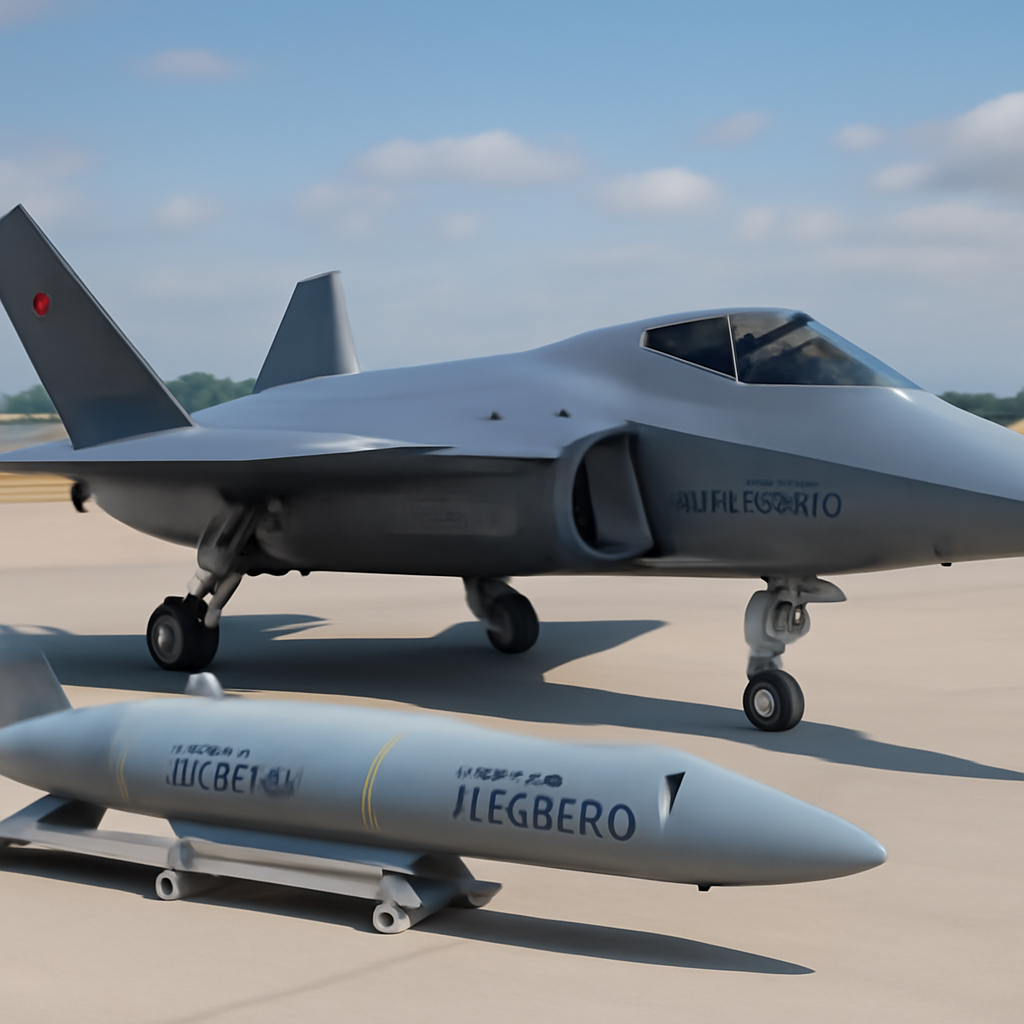
Baykar recently test-fired a Roketsan JET-230 air-launched ballistic missile (ALBM) from its Bayraktar Kızılelma unmanned combat aerial vehicle (UCAV), adding to last year’s world-first radar-guided air-to-air missile launch from the same platform.
Baykar’s Kızılelma: munitions, engines, and a push toward autonomy
The Kızılelma is advancing rapidly as a strike-capable UCAV. Quwa reports that Baykar has integrated a growing suite of air-to-air and air-to-surface munitions onto the 8.5-ton platform and that recent tests included both a radar-guided air-to-air missile (previously) and the Roketsan JET-230 ALBM. Turkish supply chains are also moving: Tusaş Engine Industries has said its TF-6000 turbofan (26.7 kN thrust) will be ready for integration with the Kızılelma and Anka-3 in 2027. Baykar Group also publicly frames UCAVs as successors to crewed fighters and is developing the autonomous capabilities that would be necessary for operations when communications and satellite links are degraded.
Why the J-35AE is described as the frontrunner to replace the F-16A/B
Quwa positions the J-35AE, a stealth next‑generation fighter aircraft (NGFA), as the probable front-runner to supplant Pakistan Air Force (PAF) F-16A/B Block-15 squadrons due for replacement by 2040. The argument rests on two claims in the reporting: first, that the J-35AE is the largest strike-capable fighter available to the PAF among contenders; and second, that its stealth characteristics are an additional—if potentially maintenance-intensive—advantage. Quwa frames the F-16 as a long-standing, centrally important asset to the PAF, and argues that replacing its strike capability allows room for significant procurement expense if the new platform delivers equivalent operational benefits.

This site is the portfolio.
OSINTSights runs on Cloudflare Workers, D1, R2, and Vectorize, with an AI pipeline on Hetzner ARM. Nubivance designed, built, and operates it. We do the same for clients.
See what we buildThe 'mass' problem: J-10CE, JF-17, and F-16 trade-offs
Quwa highlights a core tactical challenge: stealth fighters typically operate in concert with medium-to-heavy four- or 4.5-generation fighters that deliver the ordnance “mass.” In this context, three options are weighed. The J-10CE could provide range and payload but, Quwa notes, China commonly uses it as an air-defence or localized air-superiority fighter—raising risks that intensive strike use could stress the airframe and complicate maintenance. The JF-17 has been prepared for strike roles through the integration of stand-off weapons such as AZB family precision-guided bombs and the Taimur air-launched cruise missile, but it lacks the payload and range of larger strike-optimized fighters. Finally, Quwa describes an ideal scenario—new and used F-16C/D airframes plus life-extension, upgraded avionics, and expanded stand-off weapons integration akin to Türkiye’s ÖZGÜR Project—but characterizes that path as “untenable” because, Quwa argues, the US has structurally blocked Pakistan from developing far-reaching strike capabilities.
Pairing the J-35AE with the Kızılelma: an asymmetric option
Given the trade-offs, Quwa proposes a different architecture: pairing a stealth NGFA like the J-35AE with large, strike-capable UCAVs such as the Kızılelma to deliver ordnance mass at lower cost and with simpler logistics. In that model, the J-35AE would act as a high-value node to neutralize key defenses and enable UCAVs to both lead high-risk strikes and exploit openings afterward. However, Quwa cautions that current Kızılelma tests still involve ground operators and that true operational efficacy in contested electronic-warfare environments will require substantially more autonomous capabilities—work Baykar says it is undertaking but which Quwa describes as years away.
Integrating NESCOM munitions and Pakistan’s drone industry
Quwa notes an operational and industrial advantage for the Kızılelma: Baykar’s business model allows integration with customer vendors, which could ease mounting Pakistani munitions such as NESCOM’s Rasoob 250 and AZB-81LR. Quwa also reports Pakistani private-sector firms and state-owned enterprises are already developing autonomy work for loitering munitions and interceptor drones, and that a large UCAV contract could create commercial offsets tying SOEs and private companies into software and hardware development—providing capital and experience for AI/ML and original hardware work.
What this means for the Pakistan Air Force, Baykar Group, and Pakistani defense companies
- Pakistan Air Force: faces a strategic choice between a conventional path—replacing F-16s with a mature 4+/4.5-generation backbone—or an asymmetric leap to J-35AE-led operations supported by autonomous UCAVs; Quwa suggests operational and industrial management will determine which path yields enduring capability.
- Baykar Group: stands to expand influence if Kızılelma proves a viable mass-strike UCAV and if its flexible integration model attracts NESCOM and Pakistani industry partnerships.
- Pakistani defense companies and SOEs: could gain access to significant offsets and technical projects—particularly in autonomy, sensors, and munitions integration—if large-scale UCAV procurement proceeds.
Quwa’s reporting leaves two clear, interlinked tests: whether the J-35AE will perform as a practical, maintainable strike-capable NGFA for the PAF, and whether the Kızılelma can mature from demonstration launches—air-to-air missiles and the JET-230 ALBM—to resilient, autonomous strike operations under contested EW conditions. The PAF’s procurement choice will shape not only its force architecture but also the future role of Pakistan’s aerospace suppliers.



