The Pakistan Air Force is positioning the National Aerospace Science and Technology Park (NASTP) as its lead in-house designer and integrator — shifting aircraft upgrades, radars, electronic warfare, and one-way attack munitions through a single, service-directed bureau rather than routing most work through existing state suppliers.
Aircraft upgrade concepts: F-16, JF-17 and Saab 2000
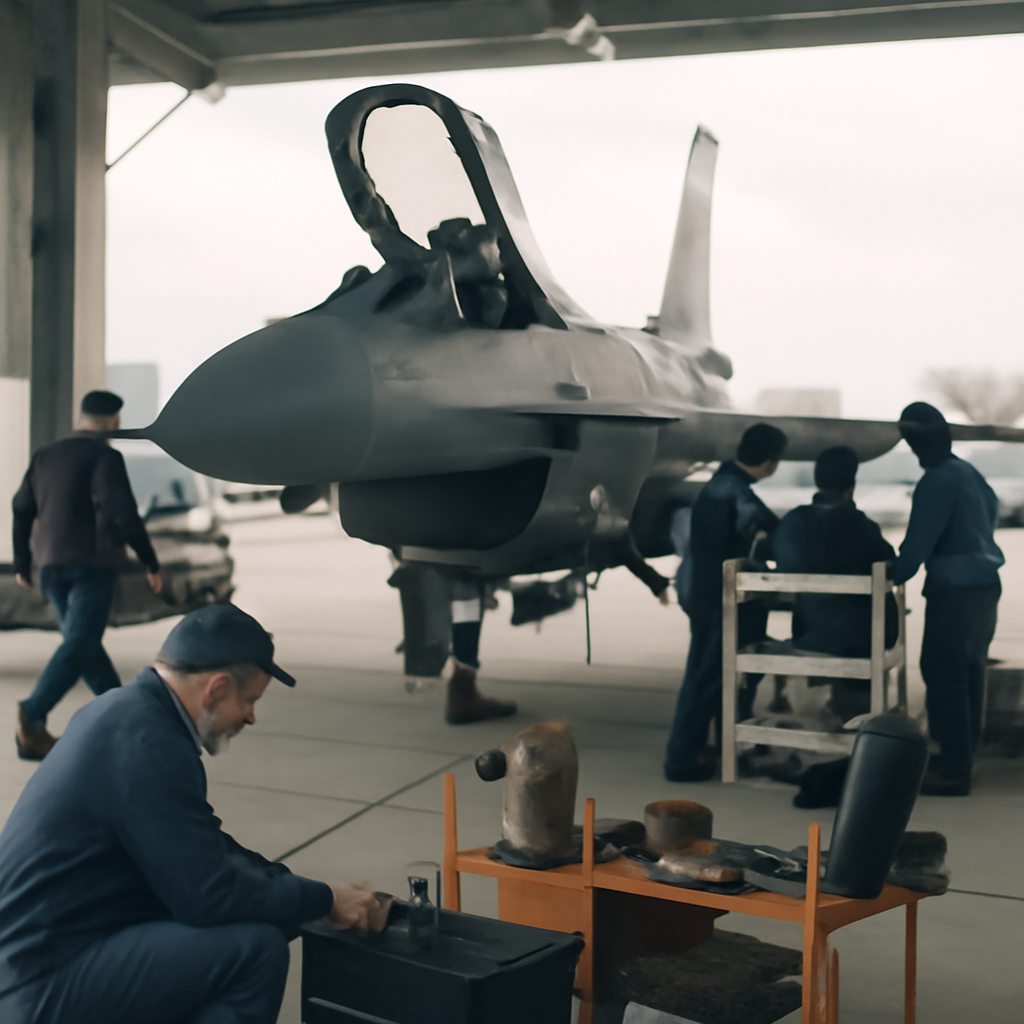
NASTP recently released low-resolution stills showing apparent upgrade proposals for the F-16, JF-17, and Saab 2000 fleets. For the Saab 2000 and the F-16, the material frames an approach built around structural upgrades coupled with modest subsystem additions or changes. In the F-16’s case, Quwa notes that the apparent proposal lines up with recent U.S. approvals to release new tactical datalinks (TDL) and other modest subsystems. For the JF-17, NASTP showcased concepts and illustrations for a new active electronically scanned array (AESA) radar, tying back to an earlier reveal of Project PFX Alpha — an apparent upgrade to the Thunder platform.
Radars and GaN transmit/receive modules as a common building block
NASTP is developing original air-defence and surveillance radars under the Machaan series, and much of that work uses gallium-nitride (GaN) transmit/receive modules as a common building block. That same module work appears in a future JF-17 radar concept and in airborne early-warning applications shown in the corpus of material. The project follows a precedent in which legacy Siemens Mobile Pulse‑Doppler Radars (MPDR) were replaced by phased-array systems built around Hensoldt-sourced modules — a retrofit that Quwa describes as a deep replacement rather than a cosmetic refresh.
By exploiting GaN-based arrays across land-based surveillance, airborne radars, and platform-specific AESA concepts, the PAF appears to be aiming to densify radar coverage at low altitudes, close curvature gaps left by high-altitude systems, and increase ISTAR capacity to feed surface-to-air missiles (SAM), anti-aircraft guns (AAG), and emerging directed-energy weapon options.

Audit-ready is a season. It shouldn't be.
Evidence in spreadsheets, controls drifting between audits, frameworks multiplying on flat headcount. Nubivance runs continuous compliance on Rapid7 Cyber GRC - SOC 2, HIPAA, ISO 27001, PCI, CMMC.
End the scrambleOne-way attack munitions, EW/ESM, and ISR enablers
NASTP’s portfolio extends beyond sensors into effectors and electronic systems. The PAF’s growing one-way-attack (OWA) and loitering munition lines — YiHA, KaGeM V3, and Dark Angel — are cited as scale‑intensive programs now routed through NASTP. Routing these lines through an in-house integrator allows the PAF to pursue proprietary approaches to autonomy, mesh operations, and ECCM/EW-resilient modes.
Electronic warfare and electronic support measures are also central to the PAF’s posture in the material: investments include land-based passive sensors for electronic intelligence (ELINT) and active emitters for electronic attack and jamming. Quwa describes these enabler-type programs — radars, EW/ESM, and communications — as already being routed to NASTP.
Organizational realignment: Aviation City, PAC, NESCOM, and the inside-out model
NASTP evolved from the PAF’s earlier Aviation City initiative and the Aviation Design Institute (AvDI), absorbing those entities after Project AZM — the shelved next-generation fighter aircraft program — ran into structural problems. The PAF had signalled NGFA ambitions as early as 2016, but Project AZM encountered limits in upstream industry inputs and in-house experience for fighter design, testing, and integration. The shift into NASTP represents a more pragmatic, bottom-up path: building integration muscle on radars, EW, munitions and subsystems first, rather than beginning at a fighter program apex.
Historically, Pakistan Aeronautical Complex (PAC) handled much of the PAF’s in-house production, integration and support, while organisations such as NESCOM and the National Radio and Telecommunications Corporation (NRTC) supplied original solutions like Link‑17, the Ra’ad and Taimur ALCMs, and AZB-series precision-guided bombs. Quwa presents NASTP as the PAF’s chosen conduit to engage civilian labour and to host foreign OEM investment — Baykar Group and Leonardo are cited as companies setting up inside Pakistan through NASTP — a route that might have been harder through NESCOM’s security confines.
The practical result: NASTP carving design and integration capacity while PAC returns to its maintenance‑repair‑overhaul (MRO) roots. Quwa lists organizational, lifecycle, and core-capability reasons for separating R&D/integration (NASTP) from sustained MRO (PAC).
What this means for PAC, NESCOM, and Baykar Group
- PAC: Expect a concentrated MRO role — PAC’s lifecycle services fit persistent operational needs and avoid idle overheads tied to production cycles.
- NESCOM and AWC: These entities remain sources of original systems and strategic weapons, but NASTP offers the PAF a less-constrained venue to engage foreign partners and civilian talent.
- Baykar Group: The company is explicitly mentioned as expanding a footprint inside Pakistan and could be a key partner if NASTP pushes toward aircraft design, development, or a potential UCAV program; Quwa notes Baykar’s involvement may matter most should NASTP seek to climb further up the value chain.
Taken together, the F-16, JF-17, and Saab 2000 concepts are less about individual airframes than about an institutional decision: the PAF has settled on NASTP as its lead integrator, with PAC repositioned to MRO. The unresolved question remains how far NASTP can ascend — from enablers and subsystem integration into full aircraft design and production — and whether partners such as Baykar will be the decisive factor in that climb. Quwa notes this is a thread it will continue to follow.
Source: Quwa — NASTP Is the Pakistan Air Force’s Lead Integrator