"LIFT aircraft 'are like fighters' and cost 'around the same as an F-16,'" Air Chief Marshal Sohail Aman said in 2015 — a judgment that still shapes the Pakistan Air Force's procurement calculus today.
Where the pipeline starts — and where it now breaks
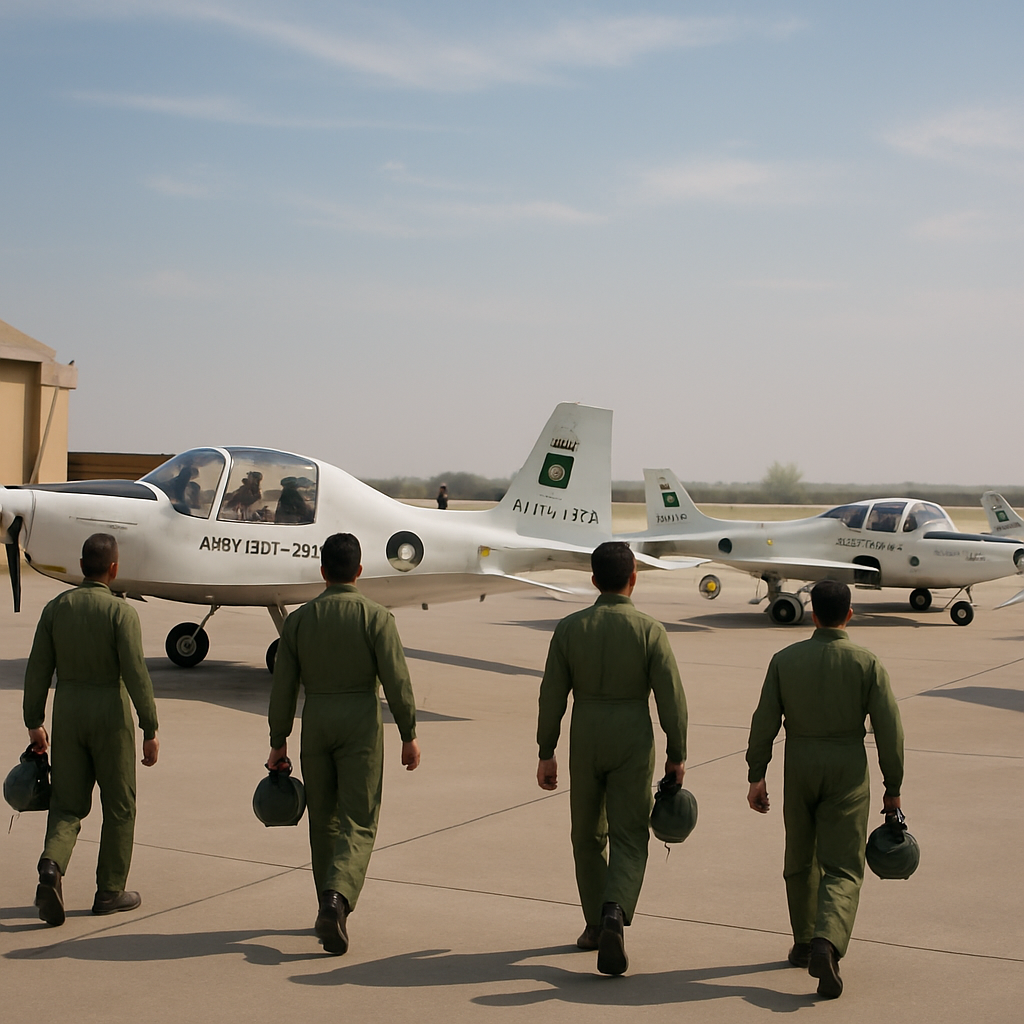
The PAF’s training pipeline rests on four legacy types: the Super Mushshak for ab initio training, the Cessna T-37 Tweet as the basic jet trainer, the Hongdu K-8 Karakorum for intermediate/advanced jet training, and the Chengdu FT-7P/PG used as an interim lead-in fighter trainer (LIFT) by the Shooter Squadron at PAF Base M.M. Alam. The T-37s date from the 1950s and survive only through repeated service-life extension programs; Flight Global recorded at least 18 active T-37s plus 34 surplus units from Turkey. PAC produces the Super Mushshak and has exported it widely. The K-8 fleet numbers at least 38 active airframes, while the FT-7P/PGs are listed among legacy platforms the PAF marked for retirement in January 2024.
The core deficit: no dedicated modern LIFT
The PAF lacks a purpose-built LIFT that can replicate the avionics, data links, and subsystem workflows of its 4th–4.5th‑generation fighters. Pilots currently move from the subsonic K-8 directly to an operational conversion unit (OCU) on AESA-equipped, HMD/S-integrated, TDL-networked fighters such as the JF-17C Block‑III and J-10CE. AHQ first signalled the formal LIFT requirement in 2015; CAS Sohail Aman evaluated the KAI T-50 and Hongdu L-15 but rejected them as too expensive. Specifications set in 2018 called for an afterburning engine, a multi‑mode radar, and a tactical data link; by 2019 the afterburner was made optional. The L-15B tested in Pakistan in late 2023 has not translated into a signed contract, and the Shooters’ FT-7P/PGs are aging toward retirement — leaving a persistent gap between K-8 training and platform-specific OCU.

Audit-ready is a season. It shouldn't be.
Evidence in spreadsheets, controls drifting between audits, frameworks multiplying on flat headcount. Nubivance runs continuous compliance on Rapid7 Cyber GRC - SOC 2, HIPAA, ISO 27001, PCI, CMMC.
End the scrambleCapability disaggregation and the training scale problem
What was once concentrated in a small elite tier of F-16s has diffused horizontally. The JF-17C Block‑III, J-10CE, and future fighters carry AESA radars, HMD/S, integrated ECM, Link‑17 TDL, BVR missiles, and precision-strike weapons. The PAF’s ISTAR, EW and C2 layers — Erieye AEW&C, TPS‑77 radars, passive ELINT systems, indigenous ELINT, and a new Space Command — now create a fleet-wide operating environment. The result: tactical complexity is a common baseline for every frontline pilot. Where the PAF once needed advanced training for perhaps 75–100 pilots, the requirement expands toward 300+ pilots. Quwa’s analysis suggests a LIFT fleet of 80+ aircraft may be necessary rather than the 12–16 units initially contemplated.
Vendor and industrial pathways: three concrete opportunities
- Primary trainer — domestic design through PAC/NASTP: The Super Mushshak is not yet urgent for replacement, but the report identifies a next‑generation turboprop as Pakistan’s highest strategic industrial opportunity. A locally designed, glass‑cockpit turboprop with HOTAS and embedded training could sell for $3–5M and leverage PAC’s production and export network. The Baykar–Piaggio Aerospace acquisition (completed 30 June 2025) positions Baykar as a possible partner; Baykar is investing in turboprop/turbofan engine development and already collaborates with the PAF on UAVs.
- LIFT — Chinese import (L-15B or JL-XX): Fleet interoperability and an ITAR‑free path make the Hongdu L-15B the near‑term candidate. The L-15B offers afterburning engines, PESA X‑band radar, glass cockpit, FBW, HOTAS, and a 3,000 kg payload; UAE pricing for 12 L-15s (~$440M) implies about $36.7M per unit inclusive of support. Projected requirements have ranged from 30–40 units to as many as 80+ if dual-role light-attack uses are included. HAIG’s JL‑XX, test‑flown in 2025, could be an alternative if it materializes in time.
- Basic/intermediate jet — off‑the‑shelf import or K-8P completion: This tier has been neglected and may be satisfied either by completing the K-8P glass cockpit upgrade across the fleet or by procuring an off‑the‑shelf trainer (candidates named include Leonardo M‑345 HET, L‑39NG, or a turboprop such as the TAI Hürkuş). The realistic path favours turnkey imports with NASTP/PAC offsets rather than original design for this mid‑tier.
Downstream market: LVC, simulators, and courseware
Beyond airframes, the largest sustained market lies in software, simulation, and ranges. A full live‑virtual‑constructive (LVC) system — constructive entity generators, synthetic inject‑to‑live middleware, scenario authoring, after‑action review tools, and networking — would multiply the value of LIFT flight hours and could reduce total training costs by an estimated 30–50% versus live‑only training. Full‑mission simulators, visual databases of Pakistani terrain, adaptive courseware, AI‑driven performance analytics, and range instrumentation represent long‑term work packages that NASTP, PAC and private software firms could capture, potentially partnering with primes such as CAE or CETC for architecture and standards.
What this means for Air Headquarters, NASTP/PAC, and Baykar
- Air Headquarters (AHQ): Faces a fiscal trade‑off — immediate deterrence platforms (SAMs, fighters, AEW&C, drones) continue to absorb capital, while the LIFT requirement remains fiscally deferred despite being operationally urgent.
- NASTP/PAC: Can use the primary‑trainer program and LVC contracts to seed indigenous design, industrial scale, and exportable IP, turning aircraft sales into higher‑value training systems.
- Baykar: Presents a concrete industrial partner through its Piaggio Aerospace acquisition and existing Pakistan collaborations, particularly on turboprop/turbofan development and UAV co‑development.
Conclusion — The PAF’s training gap is not an administrative shortfall but a doctrinal inflection: advanced capabilities are now a fleet‑wide baseline and so is the need to teach them at scale. The L‑15B (or HAIG’s JL‑XX) may plug the most critical hole, but the larger, enduring work is domestic: a next‑generation primary trainer, a completed basic/intermediate solution, and an LVC backbone. Together those investments are the multiplier that turns limited aircraft numbers into credible deterrent effect — a fact AHQ’s operational record, from Swift Retort to Bunyan‑un‑Marsoos, has repeatedly proved.
Source: Quwa — Demand Tracker: The Pakistan Air Force’s Air Training System Requirements