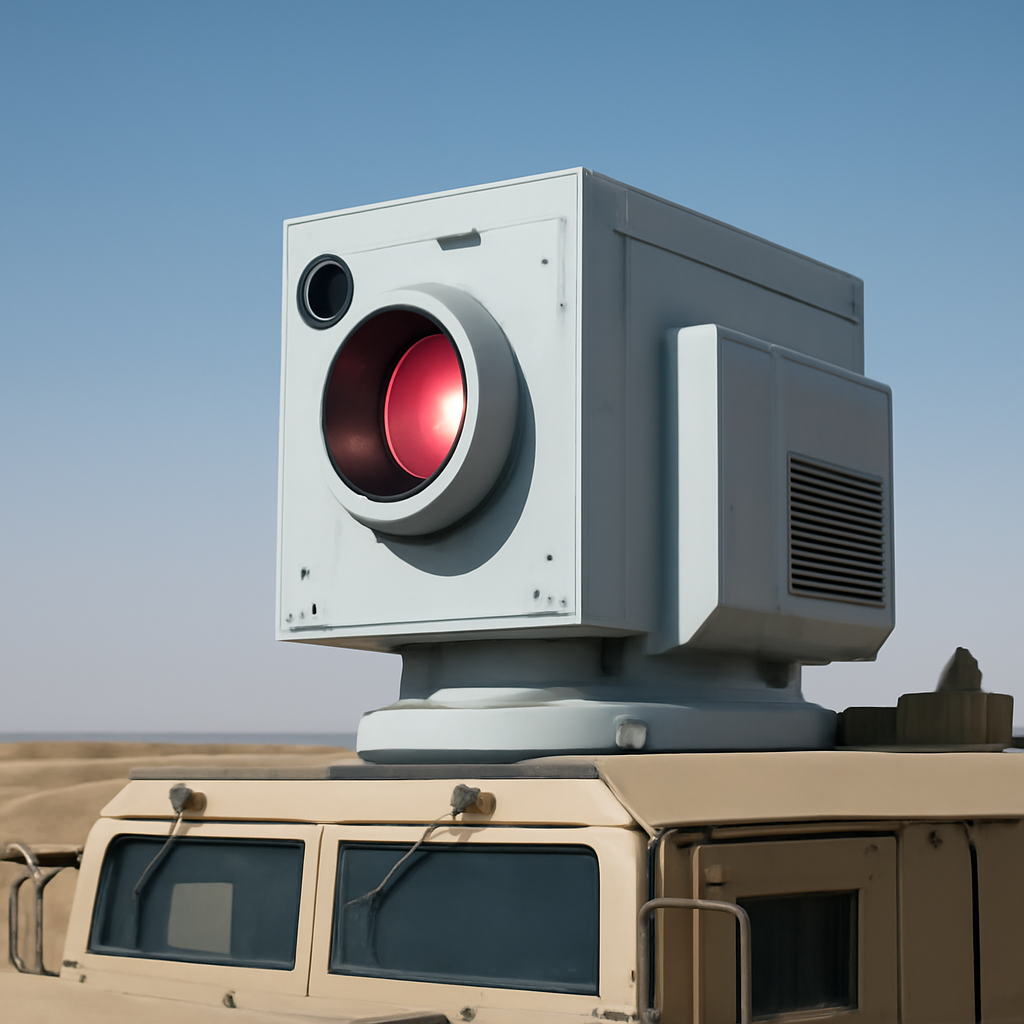
"The first known DEW program came through the Pakistan Navy’s (PN) tender for two high-energy laser (HEL) systems."
Pakistan's current C-UAS posture
Pakistan’s counter‑UAS (C‑UAS) efforts, as reported, rest primarily on electronic‑warfare (EW) systems for wide‑area denial and anti‑air guns (AAG) as the principal hard‑kill layer. That posture is being augmented by potential interceptor drones and, since 2024, an effort to field directed‑energy weapons (DEW) including high‑energy lasers (HEL) and high‑powered microwaves (HPM). The Pakistan Navy’s tender for two HEL systems represents the first explicitly documented DEW procurement, and the PAF has signalled via a promotional video that it is exploring both HELs and HPMs.
Why the PAF would seek 10 kW–30 kW HELs
Quwa’s assessment frames HELs in Pakistan as tools aimed at countering sporadic loitering munitions and low‑intensity, asymmetric threats rather than mass saturation attacks. For that mission set, the PAF is expected to prioritise protection of air bases and domestic counter‑insurgency/counter‑terrorism (COIN/CT) tasks. The likely power band identified for those requirements is 10 kW to 30 kW—sufficient against slow‑moving loitering munitions while remaining cost‑accessible and not classified as the most sensitive technology.

Audit-ready is a season. It shouldn't be.
Evidence in spreadsheets, controls drifting between audits, frameworks multiplying on flat headcount. Nubivance runs continuous compliance on Rapid7 Cyber GRC - SOC 2, HIPAA, ISO 27001, PCI, CMMC.
End the scrambleOperational limits of HELs and the need for layered defence
The source emphasises key performance constraints: HELs incur a dwell time measured in seconds for each shot, plus a recovery lag between shots, which limits their ability to defeat saturation strikes or high‑speed threats alone. As a result, HELs must be integrated into multi‑layered architectures alongside EW, HPM and kinetic systems. Poland’s stated requirement for 150 HELs to augment point‑defence, and Israel’s limited induction of 100 kW systems to augment Iron Dome, are cited as examples of HELs serving as an adjunct layer rather than a stand‑alone solution.
Likely suppliers and procurement dynamics
Given Pakistan’s established procurement relationships and financing considerations, the assessment anticipates Chinese suppliers to be the most likely providers for PAF HELs in the 10–30 kW band. China already supplies a wide range of Pakistan’s air‑defence systems, and the source argues accessibility and financing would not be obstacles. Türkiye is also flagged as a plausible competitor, able to offer loans, technology transfer and offsets as it has in other Pakistan defence programs. The reporting notes that Western suppliers do not face regulatory reasons to abstain, but warns that staying out of the market would cede a potential customer to China or Türkiye.
The source situates HELs within Pakistan’s wider air‑defence choices: while some modern surface‑to‑air missiles (SAM) such as the MBDA CAMM‑ER are available to Pakistan, the PAF has opted to invest in the Chinese HQ‑16FE for conventional threats requiring longer range and higher maneuverability. The Pakistan Navy’s two‑unit HEL tender appears to be a pilot‑scale project likely aimed at configuring two Tughril‑class (Type 054A/P) frigates.
What this means for the Pakistan Air Force, Pakistan Navy, and potential suppliers
- Pakistan Air Force: The PAF will prioritise base protection for COIN/CT operations and is likely to target 10–30 kW HELs to neutralise sporadic loitering munitions without depleting kinetic inventories.
- Pakistan Navy: The PN’s tender for two HEL systems is probably a pilot project to fit Tughril‑class/Type 054A/P frigates and to evaluate ship‑borne DEW concepts at limited scale.
- Potential suppliers (China, Türkiye, Western vendors): China and Türkiye are positioned to offer accessible financing and transfer options; Western suppliers face a competitive market choice where non‑participation risks ceding business to those competitors.
In short, Pakistan’s move toward HELs appears pragmatic and narrowly focused: smaller, cost‑effective DEW systems to handle sporadic UAS threats in COIN/CT contexts, integrated with EW and kinetic layers for resilience against larger, higher‑speed attacks. The decisive variables will be the PAF’s selection of power class (the 10–30 kW band signalled), the scale of initial buys, and which suppliers — Chinese, Turkish or Western — win the trial and follow‑on business.