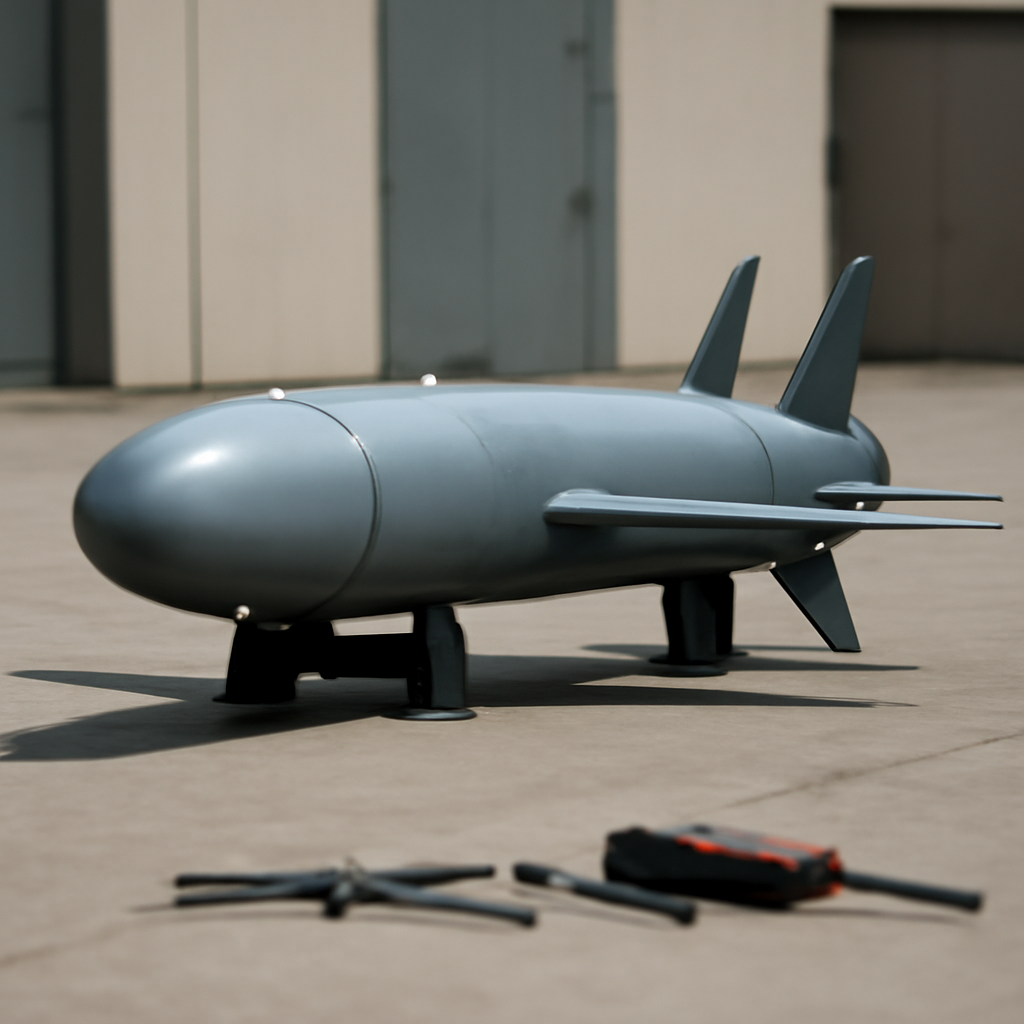
“The real differentiator is the warhead and total weight.” That stark technical point from Quwa frames how Pakistan’s missile developers are positioning themselves in a global shift toward cheaper, mass-producible cruise munitions.
Sizing and design: where weight, warhead, and cost meet
Across multiple vendors in the United States, Europe, and the Middle East, manufacturers are pursuing two related but distinct paths: very light, jet‑powered one‑way attack (OWA) drones, and low‑cost cruise missiles (LCCMs) that deliberately trade complexity for heavier payload and sustained range. Quwa notes the practical line between the two is not purely range but rather total mass and warhead size — LCCMs occupy the heavier end, often targeting warhead masses in the hundreds of kilograms (e.g., 200–400 kg), while OWAs and light ALCMs carry smaller warheads.
Concrete examples crystallize the distinction. Pakistan’s Sarfarosh is offered with a 1,000 km range, a 175 kg total mass, and a 50 kg warhead; by contrast, Zone 5’s AGM‑188A Rusty Dagger carries a 45 kg warhead at roughly 200–225 kg total mass and targets a unit price point near USD $150,000. Design simplifications that appear across LCCM concepts include fixed control surfaces, externally mounted miniature turbojets (often COTS), and omission of integrated air intakes — all choices intended to lower production and maintenance costs.
Platforms Pakistan could scale: Sarfarosh, Fatah‑4, and the Babur lineage
Quwa outlines several pathways for Pakistan to field cheaper cruise missiles without wholly new programs. One option would be to enlarge Sarfarosh, which already mirrors Crossbow‑like design attributes in miniature. A more likely avenue, the analysis argues, is further simplification of the Fatah‑4 — the Pakistan Army Rocket Force Command’s (ARFC) land‑attack cruise missile — to make it highly scalable and lower complexity.
Alternatively, NESCOM could evolve the Babur lineage (including Harbah NG and Fatah‑4) as higher‑end options while spinning off cheaper, mass‑production variants. The argument is procedural: ARFC’s mission is guided strike at scale, and simplifying existing designs (fixed control surfaces, externally mounted turbojets, launcher compatibility) could remove industrial bottlenecks tied to specialized canisters and vehicles.

This site is the portfolio.
OSINTSights runs on Cloudflare Workers, D1, R2, and Vectorize, with an AI pipeline on Hetzner ARM. Nubivance designed, built, and operates it. We do the same for clients.
See what we buildAir‑launched options: KaGeM V3, LAHAB engines, and NESCOM’s ALCMs
The Pakistan Air Force’s KaGeM V3 — developed by the National Aerospace Science and Technology Park (NASTP) and Turkiye’s Baykar Group — is a miniature ALCM with a 20 kg warhead and an estimated 70–100 kg total weight. Quwa suggests NASTP could scale KaGeM V3 into a Rusty Dagger‑like ALCM (45 kg warhead, ~225 kg total) if it follows the same simplified design approach: fixed stabilizers, fewer integrated systems, and reliance on miniature turbojets.
NASTP is reportedly developing a family of miniature turbojet engines under the LAHAB series (LAHAB‑20/‑40/‑60/‑80). Quwa points out that if one LAHAB variant is at least analogous to the Czech PBS TJ80 (which powers the Rusty Dagger), then a larger ALCM is likely under development. NESCOM is also developing two ALCMs — AZB‑81LR and Rasoob 250 — that sit in the AGM‑188A weight class and could be adapted into simpler, lower‑cost designs.
Industrial inputs and policy levers: MoDP, SOEs, and private firms
Quwa emphasizes that Pakistan already possesses many of the core ingredients to build LCCMs: loitering munitions work, SSM efforts, and increasing localization of upstream inputs like piston and miniature turbojet engines. But the current model includes bottlenecks. Quwa reports significant restrictions within Pakistan on basic munitions testing, though reforms are reportedly beginning and some private firms (for example, Woot‑Tech with its RATO‑150) have been allowed to develop and test controlled materials.
To accelerate scale, Quwa offers three practical policy options. First, the Ministry of Defence Production (MoDP) could establish accessible, commercial‑oriented testing facilities (instrumentation, windtunnels, etc.) that private companies could lease under strict controls. Second, state‑owned enterprises (SOEs) such as NESCOM or NASTP could co‑invest in ventures with private partners, aligning incentives and easing technology transfer. Third, explicit clearance and support for private design work — including modest annual funding from the armed forces for pilot demonstrators — could spur private companies to prototype Crossbow, Rusty Dagger, and related concepts domestically.
What this means for ARFC, NASTP, and private developers
- ARFC (Pakistan Army Rocket Force Command): has institutional incentive to simplify the Fatah‑4 and widen launcher compatibility to enable high‑volume strike capabilities.
- NASTP and the Pakistan Air Force: possess a roadmap to scale KaGeM V3 into larger, lower‑cost ALCMs if LAHAB engine variants match required performance (analogy to the PBS TJ80 is noted by Quwa).
- Private firms and newcomers (e.g., Woot‑Tech): stand to gain if MoDP or SOEs provide testing access, co‑investment, or explicit clearance to conduct original design and testing work under controlled terms.
Taken together, Quwa’s reporting argues Pakistan is well placed to join an international trend: deliberately simplified cruise munitions designed for cost and scale. The technical building blocks exist — design templates favoring fixed surfaces and external turbojets, engine development, and existing missile families — but unlocking mass production, Quwa concludes, will depend as much on policy changes and industrial arrangements as on engineering choices.