“Atlas”, which it terms as its “perception stack.” — Gradient Aerospace
Indus RAS Expo 2026 and the Sky47 data centre
Last week Pakistan’s Ministry of IT and Telecom hosted the inaugural Indus Robotics and Autonomous Systems Expo (Indus RAS Expo 2026), where state-owned enterprises (SOEs) and private companies displayed drone, robotics, and artificial intelligence work. Immediately after the exhibition, the government inaugurated Sky47, a new hyperscale-capable data centre described as a key node in Pakistan’s effort to build sovereign cloud and AI capabilities. Although the expo included significant commercial and civilian industry participation, defence applications were prominent across booths and demonstrations.
Interceptor drones and integrated command-and-control work
Pakistan’s push into interceptor drones has moved from concept to multiple concurrent efforts. In May 2026 the Pakistan Army revealed it was working on interceptor drones and released a video still showing a large number of interceptors it had tested. By July, Pakistan publicly identified at least three different integrated interceptor drone systems. Heavy Industries Taxila (HIT) announced the P-905, which pairs an I-402 interceptor drone with the OR-503 dual-radar and electro-optical (EO) tracking system, presenting an integrated sensor-and-kinetic solution.
The Pakistani approach mirrors an operational lesson emphasized at the expo: interceptors are most effective when embedded into an integrated C2 stack that fuses sensor inputs and vectors assets. The report referenced Ukraine’s Sky Map system as an example of such integration — Sky Map aggregates acoustic sensors, radars, and other nodes to generate situational awareness and vector interceptor units — and noted Ukraine’s claimed use of interceptors to destroy thousands of drones during recent fighting.

This site is the portfolio.
OSINTSights runs on Cloudflare Workers, D1, R2, and Vectorize, with an AI pipeline on Hetzner ARM. Nubivance designed, built, and operates it. We do the same for clients.
See what we buildPrivate-sector autonomy stacks: Gradient Aerospace’s “Atlas” and kinetic pairings
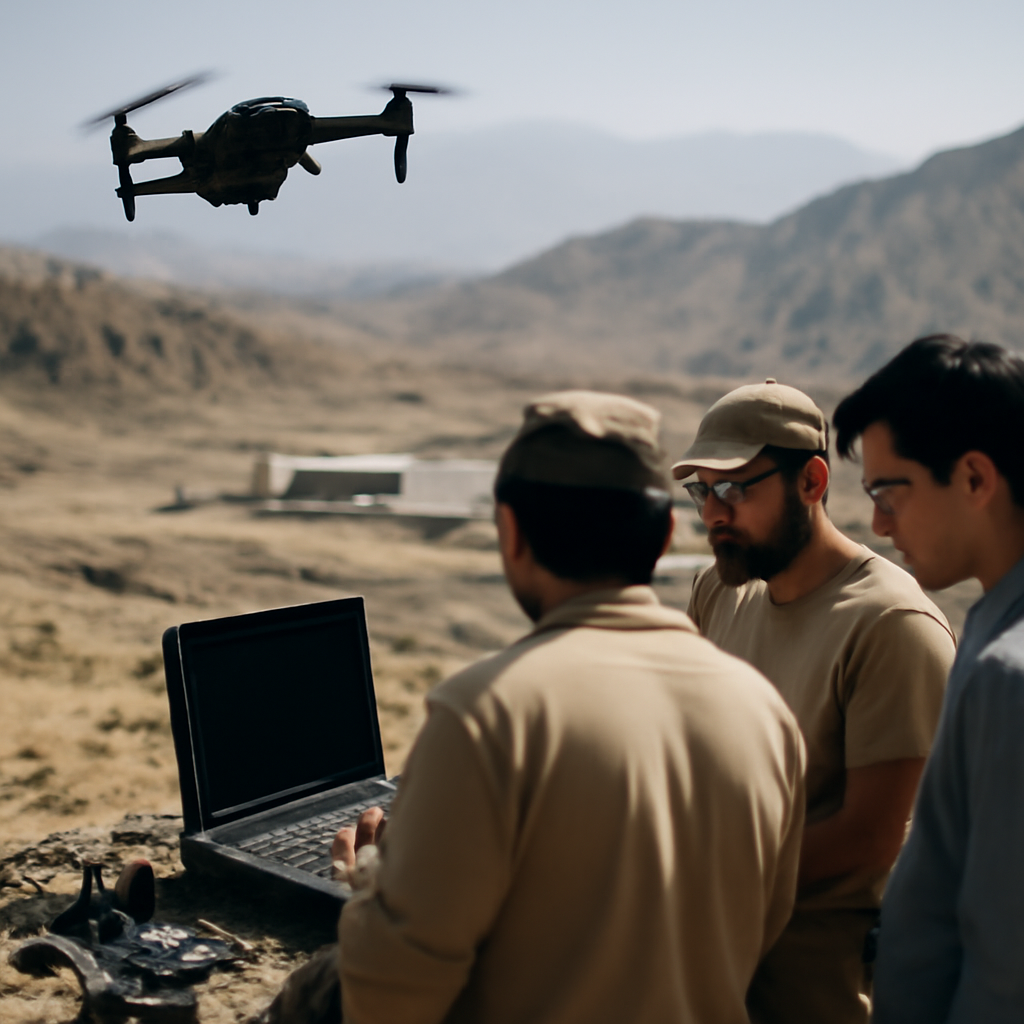
Private firms are explicitly building the autonomy and data-link layers that link sensors to interceptors. Gradient Aerospace unveiled “Atlas”, which it terms its “perception stack.” According to the company, Atlas fuses multiple sensor sources for target detection and classification and routes tracks via secure data-links to enable interceptors to initiate pursuit with human-in-the-loop authority. Gradient is also developing two kinetic drones to work with Atlas: Swift, a lightweight interceptor, and Shark, a larger high-speed human-operated interceptor.
Quwa reported another private CEO developing similar capability focused on the data-link and autonomous pursuit layer. The account also notes overlapping work at SOEs such as the National Engineering and Scientific Commission (NESCOM), National Radio and Telecommunication Corporation (NRTC), and the National Aerospace Science and Technology Park (NASTP).
Loitering munitions: long-range, piston-powered designs proliferate
SOEs and private firms both showcased new loitering munitions. HIT revealed the D-248, a tailless delta-wing loitering munition with a range of up to 3,000 km, cruising speed of 150–250 km/hour, flight ceiling up to 4,500 m, endurance over 11 hours, and payload capacity in excess of 40 kg. HIT also revealed the S-369, a cranked delta-wing design optimized for long-range strike with a 2,000 km reach, a flight ceiling of 4,500 m, and a payload of 50+ kg.
Sysverve, described in the report as a commercial front of an SOE, showcased the Mudamir-LR, a tailed-delta loitering munition with a 600 km range that entered mass production earlier in 2026. Among private vendors, NaqCoDE Technologies revealed two designs: the Ateed (MTOW <19 kg, 4 kg warhead, 250 km range) and the Nasr (under 80 kg, 15 kg warhead, 1,500 km range). The report observed that private companies can produce concepts and prototypes quickly but are often limited by upfront investment and testing bottlenecks.
The larger picture described at the expo is a doctrinal mix: lower-cost, slower piston-powered loitering munitions for mass long-range strike working alongside jet-powered munitions such as Woot-Tech’s HiMark-25TJ and Nimbus-2K, GIDS’ Delta Baaz and Sarfarosh, and NASTP’s KaGeM V3. One capability the report flagged as missing at present is an integrated decoy drone or payload — for example, a module that could be fitted to a munition like the KaGeM V3 to spoof radars.
Kamikaze USVs and maritime options: Beyond Koncept’s Muhassir
Naval unmanned surface vessels also moved toward offensive roles. Beyond Koncept — a company the report notes is likely connected to NESCOM — earlier presented the Muhassir USV as an ISR platform. At Indus RAS Expo 2026, Beyond Koncept confirmed the Muhassir can be fitted with explosives via a bow-placed explosives hatch, converting it into a kamikaze USV. The report situates that development alongside recent examples of kamikaze USV employment by other countries, noting both offensive and defensive uses.
Industrial scale, duplication, and procurement pressure
The report outlines two industrial tensions. First, multiple SOEs and private firms are working on overlapping solutions, raising potential efficiency concerns. Second, private vendors face capital and testing constraints that could constrain prototyping and production unless the government or armed forces provide regulatory reforms, development funding, or order guarantees. Quwa observed that while Pakistan is unlikely to match Ukraine’s production scale — which the report cites as 30,000 to 60,000 interceptor drones per month — Pakistan could conceivably reach monthly run-rates in the thousands or, in a higher-output scenario, exceed 10,000.
Pakistan’s public- and private-sector activity at Indus RAS Expo 2026 shows a coherent direction: the country is building not just drones and munitions but the sensor, data-link, and autonomy stacks to network them. The technical designs and productization are advancing; the next, decisive challenge is scaling manufacturing and operational testing — a task the report points directly to government funding, procurement choices, and regulation as the likely enablers or choke points.