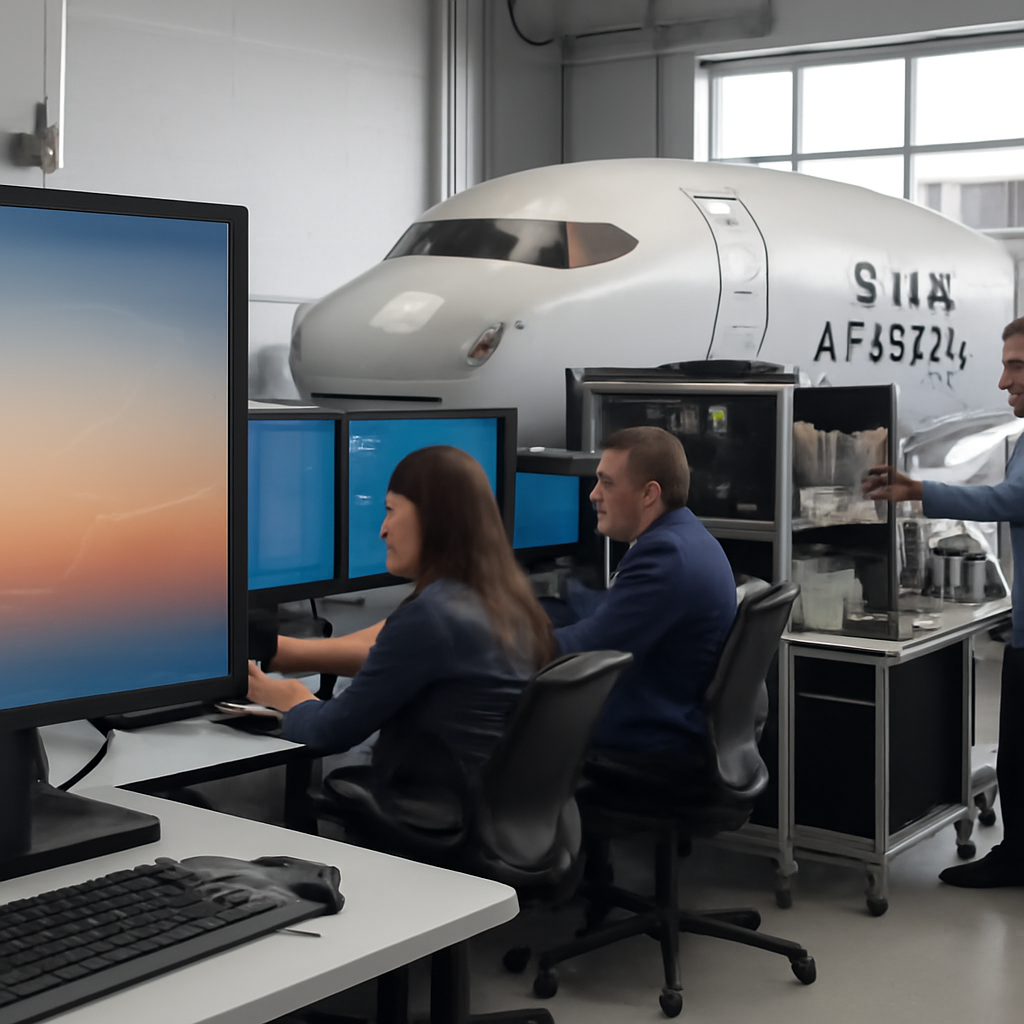
"A P-8A operator issued machine readable, machine actionable mission tasking to a simulated MQ-4C Triton using UCI formatted messages," Boeing said in its release describing a first-of-its-kind laboratory test.
Laboratory demonstration: what happened
Boeing and Northrop Grumman reported a joint, laboratory-based test that showed P-8A Poseidon crews could issue direct tasking to MQ-4C Triton systems. The exercise used simulations only — "the testing was conducted in a laboratory environment and no real aircraft were involved," the companies said. Boeing described the interaction in operational terms: "The P-8A cued the Triton transit to a specific area. After receiving the request, the Triton autonomously planned and executed a transit to the area, employed sensors per the tasking, processed findings onboard, and reported results back to the P-8A Poseidon."
How the P-8A and MQ-4C interacted
Both platforms were treated as a team in the test. Northrop Grumman said Triton’s system "used AI algorithms to collect, process and share intelligence data with P-8A Poseidon in response to a request sent by the P-8A Poseidon system." Data routes included satellite relay to reflect "realistic operational communications," Northrop added. Boeing emphasized that mission management and autonomy layers communicated via OMS/UCI rather than custom point-to-point interfaces, allowing direct, machine-readable tasking from the P-8A to the Triton.

This site is the portfolio.
OSINTSights runs on Cloudflare Workers, D1, R2, and Vectorize, with an AI pipeline on Hetzner ARM. Nubivance designed, built, and operates it. We do the same for clients.
See what we buildStandards, autonomy, and data flow
The demonstration relied on open-standards interfaces and onboard autonomy. Boeing stated that using UCI — the Universal Command & Control Interface — lets "the platforms collaborate with any U.S. or allied asset sharing the same interface," reducing operator workload and accelerating decisions. Northrop and Boeing both highlighted onboard processing: Triton planned and executed transits autonomously and performed initial processing of sensor data so it could "report results back" without sending raw volumes of information back to a distant command node.
The source materials describe specific sensing and communications capabilities on each platform: the P-8A carries a surface search radar with a synthetic aperture radar (SAR) mode, a sensor turret with electro-optical and infrared full-motion video, and a signals intelligence suite; the MQ-4C, derived from the RQ-4 Global Hawk, also has SAR, electro-optical/infrared cameras, electronic support measures for passive ELINT/SIGINT collection, and the ability to descend to lower altitudes for closer inspection. Boeing noted that reducing the amount of data sent can ease bandwidth and latency demands — a purpose of performing initial classification and highlighting onboard.
What this means for the U.S. Navy, allied P-8 operators, and manufacturers
- The U.S. Navy: The service already "teams the two platforms up today," using MQ-4C as a long-endurance ISR asset that "often times feeds us updated posits on contacts of interest," a P-8A pilot assigned to Patrol Squadron Five (VP-5) told TWZ in an earlier interview. Direct tasking from P-8A crews to Tritons could speed responses to sudden developments and reduce reliance on remote ground command centers.
- Allied P-8 operators: The MQ-4C is currently operated by the United States and Australia, and both nations also field P-8s. Several other countries fly or are acquiring P-8s — Canada, Denmark, Germany, India, New Zealand, Norway, South Korea, and the United Kingdom — while Denmark, Finland, Germany, and Norway last month announced a joint plan to acquire and operate a fleet of Triton drones under NATO. Boeing framed the test as enabling "current and future global P-8A operators" to expand mission scope with "low risk, evolutionary enhancements."
- Manufacturers and potential partners: Northrop framed the work as a jointly funded technology collaboration and emphasized industry investment and partnerships. General Atomics is already pitching its SeaGuardian (MQ-9B) as a potential P-8 partner; that platform has been tested with sonobuoy dispensers and the ability to pass sonobuoy data to other nodes, suggesting additional crewed-uncrewed teaming paths beyond Triton.
Next steps and the limits set by acquisition paths
Boeing cautioned that any flight demonstration and fielding will follow customer requirements and "established acquisition, testing and fielding paths." A Boeing spokesperson told TWZ the recent effort was a jointly funded technology collaboration demonstrating an interoperable, standards-based approach intended to be low-risk. The companies did not announce a timeline for a live flight test.
The lab exercise establishes a technical baseline: common interfaces (OMS/UCI), satellite-capable data routing, and onboard AI-enabled processing. It also underscores what both firms described as practical benefits — reduced operator workload, faster decision-making, and easier integration across allied platforms — while leaving deployment timing to customers and formal acquisition steps.