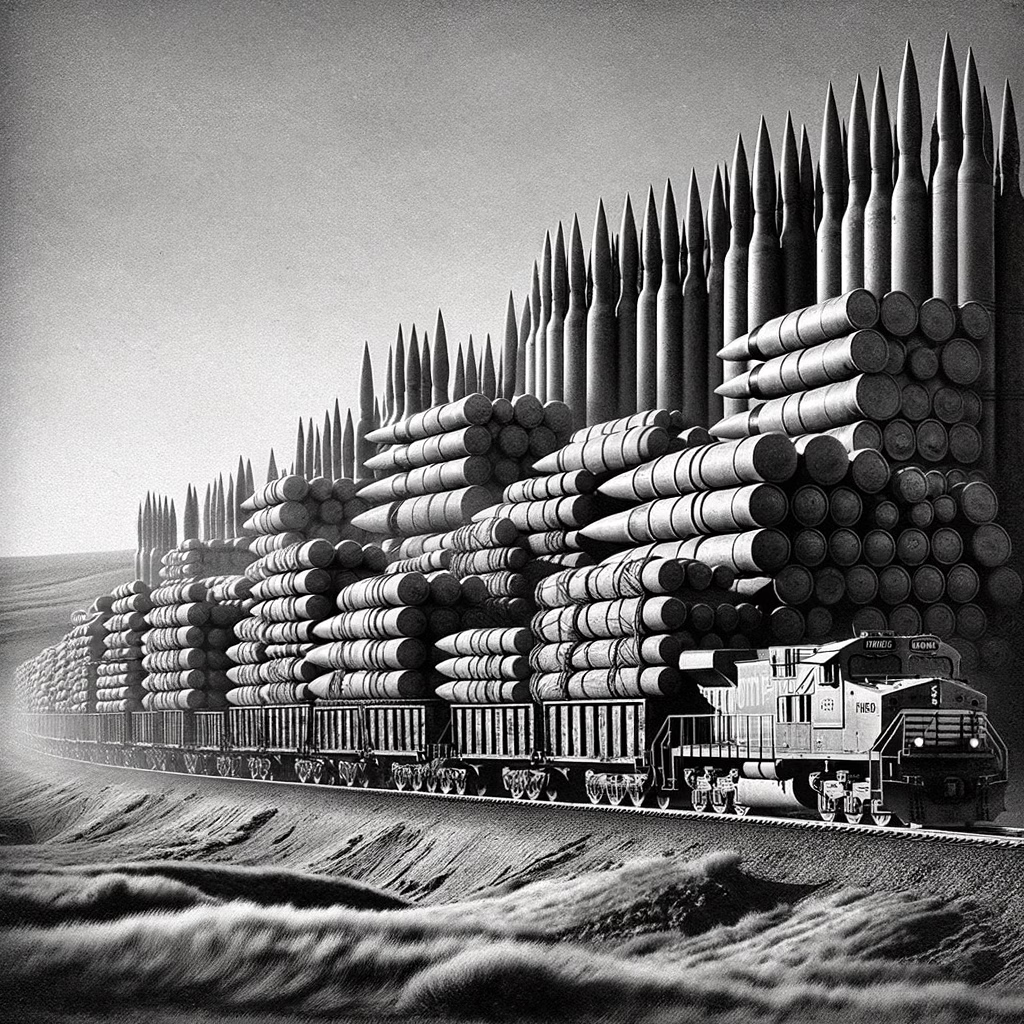
What compels one of the world’s most secretive states to pour millions of artillery shells into another country’s brutal conflict? The answer, it seems, lies at the intersection of geopolitics, survival instincts, and the shifting calculus of global alliances. Recent reports reveal that North Korea has supplied Russia with over 12 million rounds of 152mm artillery shells, a staggering quantity that underscores Pyongyang’s increasingly active role in the Ukraine war.
According to intelligence gathered by South Korea’s Defense Intelligence Agency (DIA), North Korea has dispatched approximately 28,000 containers loaded with weapons and ammunition to Russia. This delivery predominantly includes 152mm artillery shells, a mainstay in Moscow’s military operations. The details, first reported by Defence Blog and confirmed through multiple intelligence channels, indicate a level of logistical support that far exceeds previous estimations of North Korea’s military aid to Russia.
To understand the significance of this development, one must appreciate the ongoing dynamics of the Russia-Ukraine war. Since its onset in February 2022, Russia has faced substantial challenges, including depleted artillery stockpiles and supply chain difficulties. Ukraine’s robust defense and counteroffensive campaigns have highlighted Moscow’s reliance on heavy artillery barrages, making ammunition a critical strategic resource. It is in this context that North Korea’s largesse takes on added meaning.
Pyongyang’s motivations are multifaceted. On one hand, North Korea has been eager to circumvent international isolation, finding in Russia a partner willing to sidestep Western sanctions and offer economic and military support. Some experts see this transfer as a demonstration of solidarity between two pariah states united by common grievances against the West. “This is not just about artillery shells; it’s about signaling and mutual benefit,” noted Ankit Panda, senior fellow at the Carnegie Endowment for International Peace.
From Russia’s perspective, the acquisition of over 12 million rounds alleviates some pressure on its diminishing reserves. The sheer volume of ammunition suggests not only immediate battlefield resupply but also an extended campaign horizon. Russia’s strategic planners face the arduous task of sustaining offensive momentum despite heavy attrition, and North Korea’s contribution provides a vital injection of munitions without the need for diplomatic scrutiny common with Western suppliers.
For analysts and technologists, the scale of this shipment raises questions about logistics, compatibility, and effectiveness. The 152mm caliber is standard in many Soviet-era weapons systems, which Russia continues to employ extensively. However, issues such as quality control, ammunition lifespan, and integration with existing ordnance must be considered. “Sending large quantities is one thing; ensuring operational effectiveness is another,” commented Marcus Weisgerber, defense technology correspondent for Defense News.
Policy makers, particularly in Seoul and Washington, face a dilemma. The revelation underscores North Korea’s growing role as a weapons supplier in a conflict that has global repercussions. It also raises concerns about the potential for expanded arms proliferation and the erosion of international nonproliferation norms. South Korean officials have condemned the transfers, emphasizing that such actions destabilize regional security and violate United Nations sanctions imposed on Pyongyang.
Meanwhile, users on the frontlines in Ukraine face the grim reality of a protracted artillery duel. Each additional shell may alter tactical situations but also prolong human suffering. This intersection of distant political calculations and immediate battlefield consequences serves as a somber reminder of the complexity and tragedy of modern warfare.
Adversaries and allies alike must weigh the implications. The injection of North Korean munitions into the Russian war effort complicates conflict resolution and signals a widening web of international involvement. It challenges efforts to isolate rogue regimes and invites a reassessment of how sanctions and diplomatic pressure are enforced.
As the world watches, one cannot help but ask: Will this massive transfer of artillery shells merely extend the agony of war in Ukraine, or does it foreshadow a deeper realignment of power where conventional military support flows between unlikely partners? The answer remains uncertain, but the stakes have never been higher.