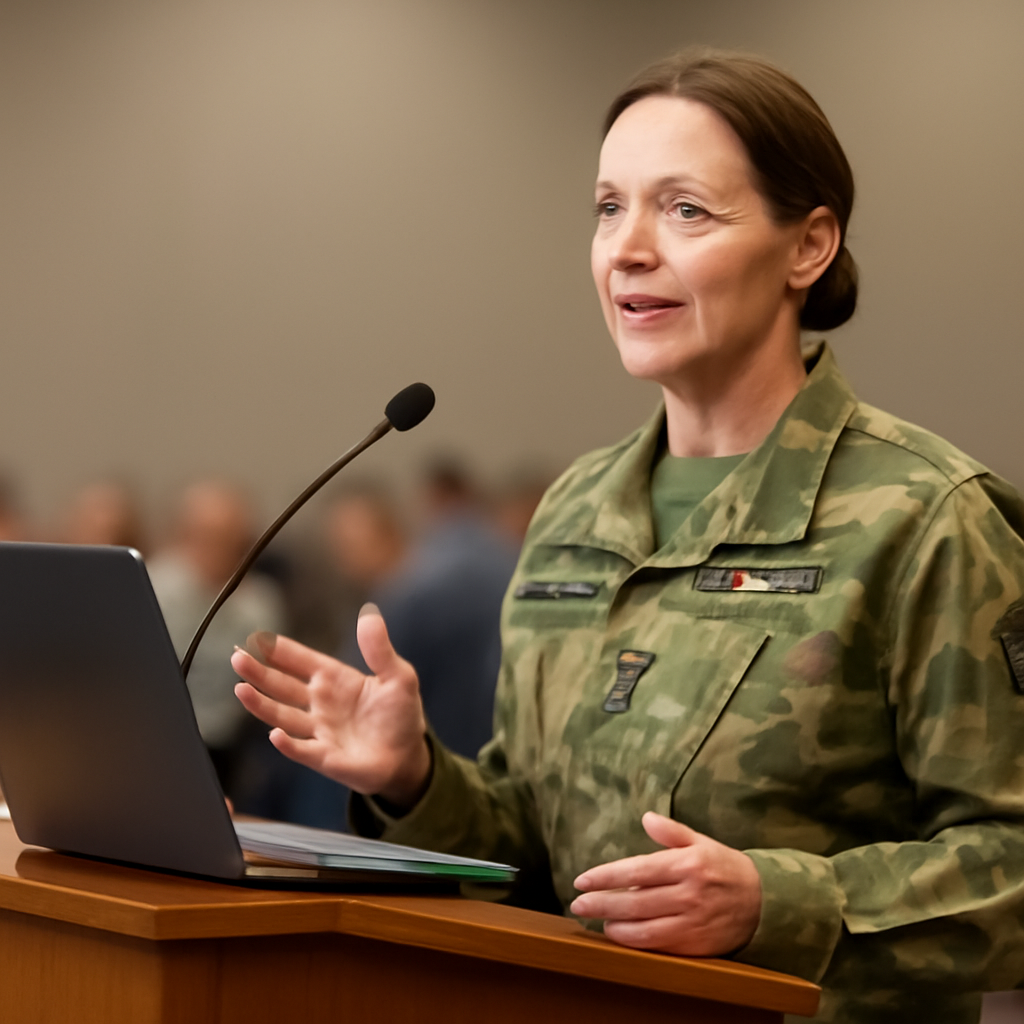
“AI does not replace human judgment. It amplifies it,” NGA Director Army Lt. Gen. Michelle Bredenkamp told the US Geospatial Intelligence Foundation’s annual GEOINT Symposium in Denver, framing a fast-moving push to fold artificial intelligence into the agency’s work.
NGA’s imminent AI blueprint: scope and purpose
Bredenkamp said the National Geospatial-Intelligence Agency is “working to finalize” a new framework for its use of AI and “will make it available very soon.” She described the document as a “blueprint for becoming an AI first organization” that will align to the department’s AI strategy, “reflecting its pace, setting projects, lines of effort and goals.”
According to Bredenkamp, the blueprint will be broad in ambition: it will “cover everything from operationalizing GEOINT and AI across the intelligence cycle: modernizing business operations, revolutionizing acquisition, strengthening our partnerships and maturing AI governance.” The plan, she said, is intended to transform how the agency produces and pushes geospatial intelligence to decision-makers.
Human-machine teaming and governance
Central to Bredenkamp’s message was an insistence that AI will be an amplifier, not a replacement, for human analysis. She said NGA is “building AI-responsible systems where humans remain in the loop on decisions that matter the most,” and framed the respective roles this way: “AI handles the volume, the speed, the pattern recognition across massive data sets, but critical thinking, contextual understanding, the ability to ask, ‘What does this actually mean?’ that is irreplaceable human expertise that we will continue to deliver.”
Her repeated references to AI literacy tools and career pathways — “ensure that every employee is equipped for human machine teaming excellence with AI literacy tools and career pathways that make innovation the norm in our agency” — underscore that governance and workforce development are explicit elements of the blueprint.

Audit-ready is a season. It shouldn't be.
Evidence in spreadsheets, controls drifting between audits, frameworks multiplying on flat headcount. Nubivance runs continuous compliance on Rapid7 Cyber GRC - SOC 2, HIPAA, ISO 27001, PCI, CMMC.
End the scrambleFrom maps and images to a data agency
Bredenkamp framed the shift as a strategic redefinition of NGA’s role. “This is our moment to change, and for NGA, our vision is one beyond just maps and images, one where NGA serves as a data agency, leveraging multi-intelligence along with artificial intelligence to produce the best geospatial intelligence supremacy for our decision-makers,” she said. The new vision and strategy, she added, “ensures we remain ready — ready to meet any operational demand — are resilient against evolving threats and are relevant to the warfighters and the decision-makers that we serve.”
The agency’s statutory role is reiterated in Bredenkamp’s remarks: NGA is the functional manager for geospatial intelligence for the Department of Defense, “responsible for fusing, analyzing and disseminating data from government and commercial intelligence, surveillance and reconnaissance satellites.” The blueprint is being cast as the tool to operationalize that responsibility at AI speed and scale.
Rapid Capabilities Office and acquisition changes
To accelerate delivery, NGA has stood up a new Rapid Capabilities Office (RCO), being led by Chris Parrett. Bredenkamp said she “personally charged Chris and our RCO team with engaging industry and using the full range of acquisition authorities, including Other Transaction Authorities, to deliver capabilities at speed.”
She also stated that the RCO “will take more acquisition risk to reduce our operational risk, because that is what is required in our current environment,” and urged industry to engage: “I urge our industry partners to engage with our RCO team and bring forward your disruptive solutions and assist to help us address our urgent needs.”
Industry engagement: a July industry day on advanced analytics
As a near-term, concrete touchpoint, Bredenkamp said NGA will hold an industry day in July on “advanced analytics,” including both “classified and unclassified forums” to allow for a broad range of innovative input from industry. The item was presented as a bid to solicit both classified and unclassified ideas and accelerate contributions into the agency’s AI push.
What this means for warfighters, technologists, and industry
- Warfighters and decision-makers: Expect faster, AI-assisted streams of GEOINT intended to be more resilient and relevant to operational needs, as NGA shifts toward serving “as a data agency” and delivering “geospatial intelligence supremacy.”
- Technologists and security teams: NGA intends to prioritize AI literacy and human-machine teaming tools and to “mature AI governance,” signalling internal demand for systems that embed human oversight and address governance requirements across the intelligence cycle.
- Industry and procurement leaders: NGA’s RCO under Chris Parrett will use the “full range of acquisition authorities, including Other Transaction Authorities,” and plans to take “more acquisition risk to reduce our operational risk,” while soliciting disruptive solutions at a July industry day that will include both classified and unclassified engagement.
Bredenkamp’s public remarks sketch a clear course: finalizing and releasing a detailed AI framework “very soon,” standing up an RCO to accelerate deliveries, and inviting industry into classified and unclassified dialogues in July. The contours she described — workforce AI literacy, human-in-the-loop governance, acquisition experimentation, and a data-centric agency identity — set specific expectations but leave measurable details and timelines for the agency’s forthcoming blueprint.