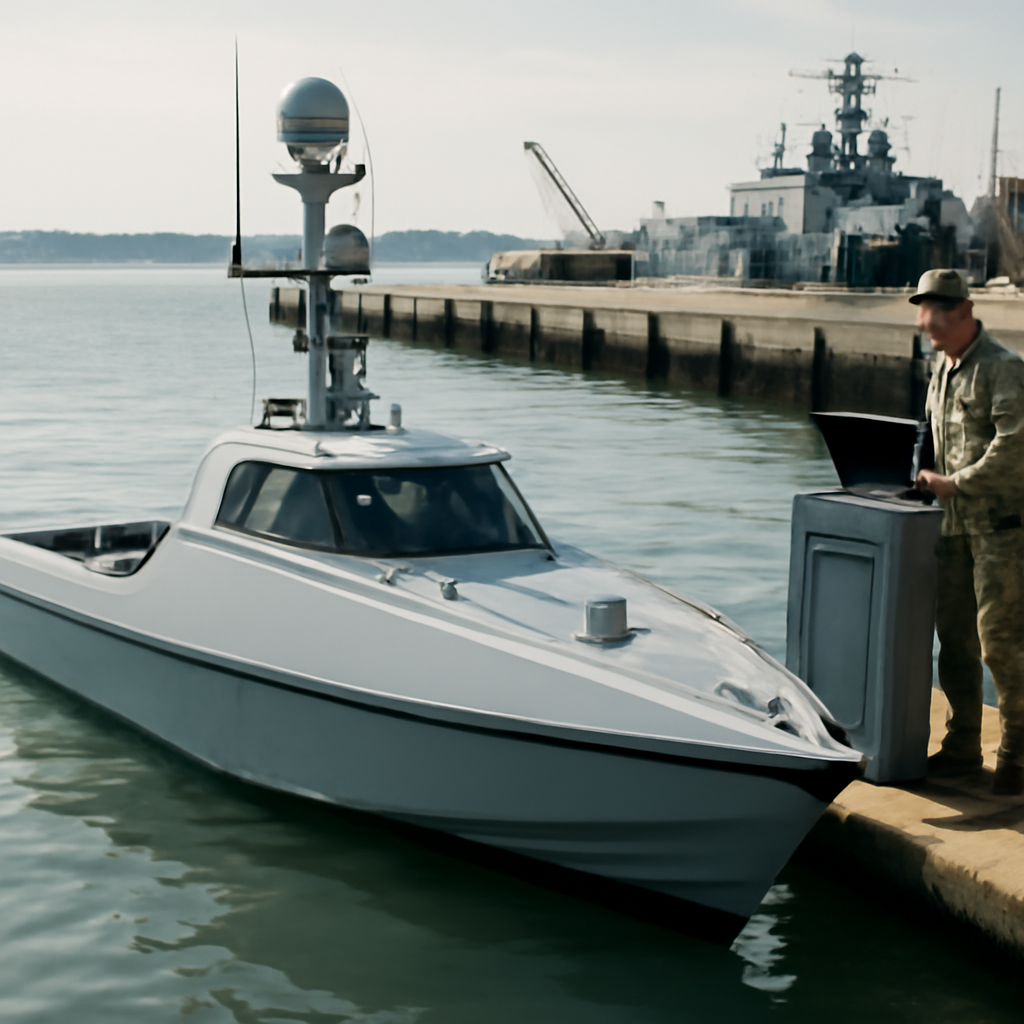
"We're hiring now, and every single new person we hire has to prove some capability of AI and data management," Navy Rear Adm. Michael Baker said at the Defense One Tech Summit.
Navy Rear Adm. Michael Baker on hiring and training
At the Defense One Tech Summit, Navy Rear Adm. Michael Baker laid out a simple, firm threshold for anyone entering the National Geospatial‑Intelligence Agency: proof of AI and data‑management capability. Baker said that “every single new hire has to go through AI and data management training,” and added that the requirement extends to existing staff as well: “Every single old hire has to go through AI training and data management so that all of us are operating inside of the reality of what this ecosystem is.”
AI agents: practical tools and future planners
Baker described AI not as a sidebar but as an active teammate. He said he himself “uses an AI agent at work,” and sketched a near‑term vision in which that agent becomes a trainer: “And a real ideal is, in the future, that agent is also helping to train me,” he said. Baker emphasized an evolution in use cases — from machines that help “understand history” to machines that help “try to predict and understand the future.” He also raised the possibility that AI agents could be employed for “high‑level strategic planning.”

This site is the portfolio.
OSINTSights runs on Cloudflare Workers, D1, R2, and Vectorize, with an AI pipeline on Hetzner ARM. Nubivance designed, built, and operates it. We do the same for clients.
See what we buildHuman resources, risk calculation, and operational relief
Leaders at NGA are exploring AI for tasks beyond pure analysis. Baker said officials are examining AI’s use for human resources work, a change he argued would take “the burden off of the operator.” That specific push is not without internal concern: “Recently, a deputy director of human development at NGA expressed fears that employees would get so dependent on AI that their skills would atrophy,” the agency acknowledged.
Baker further framed AI as a tool to help navigate “the insatiable requirements that the intelligence community” places on risk calculation, suggesting the agency sees generative and agentic AI as a way to scale decision support for complex, rapid demands.
Balancing rapid innovation with security and order
Baker acknowledged the tradeoffs in adopting these technologies. He described the effort as a “balancing act,” saying he wants NGA to “rapidly innovate” while remaining “mindful of security and avoid[ing] ‘chaos.’” “That is the complex pace that we're in,” he said. “That's a really hard challenge for leaders, but it's a pretty fun space to be in.” The phrasing signals a dual imperative: move quickly enough to exploit AI’s capability gains, but build guardrails that preserve operational security and institutional coherence.
Workforce context: rebuilding after last year’s cuts
The agency is pursuing this AI pivot while rebuilding its workforce following “last year’s DOGE cuts,” Baker said. NGA currently lists about 14,500 civilian, military and contract employees on its website. It is unclear how many people left during “the Trump administration’s rush to reduce intelligence‑community headcount by thousands of workers last year,” and Reuters has reported that employment figures for the community’s largest agencies are classified.
What this means for applicants, current employees, and HR leaders
- Applicants: Expect to demonstrate AI and data management skills as part of hiring. New hires will “have to prove some capability” and will be routed through mandatory AI and data‑management training, per Baker.
- Current NGA employees: All existing staff must complete AI and data‑management training, confronting both the practical demands of new tools and concerns about skill atrophy voiced by a deputy director of human development.
- HR leaders at NGA: Leaders are actively exploring AI for human resources tasks to relieve operational burdens, while needing to balance efficiency gains with the workforce development and security considerations Baker described.
NGA’s stated approach is straightforward: institutionalize AI literacy, fold agents into everyday work, and try to maintain order while moving quickly. The strategy leaves concrete, open questions in its wake — notably how the agency will police dependency, measure training outcomes, and reconcile rapid adoption with classified workforce constraints — but the immediate directive is clear: if you want to join NGA, come with AI skills and be prepared to train.