The Saturday test flight at MidAmerica Airport
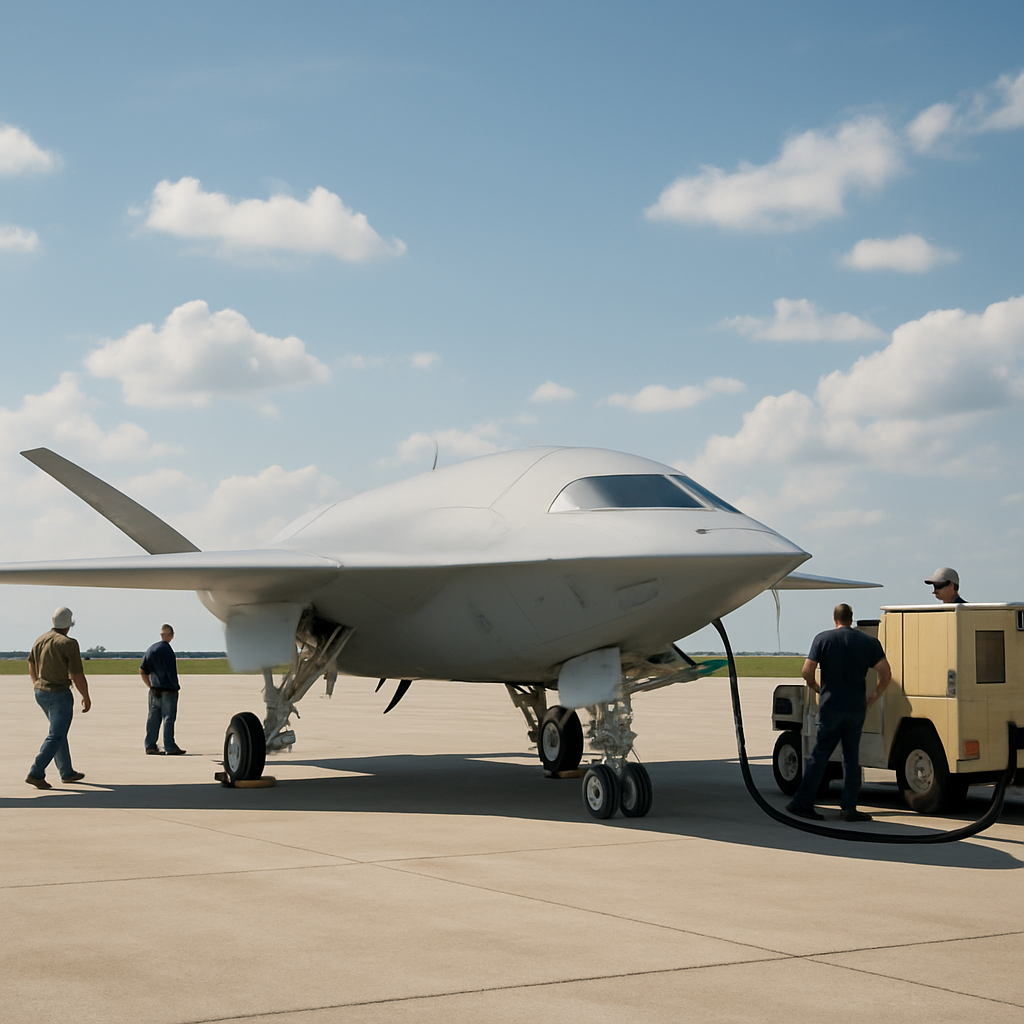
A production representative MQ-25 Stingray unmanned aerial system completed its first test flight on Saturday, taking off from Boeing’s facility at MidAmerica Airport in Mascoutah, Ill. The sortie lasted approximately two hours and, according to Boeing, demonstrated the aircraft’s ability to autonomously taxi, take off, fly, land, and respond to ground control station commands. The flight represents the first test of an operational-production aircraft, distinct from earlier demonstrator flights.
Autonomy, flight envelope, and prior refueling demonstrations
Boeing and Navy statements emphasized autonomous operation as a central element of the test. Boeing described the MQ-25A as capable of responding to ground control station commands while executing core flight phases autonomously. The company also noted that a previous test version of the MQ-25 had demonstrated aerial-refueling capability by refueling three carrier aircraft types: the F/A-18 Super Hornet, the E-2D Hawkeye and the F-35C Lightning II.

Audit-ready is a season. It shouldn't be.
Evidence in spreadsheets, controls drifting between audits, frameworks multiplying on flat headcount. Nubivance runs continuous compliance on Rapid7 Cyber GRC - SOC 2, HIPAA, ISO 27001, PCI, CMMC.
End the scrambleBoeing and Navy messaging on integration and complexity
Dan Gillian, vice president and general manager of Boeing Air Dominance, framed the recent flight as “a major maturation of the program,” saying the success “builds on years of learning from our MQ-25A T1 prototype.” Gillian added that “The MQ-25A is the most complex autonomous system ever developed for the carrier environment,” and called the flight a step toward safely integrating the Stingray into the carrier air wing.
Rear Adm. Tony Rossi’s comment tied the program to operational impact on carrier aviation, stressing unmanned aerial refueling as a means to let manned fighters “fly further and faster.” Those two lines — Boeing’s emphasis on systems maturity and the Navy’s emphasis on operational reach — anchor how the service and the contractor are describing the program’s immediate significance.
Rolls‑Royce’s engine and production context
The MQ-25A flown on Saturday is outfitted with the AE 3007N engine made by Rolls‑Royce. Meagan Rater, Rolls‑Royce director of US Mature Programs, Defense, said the company “will continue to work with the Navy and Boeing to make the aircraft ‘a reality for our service members, giving them a key strategic advantage in contested environments.’” The flight follows production delays and comes after a demonstrator version of the MQ-25 conducted its first flight in 2019.
Program timing, budget signals, and next test sites
Budget and schedule details released this month show the Navy’s fiscal 2027 budget request includes three MQ-25s. The program’s initial operating capability (IOC) date, originally scheduled for 2024, has been postponed several times; new budget documents now indicate the Navy anticipates IOC by FY29. Navy and Boeing plan to continue subsequent test flights out of MidAmerica Airport, then move the aircraft to Naval Air Station Patuxent River, Md., later this year to lay the groundwork for carrier qualifications.
What this means for the carrier air wing, Boeing, and Rolls‑Royce
- Carrier air wing commanders will be watching integration activities at Patuxent River closely, because the Navy frames the MQ-25A primarily as an unmanned refueling asset intended to extend the range and endurance of manned fighters.
- Boeing will use the MidAmerica and Patuxent River test program to translate prototype lessons into production-standard behavior; company statements describe the flight as advancing “closer to safely integrating the Stingray into the carrier air wing.”
- Rolls‑Royce, as the engine supplier, has positioned itself to continue working with the Navy and Boeing through production and testing, stressing the AE 3007N’s role in making the aircraft available to “our service members.”
The flight on Saturday is a tangible step from demonstrator to production-representative aircraft, but it leaves clear next milestones on the calendar: more flights from MidAmerica, transfer to Naval Air Station Patuxent River later this year, carrier qualifications, and the path toward an IOC now expected in FY29. How reliably the production aircraft repeat the demonstrator’s aerial-refueling achievements and how quickly carrier qualifications proceed will determine whether the MQ-25A meets the timeline embedded in the Navy’s FY2027 budget request.
Source: Breaking Defense — Navy’s MQ-25 Stingray carrier drone completes first test flight