"If you do it, I might, like, throw a wild dog in your house," Bala Selvam said, recalling how he forced commanders to stop talking vaguely about “AI” and instead list exactly what they needed to accomplish.
Bala Selvam’s overhaul at Special Operations Command Pacific
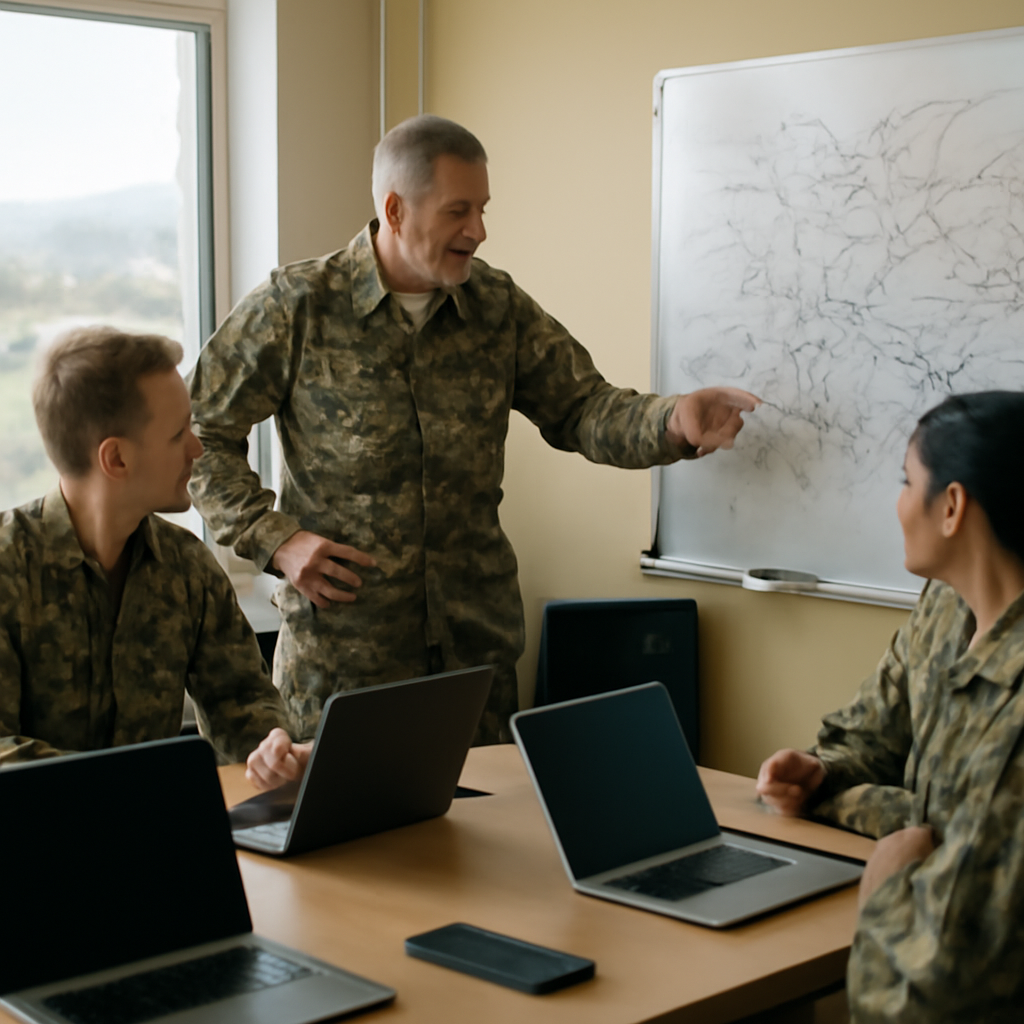
When Bala Selvam, a former Marine, became chief technical officer for Special Operations Command Pacific in early 2025, he found data workflows optimized for plentiful networks and enterprise compute—conditions that do not exist across INDOPACOM’s vast distances. Selvam systematically cataloged tasks from senior leaders, reduced dozens of claimed requirements to a short list he called “commandments,” and then compelled users to prove their needs. For a time he removed computers, installed whiteboards, and required personnel to enter inputs in the Joint Operations Center; only after commanders could specify what they were trying to accomplish did he restore tools such as Palantir and Databricks for those precise tasks.
INDOPACOM’s latency problem: 9,000 miles and milliseconds
Selvam framed the technical challenge in geographic and temporal terms. The distance from INDOPACOM’s Hawaii headquarters to its second-largest data center is 9,000 miles—so long, he said, that even low-earth-orbit satellites do not make transfer efficient. Analysis and bureaucratic flows can add thousands more miles by routing data back to centralized sites—“If you're SOCOM, it goes back to Tampa, or if you're any other service, back over here,” Selvam said, pointing to Washington, D.C. The deadline in this environment is measured in milliseconds: Selvam warned that staying ahead matters because, he said, China is “working 83 percent as quickly.”

Audit-ready is a season. It shouldn't be.
Evidence in spreadsheets, controls drifting between audits, frameworks multiplying on flat headcount. Nubivance runs continuous compliance on Rapid7 Cyber GRC - SOC 2, HIPAA, ISO 27001, PCI, CMMC.
End the scrambleWar Data Platform, Advana, and the cloud picture
The War Data Platform (WDP), a branch of the Pentagon’s Advana data system, is being developed to ingest large numbers of sources and support AI-enabled decisionmaking. Cameron Stanley, the Pentagon’s Chief Digital and Artificial Intelligence Officer, said the WDP is drawing on roughly 4,000 data sources from more than 55 organizations and aims to create “a single pane” or “single repository of truth” for data that was previously disaggregated. Stanley also pointed to recent operational use: during Operation Epic Fury, he said, dozens of new feeds were added in real time to serve applications that had to “get data at the speed of conflict.” He further suggested elements of Selvam’s work “are going to become a program of record here pretty soon.”
AWS, brigade-sized nodes, and the edge inference trade-off
Around January, Selvam traveled to AWS’ Crystal City offices and met Joshua Hobgood, who leads AWS’ military AI sales efforts. The two sketched an approach that departs from large, division-level nodes and instead favors smaller compute clusters sized to support battalions—a few thousand troops—rather than divisions of 20,000 or more. The architecture assumes continuous learning while connectivity exists—“up to the point of a conflict scenario”—with most inference and analysis occurring in the AWS cloud, Hobgood said. But as they fleshed out the plan, Selvam and Hobgood concluded smaller, lower-power models could execute useful AI functions at the edge, enabling tools to “sip power and compute” and still deliver results to troops when enterprise resources are unavailable.
What this means for SOF commanders, the CDAO, and AWS
- SOF commanders: Selvam’s process prioritizes clear task definition. Commanders will have to specify which duties humans perform and which are delegated to AI agents—Hobgood described explicit task lists and limits on agent autonomy as part of operational discipline.
- The Chief Digital and Artificial Intelligence Office (CDAO): The office is consolidating thousands of sources into the WDP and signaling the approach may be formalized as a program of record. CDAO leaders will need to align centralized data repositories with distributed, lower-power compute at the edge.
- AWS (and cloud vendors): AWS has been asked to deliver smaller, resilient cluster designs that support continuous learning while enabling inference on-device or near the edge; the company’s approach must bridge cloud-based training and battlefield-constrained execution.
Selvam summarized the stakes in blunt terms: solving the department’s cross-domain storage (CDS) problem is the mission he set for himself—“If I did solve it, I'm going to put it on my tombstone…It's going to say, ‘I solved the [Department of War] CDS problem,’” he said. The plan he and partners sketched ties three elements together: ruthless task discipline, a centralized repository of many data sources, and a new class of smaller, lower-power compute nodes. How brigade-sized clusters ultimately integrate with the War Data Platform remains unclear, but Stanley’s comment that the approach could become a program of record suggests the Pentagon intends to move from prototype to institutional capability.