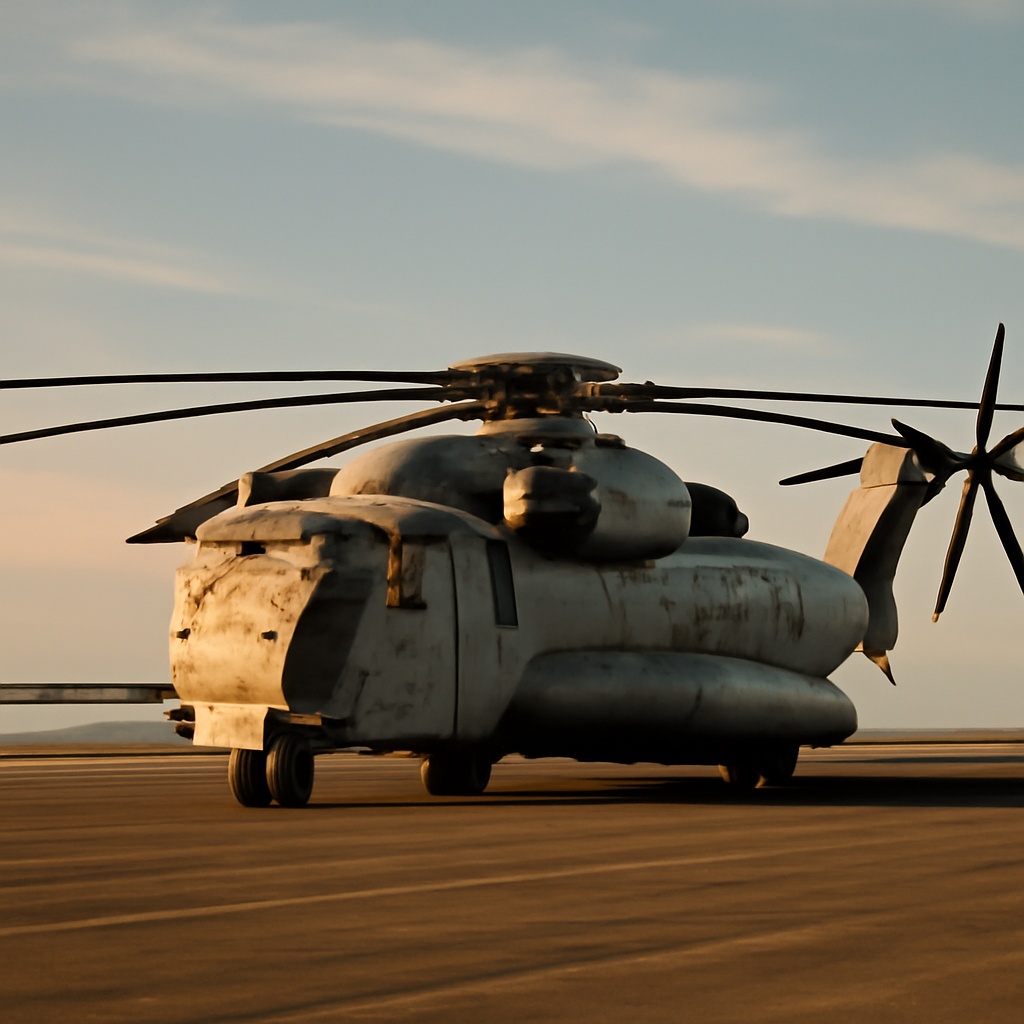
"it's really a young person's game," said Steve Jones, a former MH-53E Sea Dragon pilot who learned the helicopter’s limits the hard way and lived to tell the story.
MH-53E design, endurance, and brute strength
Jones described the MH-53E as a machine built for power: three GE engines, oversized fuel sponsons that held about 22,000 pounds of fuel, and a design tailored to long transit times and heavy tow loads. The sponsons let crews “fly an hour to where the mission objective was, be able to stay on station for about an hour, and be able to fly back,” he said. The airframe was limited to 150 knots for preservation, but under towing conditions crews typically flew between 18 and 25 knots; when not towing Jones said the helicopter could be “one of the fastest out there.”
Tactics and tools: AN/AQS‑14, Mk‑series sleds, and the MOP
The Sea Dragon’s mission paired aircrew with a set of specialized devices. Jones walked through the basic flow: mine hunting with the AN/AQS‑14 side‑looking sonar (“the fish”), marking sonar contacts for change detection, then employing sweep gear tuned to trigger different mine‑activation mechanisms. Acoustic devices such as the Mk‑104, magnetic generators like the Mk‑105, and simple systems such as the Magnetic Orange Pipe (MOP) were part of the toolset. Different devices demanded different towing speeds, altitudes and depths; Jones noted some gear depths were classified during his service, and that towing placed “lots and lots and lots of tension” on the airframe.
That tension was enormous: Jones said towing loads could run about 15,000 to 20,000 pounds, enough to visibly crease the side of a Sea Dragon. Mission tracks were precise — crews flew up‑and‑down “rows” over a box, staying within feet of track; a 20‑foot deviation could require redoing a pass to preserve a continuous map for change detection.

Audit-ready is a season. It shouldn't be.
Evidence in spreadsheets, controls drifting between audits, frameworks multiplying on flat headcount. Nubivance runs continuous compliance on Rapid7 Cyber GRC - SOC 2, HIPAA, ISO 27001, PCI, CMMC.
End the scrambleRisk, mishaps, and the human factor
Jones was blunt about the hazards. The MH‑53E community has a history of fatal mishaps, and Jones pointed to a combination of mechanical complexity and human factors. He recounted a grounding tied to a bearing failure in the main rotor head — a thermal runaway problem that led to fatal accidents and kept aircraft on the ground while investigators fitted monitoring lights and clearer indicators so pilots could distinguish when to “land immediately” versus “land as soon as possible.”
He also described hair‑raising episodes: vertigo while under tow that forced the cross‑checking pilot to take controls, a surfacing submarine that popped up directly along a tow track in the Strait of Hormuz, and a taxi‑out where a shaft sheared and the co‑pilot’s rapid start of the APU restored hydraulics and averted disaster.
Logistics, maintenance, and operational footprint
Operational costs and manpower were central constraints. Jones said every hour of flight required 24 hours of maintenance and squadrons could reach 600‑plus personnel when they fielded ten helicopters. The Sea Dragon was transportable — crews advertised they could be anywhere in the world in 72 hours and Jones described a mass movement during Operation Iraqi Freedom that used 11 C‑5s to move half a squadron to Sicily and the other half to Bahrain. That same scale and cost, he argued, contributed to the mission set being under‑resourced relative to higher‑profile strike capabilities.
Phaseout, new approaches, and what the Navy will miss
The Sea Dragon fleet is being retired: the last 11 aircraft are scheduled to sunset sometime next year and the type is being phased out in favor of MH‑60S Seahawks paired with a suite of new aerial mine countermeasures systems and unmanned underwater and surface vessels. Jones said the mission itself is changing: newer tactics emphasize distributed sensor packages, unmanned vehicles carrying side‑looking sonar instead of towed sleds, and AI‑assisted detection. He acknowledged the MH‑60S can “do the job” in the modern approach, but stressed it cannot pull the same heavy sleds or carry as many crew and cargo as the Sea Dragon. Operationally the Navy will lose an outsized cargo and lift capability — Jones recounted moving F‑14 engines and large battalion lift tasks that a single Sea Dragon could accomplish.
What this means for the Navy, maintenance crews, and maritime traffic
- The Navy: must balance the reduced heavy‑lift and direct tow capability of the MH‑53E against newer, standoff approaches using MH‑60S helicopters and unmanned sensors; Jones said the fleet’s mine‑countermeasure posture is now “more integrated into the fleet” and faster to deploy in sensor terms.
- Maintenance and aircrew: face a tradeoff between the Sea Dragon’s complexity, high maintenance burden (24 maintenance hours per flight hour), and its unique payload/capacity; Jones suggested the service will welcome lower per‑hour costs even while losing margin for ad‑hoc heavy lift.
- Maritime shipping and regional commanders (Strait of Hormuz): remain focused on constant change detection. Jones emphasized that mines are cheap and deployable by small actors, that the sheer volume of water makes detection hard, and that operations in littoral zones demand continual mapping and follow‑up by EOD and other tools.
Steve Jones’s account is a portrait of a specialized tool reaching its technical and institutional limits: powerful, dangerous, and indispensable in a past era of mine countermeasures, but challenged by cost, maintenance and the changing character of the mission. As the MH‑53E departs, the Navy is leaning into distributed sensors, unmanned systems and different airframes — a tactical shift that answers some of the Sea Dragon’s weaknesses while giving up a raw lift and towing capability that even Jones said “they’re going to miss.”