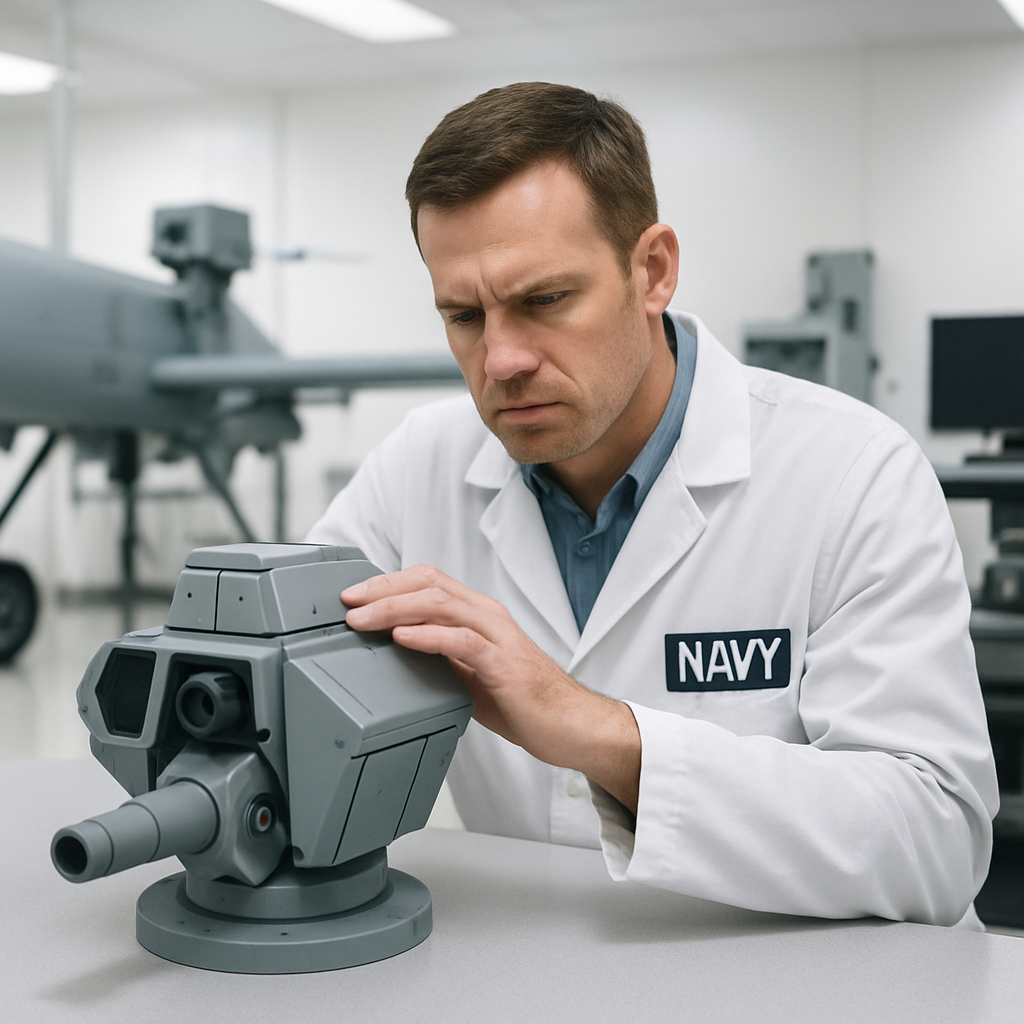
"It's our goal to actually help folks see not just what the Navy needs now, but what the Navy will need in the next three” future years defense program, or FYDP, cycles," Rachel Riley told an audience at the Sea-Air-Space symposium. That sentence frames a deliberate pivot: the Office of Naval Research is now hunting problems the private sector will not solve, even if those problems will matter a decade and a half from now.
Why ONR is looking past commercial R&D
Rachel Riley, who heads the Office of Naval Research (ONR), told symposium attendees that rising private-sector investment in defense-technology research has changed how her office sets priorities. “What we're trying to identify is: what are the things that industry cannot or will not solve?” she said, adding that ONR has roughly $3 billion a year to allocate.
Riley said ONR must be “a little humbler” about which technical challenges are still uniquely naval or military problems and which have become commercial opportunities. The office plans to concentrate on advances unlikely to attract private investment despite bearing significance for future naval operations—areas that will matter across several FYDP cycles.
Technical priorities: undersea systems, power, and explainable AI
Riley listed several focus areas where ONR believes market forces are insufficient to produce the required breakthroughs. These include new undersea technologies and novel forms of power and energy. She also emphasized artificial intelligence that is “transparent and understandable to humans, and especially commanders.”
ONR noted a military-specific risk with current commercial large language models: “the cost of a false positive, or ‘hallucination’ in AI-speak, might be low in a commercial setting” but can carry “far higher” consequences in military operations. The source states that a “growing body of research indicates that such errors are inescapable in commercial large language models, so the military needs a new approach—one that has no immediate market need.” Riley said the challenge requires work up front to let commanders “have full confidence” and to “look inside the black box.”

This site is the portfolio.
OSINTSights runs on Cloudflare Workers, D1, R2, and Vectorize, with an AI pipeline on Hetzner ARM. Nubivance designed, built, and operates it. We do the same for clients.
See what we buildBudget context and shifting research emphasis
The symposium remarks tied ONR’s strategic choices to broader shifts in federal research spending. Riley echoed the Trump administration’s decision to spend less on military-led basic scientific research—an ONR specialty—and more on applied research. That change in emphasis is part of why ONR is rethinking what it must fund directly versus what industry will take on.
Riley said ONR has not always done a strong job of surveying private-sector research to avoid duplicating commercial efforts. To correct that, the office plans a series of “innovation-to-industry days” intended to influence industry IRAD investments, inform ONR staff about mature commercial capabilities, and highlight dual-use technologies that may be approaching maturity in the private sector.
Naval Research Laboratory bets on researcher-driven ideas and satellite servicing
The Naval Research Laboratory (NRL), led by Capt. Randy Cruz, is following a parallel course. Cruz said of NRL’s roughly $1.5 billion of revolving funds, “about 80 percent of it is someone telling us what to do, as in ‘I need you to solve this problem,’” while “another 20 percent roughly is our researchers coming up with these ideas,” informed by post-deployment reports and market-research trends.
That researcher-led slice has produced programs such as the Mission Robotics Vehicle: a satellite with arms designed to repair other satellites. NRL is working with Northrop Grumman to launch the satellite in July. Cruz described the craft as a “tow-truck for satellites,” and he noted the attraction of servicing existing orbital assets because many private space companies’ business models favor more launches rather than maintenance—making on-orbit servicing an area commercial firms have largely ignored.
How ONR, NRL, and private space companies are responding
- Office of Naval Research (ONR): Reorienting to long‑horizon problems that industry will not solve, launching “innovation-to-industry days,” and prioritizing explainable AI, undersea tech, and novel power systems.
- Naval Research Laboratory (NRL): Using about 20 percent of revolving funds for researcher-initiated projects and moving forward with programs like the Mission Robotics Vehicle in partnership with Northrop Grumman.
- Private space companies: Remaining focused on launch-centric business models, a gap NRL intends to fill with satellite servicing capabilities that the private market has not broadly prioritized.
The practical picture is clear: with finite public R&D dollars—Riley cited about $3 billion annually for ONR—and shifting federal priorities away from basic military science, naval research offices are concentrating on gaps the market leaves open. They are also trying to avoid duplicating industry work by better surveying commercial R&D and by nudging industry investment through outreach. The Mission Robotics Vehicle, set for a July launch, is a concrete example of that strategy in action.
Whether those choices produce the long‑lead breakthroughs ONR seeks will be tested by the coming FYDP cycles, the results of the innovation-to-industry engagement, and missions such as the satellite-servicing launch this summer. The next visible benchmark: the July launch of the satellite being built with Northrop Grumman.