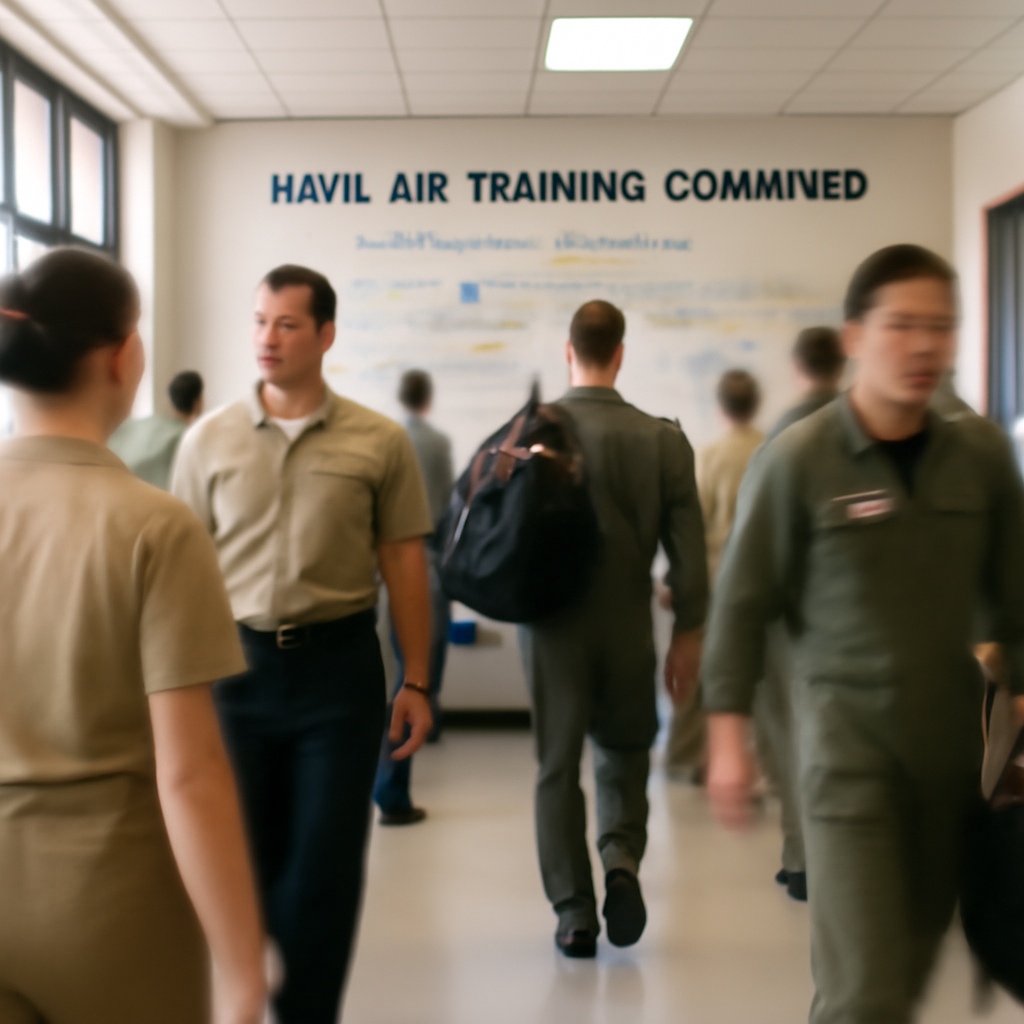
"The test of whether it is working is whether it flows smoothly, without pools forming anywhere along the line," Rear Adm. Max “Pepper” McCoy told me, summing the problem and the goal in a single image.
The conveyor-belt problem and where the pools are forming
McCoy, who commands the Naval Air Training Command (CNATRA), described a pipeline that has been underproducing against fleet requirements for the better part of ten years, driven largely by problems with the T-45. Students have entered the pipeline faster than the system could move them through, creating a backlog widely tracked as the "pre-NIFE pool"—the queue that forms before students even reach NIFE, the eight-and-a-half-week screening program at Pensacola. Fixes at one stage exposed constraints at the next: while the Naval Aviation 2025 Playbook credits Rear Admiral Richard T. Brophy Jr. with driving production back to 105 percent of requirement across every type-model-series, Fleet Replacement Squadrons (FRS) are now underproducing, creating a new logjam just before aviators become useful to the fleet.
Time-to-train vs. production percentage
McCoy reframes success not as a production percentage but as "time-to-train against entitlement"—the interval between commissioning and fleet arrival a student is entitled to under the pipeline. Compress that interval and first-tour officers complete sea tours on schedule, roll into full-length production tours before disassociated sea tours, and the system's self-feeding shortfalls begin to reverse. Late arrivals to first tours truncate junior officers' ability to complete production tours, and the downstream effect is fewer experienced rollers returning to training and FRS billets to generate the next cohort.

Audit-ready is a season. It shouldn't be.
Evidence in spreadsheets, controls drifting between audits, frameworks multiplying on flat headcount. Nubivance runs continuous compliance on Rapid7 Cyber GRC - SOC 2, HIPAA, ISO 27001, PCI, CMMC.
End the scrambleThe three-legged production stool: airplanes, instructors, students
McCoy frames the constraint as a stool with three legs—airplanes, instructors and students—and none are fully healthy. Aircraft readiness is managed through contracted logistics support and a target CNATRA calls the "North Star," the number of ready-for-training aircraft needed to execute daily schedules and surges. Instructor shortages are most acute: CNATRA's active-duty cadre is built from first-sea-tour rollers and supplemented by permanent flight instructors off the command track, reserves, Marine Corps instructors and sometimes Coast Guard personnel. The paradox on students is that there are too many in the system at once, not from over-accession but because stretched time-to-train creates pools rather than flow.
SERGRADs, contract instructors, LVC, and standards
McCoy is pulling specific levers. He has 15 Marine "SERGRADs"—selectively retained graduate wingers—flying jet training at Kingsville and Meridian, which frees experienced instructors for advanced-phase work. He is expanding contract instructor pilots—many former Navy and Marine Corps jet aviators with T-45 experience—into the primary phase. McCoy emphasized Live Virtual Constructive (LVC) training as complementary to flight time: when woven into the curriculum it builds habits so students achieve first-pass yield in aircraft rather than re-flying events. On standards, he has tightened the front end: faster triggers to attrition in NIFE and Primary training, with the expectation that attrition in advanced phases will fall because students will arrive already held to a higher bar.
Culture, ownership, and the limits of outsourcing
McCoy drew a firm line on culture. He does not want to outsource large parts of the enterprise because naval aviation—particularly shipboard aviation—carries demands a contracted model alone does not capture. His example is the Contract Operated Primary Training-Rotary program: students are supervised by a Navy O-5, and CNATRA sends personnel through at elevated frequency so students see officers in Navy and Marine Corps flight suits to reinforce cultural content. Contract instructor pilots will be former Navy and Marine Corps aviators—"they simply do not wear rank." McCoy also flagged that aviators returning from recent deployments as genuine combat veterans will move into the instructor cadre in the near term, bringing operational credibility the pipeline values.
What this means for the Fleet, CNATRA, and Instructors & Students
- The Fleet: faster, entitlement-based time-to-train would restore first-tour timelines and increase the number of officers available for full production tours—critical to filling operational seats and sustaining readiness.
- CNATRA and Naval Education and Training Command: CNATRA owns "Street to Fleet" inside its purview but does not control the schools command, which sits under Naval Education and Training Command, nor Type Wing authority over FRS. McCoy must therefore sequence levers across authorities to hit entitlement fastest.
- Instructors & Students: instructors are being asked to fly seven days a week and accept new mixes of active-duty, SERGRAD, reserve, Marine, Coast Guard, and contracted pilots; students will face earlier, firmer attrition decisions at NIFE and Primary but should arrive at advanced training better prepared.
McCoy was candid that a system in crisis makes innovation difficult because so much energy goes to keeping the machine running. Still, CNATRA is pursuing triage and parallel modernization: tightening standards, expanding instructor options, integrating LVC into curricula, and aiming to hand a successor a pipeline with the right number of airplanes, the right number of instructors and time-to-train at entitlement so modernization can accelerate from a stable production line.